
Penny Dreadfuls, 1849 · page 20 of 394
The Mysteries of the Court of London — page 20: what you’re looking at
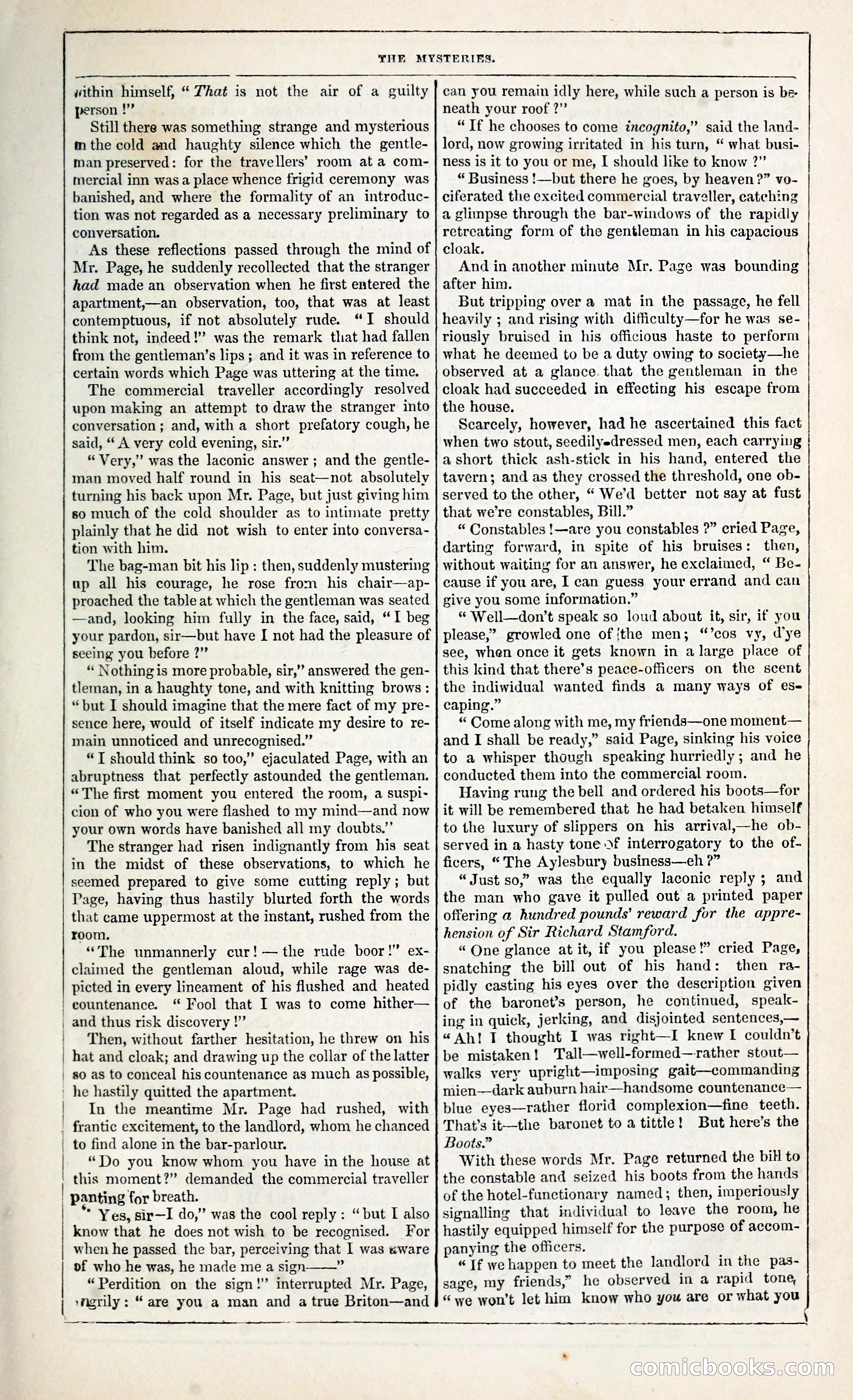
A restored page from Penny Dreadfuls, 1849. Page through the whole issue in the reader above.
📄 Transcribed text from this page (OCR, searchable)
Machine-transcribed from the original scan — historical spelling and the odd misread are preserved.
a ——— THE within himself, “ That is not the air of a guilty person !” Still there was something strange and mysterious m the cold and haughty silence which the gentle- man preserved: for the travellers’ room at a com- mercial inn was a place whence frigid ceremony was banished, and where the formality of an introduc- tion was not regarded as a necessary preliminary to conversation. As these reflections passed through the mind of Mr. Page, he suddenly recollected that the stranger had made an observation when he first entered the apartment,—an observation, too, that was at least contemptuous, if not absolutely rude. “I should think not, indeed!’ was the remark that had fallen from the gentleman’s lips; and it was in reference to certain words which Page was uttering at the time. The commercial traveller accordingly resolved upon making an attempt to draw the stranger into conversation; and, with a short prefatory cough, he said, “ A very cold evening, sir.” “ Very,’ was the laconic answer; and the gentle- man moved half round in his seat—not absolutely turning his back upon Mr. Page, but just giving him so much of the cold shoulder as to intimate pretty plainly that he did not wish to enter into conversa- tion with him. The bag-man bit his lip : then, suddenly mustering up all his courage, he rose from his chair—ap- proached the table at which the gentleman was seated —and, looking him fully in the face, said, “I beg your pardon, sir—but have I not had the pleasure of seeing you before ?” “ Nothing is more probable, sir,’ answered the gen- tleman, in a haughty tone, and with knitting brows: “but I should imagine that the mere fact of my pre- sence here, would of itself indicate my desire to re- main unnoticed and unrecognised.” “T should think so too,” ejaculated Page, with an abruptness that perfectly astounded the gentleman. “The first moment you entered the room, a suspi- cion of who you were flashed to my mind—and now your own words have banished all my doubts.” The stranger had risen indignantly from his seat in the midst of these observations, to which he seemed prepared to give some cutting reply; but Page, having thus hastily blurted forth the words that came uppermost at the instant, rushed from the room. “The unmannerly cur! — the rude boor!” ex- claimed the gentleman aloud, while rage was de- picted in every lineament of his flushed and heated countenance. “ Fool that I was to come hither— and thus risk discovery !” Then, without farther hesitation, he threw on his hat and cloak; and drawing up the collar of the latter so as to conceal his countenance as much as possible, he hastily quitted the apartment. In the meantime Mr. Page had rushed, with frantic excitement, to the landlord, whom he chanced to find alone in the bar-parlour. “Do you know whom you have in the house at this moment?” demanded the commercial traveller panting for breath. * Yes, sir—I do,” was the cool reply: “but I also know that he does not wish to be recognised. For when he passed the bar, perceiving that 1 was sware of who he was, he made me a sign 1 “Perdition on the sign!’ interrupted Mr. Page, mmgrily: “are you a man and a true Briton—and MYSTERIES. can you remain idly here, while such a person is be- neath your roof ?” “Tf he chooses to come incognito,” said the land- lord, now growing irritated in his turn, “ what busi- ness is it to you or me, I should like to know 2?” “ Business !—but there he goes, by heaven?” vo- ciferated the excited commercial traveller, catching a glimpse through the bar-windows of the rapidly retreating form of the gentleman in his capacious cloak. And in another minute Mr. Page was bounding after him. But tripping over a mat in the passage, he fell heavily ; and rising with difficulty—for he was se- riously bruised in his officious haste to perform what he deemed to be a duty owing to society—he observed at a glance. that the gentleman in the cloak had succeeded in effecting his escape from the house. Scarcely, however, had he ascertained this fact when two stout, seedilyedressed men, each carrying a short thick ash-stick in his hand, entered the tavern; and as they crossed the threshold, one ob- served to the other, “ We’d better not say at fust that we’re constables, Bill.” “ Constables !—are you constables ?” cried Page, darting forward, in spite of his bruises: then, without waiting for an answer, he exclaimed, “ Be- cause if you are, I can guess your errand and can give you some information.” “ Well—don’t speak so loud about it, sir, if you please,” growled one of ithe men; “’cos vy, dye see, when once it gets known in a large place of this kind that there’s peace-officers on the scent the indiwidual wanted finds a many ways of es- caping.” “ Come along with me, my friends—one moment— and I shall be ready,” said Page, sinking his voice to a whisper though speaking hurriedly; and he conducted them into the commercial room. Having rung the bell and ordered his boots—for it will be remembered that he had betaken himself to the luxury of slippers on his arrival,—he ob- served in a hasty tone of interrogatory to the of- ficers, “The Aylesbury business—eh ?” “ Just so,” was the equally laconic reply ; and the man who gave it pulled out a printed paper offering a@ hundred pounds’ reward for the appre- hension of Sir Richard Stamford. “One glance at it, if you please!” cried Page, snatching the bill out of his hand: then ra- pidly casting his eyes over the description given of the baronet’s person, he continued, speakk- ing in quick, jerking, and disjointed sentences,— “Ah! IT thought I was right—I knew I couldn’t be mistaken! ‘Tall—well-formed—rather stout— walks very upright—imposing gait—commanding mien—dark auburn hair—handsome countenance— blue eyes—rather florid complexion—fine teeth. That’s it—the baronet to a tittle! But here’s the Boots.” With these words Mr. Page returned the bill to the constable and seized his boots from the hands of the hotel-functionary named; then, imperiously signalling that individual to leave the room, he hastily equipped himself for the purpose of accom- panying the officers. « If we happen to meet the landlord in the pas- sage, my friends,” he observed in a rapid tone, “we won’t let him know who you are or what you com CElooolks., conn