
Penny Dreadfuls, 1849 · page 186 of 394
The Mysteries of the Court of London — page 186: what you’re looking at
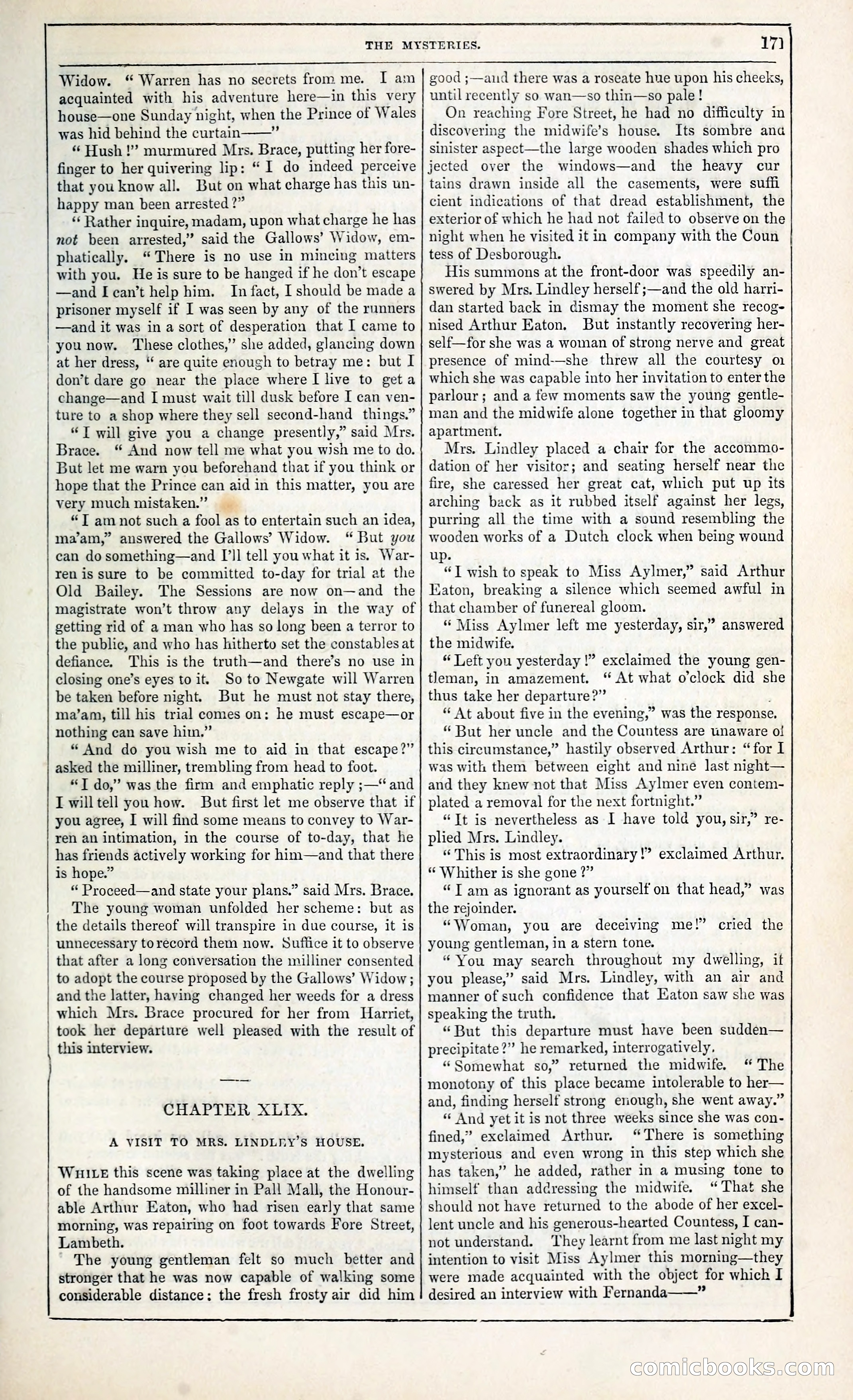
A restored page from Penny Dreadfuls, 1849. Page through the whole issue in the reader above.
📄 Transcribed text from this page (OCR, searchable)
Machine-transcribed from the original scan — historical spelling and the odd misread are preserved.
THE MYSTERIES. Widow. “ Warren has no secrets from me. I am acquainted with his adventure here—in this very house—one Sunday night, when the Prince of Wales was hid behind the curtain “ “ Hush!’ murmured Mrs. Brace, putting her fore- finger to her quivering lip: “ I do indeed perceive that you know all. But on what charge has this un- happy man been arrested ?” ‘ Rather inquire, madam, upon what charge he has not been arrested,” said the Gallows’ Widow, em- phatically. “There is no use in mincing matters with you. He is sure to be hanged if he don’t escape —and I can’t help him. In fact, I should be made a prisoner myself if I was seen by any of the runners —and it was in a sort of desperation that I came to you now. These clothes,” she added, glancing down at her dress, “ are quite enough to betray me: but I don’t dare go near the place where I live to geta change—and I must wait till dusk before I can ven- ture to a shop where they sell second-hand things.” “T will give you a change presently,” said Mrs. Brace. “ And now tell me what you wish me to do. But let me warn you beforehand that if you think or hope that the Prince can aid in this matter, you are very much mistaken.” “T am not such a fool as to entertain such an idea, ma’am,” answered the Gallows’ Widow. “ But you can do something—and I’]] tell you what it 1s. War- ren is sure to be committed to-day for trial at the Old Bailey. The Sessions are now on—and the magistrate won’t throw any delays in the way of getting rid of a man who has so long been a terror to the public, and who has hitherto set the constables at defiance. This is the truth—and there’s no use in closing one’s eyes to it. Soto Newgate will Warren be taken before night. But he must not stay there, ma’am, till his trial comes on: he must escape—or nothing can save him.” * And do you wish me to aid in that escape?” asked the milliner, trembling from head to foot. “T do,” was the firm and emphatic reply ;—“ and I will tell you how. But first let me observe that if you agree, I will find some means to convey to War- ren an intimation, in the course of to-day, that he has friends actively working for him—and that there is hope.” “ Proceed—and state your plans.” said Mrs. Brace. The young woman unfolded her scheme: but as the details thereof will transpire in due course, it is unnecessary torecord them now. Suffice it to observe that after a long conversation the milliner consented to adopt the course proposed by the Gallows’ Widow; and the latter, having changed her weeds for a dress which Mrs. Brace procured for her from Harriet, took her departure well pleased with the result of this interview. __ - CHAPTER XLIXxX. A VISIT TO MRS. LINDLNY’S HOUSE, WHILE this scene was taking place at the dwelling of the handsome milliner in Pall Mall, the Honour- able Arthur Eaton, who had risen early that same morning, was repairing on foot towards Fore Street, Lambeth. - The young gentleman felt so much better and stronger that he was now capable of walking some considerable distance: the fresh frosty air did him 17) good ;—aud there was a roseate hue upon his cheeks, until recently so wan—so thin—so pale! On reaching Fore Street, he had no difficulty in discovering the midwife’s house. Its sombre ana sinister aspect—the large wooden shades which pro jected over the windows—and the heavy cur tains drawn inside all the casements, were suffi cient indications of that dread establishment, the exterior of which he had not failed to observe on the night when he visited it in company with the Coun tess of Desborough. His summons at the front-door was speedily an- swered by Mrs. Lindley herself ;—and the old harri- dan started back in dismay the moment she recog- nised Arthur Eaton. But instantly recovering her- self—for she was a woman of strong nerve and great presence of mind-—she threw all the courtesy o which she was capable into her invitation to enter the parlour; and a few moments saw the young gentle- man and the midwife alone together in that gloomy apartment. Mrs. Lindley placed a chair for the accommo- dation of her visitor; and seating herself near the fire, she caressed her great cat, which put up its arching back as it rubbed itself against her legs, purring all the time with a sound resembling the wooden works of a Dutch clock when being wound up. “T wish to speak to Miss Aylmer,” said Arthur Eaton, breaking a silence which seemed awful in that chamber of funereal gloom. “ Miss Aylmer left me yesterday, sir,” answered the midwife. “ Left you yesterday !” exclaimed the young gen- tleman, in amazement. “ At what o’clock did she thus take her departure?” : “ At about five in the evening,” was the response, “ But her uncle and the Countess are unaware o! this circumstance,” hastily observed Arthur: “for I was with them between eight and nine last night— and they knew not that Miss Aylmer even contem- plated a removal for the next fortnight.” “Tt is nevertheless as I have told you, sir,” re- plied Mrs. Lindley. “This is most extraordinary!” exclaimed Arthur. “ Whither is she gone ?” “T am as ignorant as yourself on that head,” was the rejoinder. “Woman, you are deceiving me!’ cried the young gentleman, in a stern tone. “You may search throughout my dwelling, if you please,’ said Mrs. Lindley, with an air and manner of such confidence that Eaton saw she was speaking the truth. “But this departure must have been sudden— precipitate?” he remarked, interrogatively, “ Somewhat so,” returned the midwife. “ The monotony of this place became intolerable to her— and, finding herself strong enough, she went away.” « And yet it is not three weeks since she was con- fined,” exclaimed Arthur. “There is something mysterious and even wrong in this step which she has taken,” he added, rather in a musing tone to himself than addressing the midwife. “That she should not have returned to the abode of her excel- lent uncle and his generous-hearted Countess, I can- not understand. ‘They learnt from me last night my intention to visit Miss Aylmer this morning—they were made acquainted with the object for which I desired an interview with Fernanda——” Com Clooolks.conn