
Penny Dreadfuls, 1849 · page 181 of 394
The Mysteries of the Court of London — page 181: what you’re looking at
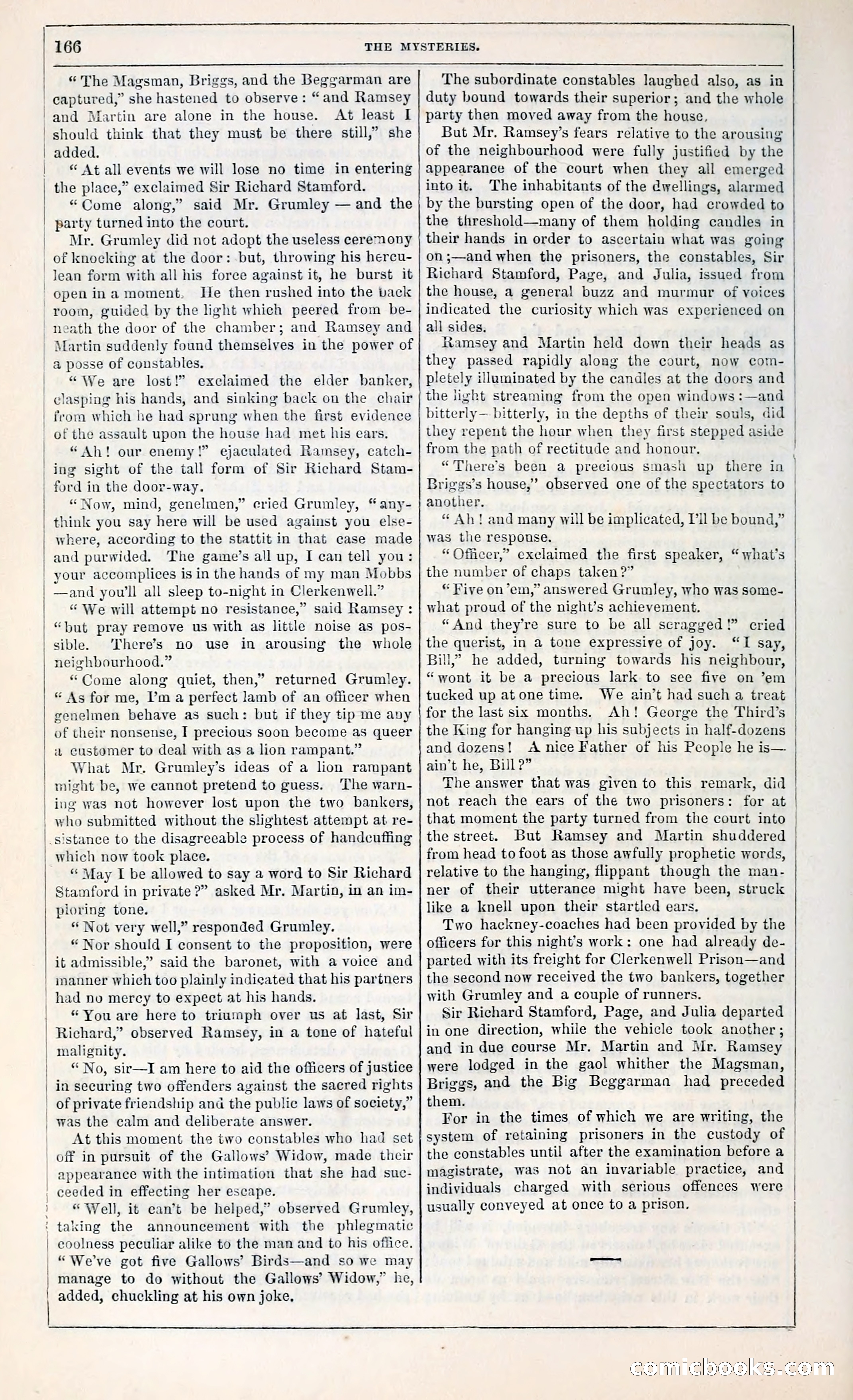
A restored page from Penny Dreadfuls, 1849. Page through the whole issue in the reader above.
📄 Transcribed text from this page (OCR, searchable)
Machine-transcribed from the original scan — historical spelling and the odd misread are preserved.
— 166 “The Magsman, Briggs, and the Beggarman are captured,” she hastened to observe: “and Ramsey and Martin are alone in the house. At least I should think that they must be there still,’ she added. « At all events we will lose no time in entering the place,” exclaimed Sir Richard Stamford. “Come along,’ said Mr. Grumley — and the party turned into the court. Mr. Grumley did not adopt the useless ceremony of knocking at the door: but, throwing his hercu- lean form with all his force against it, he burst it open inamoment. He then rushed into the back room, guided by the light which peered from be- ' neath the door of the chamber; and Ramsey and LT TT TO Fee ee es OS Martin suddenly found themselves in the power of a posse of constables. “We are lost!” exclaimed the elder banker, clasping his hands, and sinking back on the chair from which he had sprung when the first evidence of the assault upon the house had met his ears. “Ah! our enemy!” ejaculated Ramsey, catch- ing sight of the tall form of Sir Richard Stam- ford in the door-way. “Now, mind, genelmen,” eried Grumley, “ any- think you say here will be used against you else- where, according to the stattit in that case made and purwided. The game’s all up, I can tell you: your accomplices is in the hands of my man Mobbs —and you'll all sleep to-night in Clerkenwell.” “ We will attempt no resistance,” said Ramsey : “but pray remove us with as little noise as pos- sible. There’s no use in arousing the whole neighbourhood.” “Come along quiet, then,’ returned Grumley. “ As for me, I’m a perfect lamb of an officer when genelmen behave as such: but if they tip me any of their nonsense, I precious soon become as queer i customer to deal with as a lion rampant.” What Mr. Grumley’s ideas of a lion rampant might be, we cannot pretend to guess. ‘The warn- ing was not however lost upon the two bankers, who submitted without the slightest attempt at re- sistance to the disagreeable process of handcufhing which now took place. “May I be allowed to say a word to Sir Richard Stamford in private ?” asked Mr. Martin, in an im- ploring tone. “ Not very well,” responded Grumley. “ Nor should I consent to the proposition, were it admissible,” said the baronet, with a voice and manner which too plainly indicated that his partners had no mercy to expect at his hands. “You are here to triutoph over us at last, Sir Richard,’ observed Ramsey, in a tone of hateful | malignity. “ No, sir—I am here to aid the officers of justice in securing two offenders against the sacred rights _ of private friendship and the public laws of society,” was the calm and deliberate answer. At this moment the two constables who had set off in pursuit of the Gallows’ Widow, made their appearance with the intimation that she had suc- ceeded in effecting her escape. “Well, it can’t be helped,” observed Grumley, taking the announcement with the phlegmatic coolness peculiar alike to the man and to his office. “We've got five Gallows’ Birds—and so we may manage to do without the Gallows’ Widow,” he, added, chuckling at his own joke, THE MYSTERIES. The subordinate constables laughed also, as in duty bound towards their superior; and the whole party then moved away from the house, But Mr. Ramsey’s fears relative to the arousing of the neighbourhood were fully justified by the appearance of the court when they all emerged into it. The inhabitants of the dwellings, alarmed by the bursting open of the door, had crowded to the threshold—many of them holding candles in their hands in order to ascertain what was going on ;—and when the prisoners, the constables, Sir | Richard Stamford, Page, and Julia, issued from the house, a general buzz and murmur of voices indicated the curiosity which was experienced on all sides. Ramsey and Martin held down their heads as they passed rapidly along the court, now com- pletely illuminated by the candles at the doors and the light streaming from the open windows :—and bitterly— bitterly, in the depths of their souls, did they repent the hour when they first stepped aside from the path of rectitude and honour, “'There’s been a precious smash up there in Briggs’s house,’ observed one of the spectators to another. “ Ah! and many will be implicated, ll be bound,” was the response. “ Officer,” exclaimed the first speaker, “ what's the number of chaps taken?” “ Five on em,” answered Grumley, who was some- what proud of the night’s achievement. “And they’re sure to be all scragged!” cried the querist, in a tone expressive of joy. “TI say, Bill,” he added, turning towards his neighbour, “wont it be a precious lark to see five on ’em tucked up atone time. We ain’t had such a treat for the last six months. Ah! George the Third’s the King for hanging up his subjects in half-dozens and dozens! A nice Father of his People he is— ain’t he, Bill ?” The answer that was given to this remark, did not reach the ears of the two prisoners: for at that moment the party turned from the court into the street. But Ramsey and Martin shuddered from head to foot as those awfully prophetic words, relative to the hanging, flippant though the man- ner of their utterance might have been, struck like a knell upon their startled ears. Two hackney-coaches had been provided by the officers for this night’s work: one had already de- parted with its freight for Clerkenwell Prison—and the second now received the two bankers, together with Grumley and a couple of runners. Sir Richard Stamford, Page, and Julia departed in one direction, while the vehicle took another; and in due course Mr. Martin and Mr. Ramsey were lodged in the gaol whither the Magsman, Briggs, and the Big Beggarman had preceded them. For in the times of which we are writing, the system of retaining prisoners in the custody of the constables until after the examination before a | magistrate, was not an invariable practice, and S UEnUEE REE REEEEERReneeemeemmeneeeeneneeenmmeneeeneeeeeeene eee a - ee en individuals charged with serious offences were usually conveyed at once to a prison. COMA ElOOOIKS., COM