
Penny Dreadfuls, 1849 · page 170 of 394
The Mysteries of the Court of London — page 170: what you’re looking at
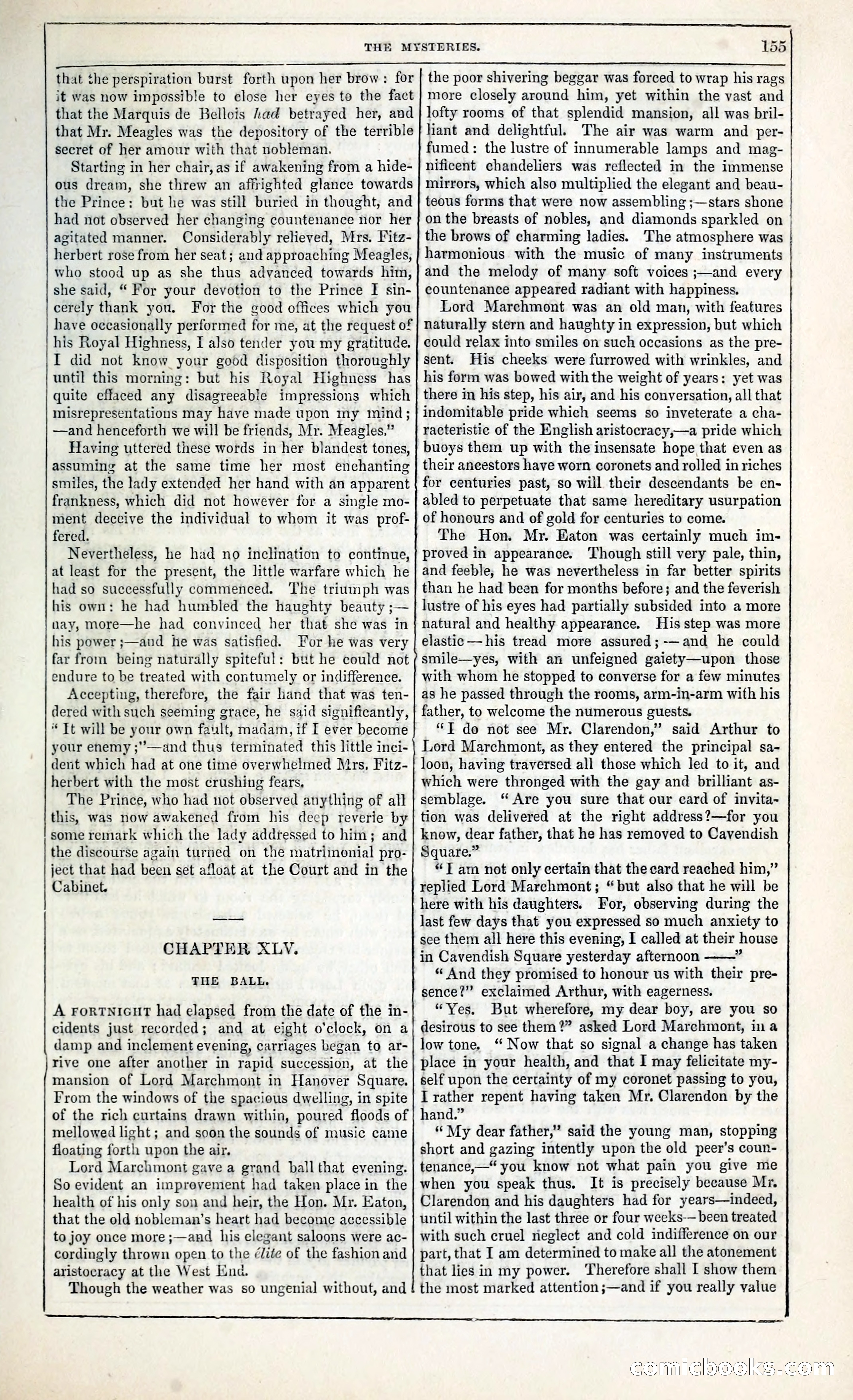
A restored page from Penny Dreadfuls, 1849. Page through the whole issue in the reader above.
📄 Transcribed text from this page (OCR, searchable)
Machine-transcribed from the original scan — historical spelling and the odd misread are preserved.
- THE MYSTERIES. 155 Sn that the perspiration burst forth upon her brow: for it was now impossible to close her eyes to the fact that the Marquis de Bellois had betrayed her, and that Mr. Meagles was the depository of the terrible secret of her amour with that nobleman. Starting in her chair, as if awakening from a hide- ous dream, she threw an affrighted glance towards the Prince: but he was still buried in thought, and had not observed her changing countenance nor her agitated manner. Considerably relieved, Mrs. Fitz- herbert rose from her seat; and approaching Meagles, who stood up as she thus advanced towards him, she said, “ For your devotion to the Prince I sin- cerely thank you. For the good offices which you have occasionally performed for me, at the request of his Royal Highness, I also tender you my gratitude. I did not know your good disposition thoroughly until this morning: but his Royal Highness has quite effaced any disagreeable impressions which misrepresentations may have made upon my mind; —and henceforth we will be friends, Mr. Meagles.” Having uttered these words in her blandest tones, assuming at the same time her most enchanting smiles, the lady extended her hand with an apparent frankness, which did not however for a single mo- ment deceive the individual to whom it was prof- fered. Nevertheless, he had no inclination to continue, at least for the present, the little warfare which he had so successfully commenced. The triumph was his own: he had humbled the haughty beauty ;— nay, more—he had convinced her that she was in his power ;—aud he was satisfied. For he was very far from being naturally spiteful: but he could not endure to be treated with contumely or indifference. Accepting, therefore, the fair hand that was ten- dered with such seeming grace, he said significantly, * Tt will be your own fault, madam, if I ever become your enemy ;”—and thus terminated this little inci- dent which had at one time overwhelmed Mrs, Fitz- herbert with the most crushing fears, The Prince, who had not observed anything of all this, was now awakened from his deep reverie by some remark which the lady addtessed to him; and the discourse again turned on the matrimonial pro- ject that had been set afloat at the Court and in the Cabinet. CHAPTER XLV. THE BALL. A FORTNIGHT had elapsed from the date of the in- cidents just recorded; and at eight o'clock, on a damp and inclement evening, carriages began to ar- rive one after another in rapid succession, at the mansion of Lord Marchmont in Hanover Square. From the windows of the spacious dwelling, in spite of the rich curtains drawn within, poured floods of mellowed light; and soon the sounds of music came floating forth upon the air. Lord Marchmont gave a grand ball that evening. So evident an improvement had taken place in the health of his only son and heir, the Hon. Mr. Eaton, that the old nobleman’s heart had become accessible to joy once more ;—and his elegant saloons were ac- cordingly thrown open to the élite of the fashion and aristocracy at the West Ind. Though the weather was so ungenial without, and the poor shivering beggar was forced to wrap his rags more closely around him, yet within the vast and lofty rooms of that splendid mansion, all was bril- hant and delightful. The air was warm and per- fumed: the lustre of innumerable lamps and mag- nificent chandeliers was reflected in the immense mirrors, which also multiplied the elegant and beau- teous forms that were now assembling ;—stars shone on the breasts of nobles, and diamonds sparkled on the brows of charming ladies. The atmosphere was harmonious with the music of many instruments and the melody of many soft voices ;—and every countenance appeared radiant with happiness. Lord Marehmont was an old man, with features naturally stern and haughty in expression, but which could relax into smiles on such occasions as the pre- sent. His cheeks were furrowed with wrinkles, and his form was bowed with the weight of years: yet was there in his step, his air, and his conversation, all that indomitable pride which seems so inveterate a cha- racteristie of the English aristocracy,—a pride which buoys them up with the insensate hope that even as their ancestors have worn coronets and rolled in riches for centuries past, so will their descendants be en- abled to perpetuate that same hereditary usurpation of honours and of gold for centuries to come. The Hon. Mr. Eaton was certainly much im- proved in appearance. Though still very pale, thin, and feeble, he was nevertheless in far better spirits than he had been for months before; and the feverish lustre of his eyes had partially subsided into a more natural and healthy appearance. His step was more elastic —his tread more assured; -—and he could smile—yes, with an unfeigned galety—upon those with whom he stopped to converse for a few minutes as he passed through the rooms, arm-in-arm with his father, to welcome the numerous guests. “¥ do not see Mr. Clarendon,” said Arthur to Lord Marchmont, as they entered the principal sa- loon, having traversed all those which led to it, and which were thronged with the gay and brilliant as- semblage. ‘ Are you sure that our card of invita- tion was delivered at the right address?—for you know, dear father, that he has removed to Cavendish Square.” “T am not only certain that the card reached him,” replied Lord Marchmont; “but also that he will be here with his daughters. For, observing during the last few days that you expressed so much anxiety to see them all here this evening, I called at their house in Cavendish Square yesterday afternoon ——” “ And they promised to honour us with their pre- sence?” exclaimed Arthur, with eagerness. “Yes, But wherefore, my dear boy, are you so desirous to see them?” asked Lord Marehmont, ina low tone. ‘“ Now that so signal a change has taken place in your health, and that I may felicitate my- self upon the certainty of my coronet passing to you, I rather repent having taken Mr. Clarendon by the hand.” “ My dear father,” said the young man, stopping short and gazing intently upon the old peer’s coun- tenance,—“ you know not what pain you give me when you speak thus. It is precisely because Mr. Clarendon and his daughters had for years—indeed, until within the last three or four weeks-— been treated with such cruel nieglect and cold indifference on our part, that I am determined to make all the atonement that lies in my power. Therefore shall I show them the most marked attention ;—and if you really value Com Cclooolkks. con