
Penny Dreadfuls, 1849 · page 17 of 394
The Mysteries of the Court of London — page 17: what you’re looking at
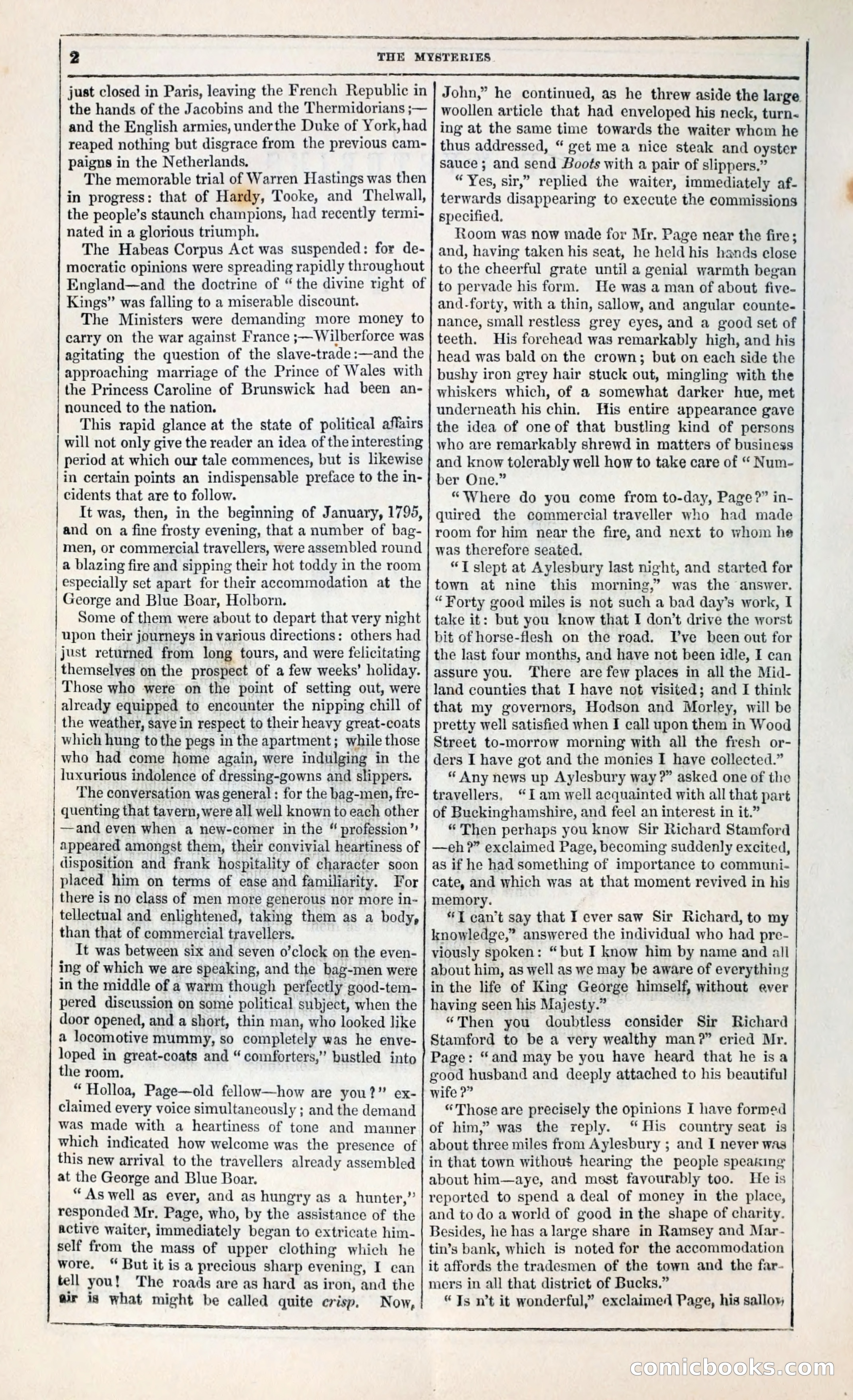
A restored page from Penny Dreadfuls, 1849. Page through the whole issue in the reader above.
📄 Transcribed text from this page (OCR, searchable)
Machine-transcribed from the original scan — historical spelling and the odd misread are preserved.
OO SE Te ee LOL LE ll ON A ES) Og ee Aa OT 226 ee | | just closed in Paris, leaving the French Republic in the hands of the Jacobins and the Thermidorians ;— and the English armies, underthe Duke of York, had reaped nothing but disgrace from the previous cam- paigns in the Netherlands, The memorable trial of Warren Hastings was then in progress: that of Hardy, Tooke, and Thelwall, the people’s staunch champions, had recently termi- nated in a glorious triumph. The Habeas Corpus Act was suspended: for de- mocratic opinions were spreading rapidly throughout England—and the doctrine of “ the divine right of Kings” was falling to a miserable discount. The Ministers were demanding more money to earry on the war against France ;— Wilberforce was agitating the question of the slave-trade:—and the approaching marriage of the Prince of Wales with the Princess Caroline of Brunswick had been an- nounced to the nation. This rapid glance at the state of political affairs will not only give the reader an idea of the interesting period at which our tale commences, but is likewise in certain points an indispensable preface to the in- cidents that are to follow. It was, then, in the beginning of January, 1795, and on a fine frosty evening, that a number of bag- men, or commercial travellers, were assembled round a blazing fire and sipping their hot toddy in the room especially set apart for their accommodation at the George and Blue Boar, Holborn. Some of them were about to depart that very night upon their journeys in various directions: others had just returned from long tours, and were felicitating themselves on the prospect of a few weeks’ holiday. Those who were on the point of setting out, were already equipped to encounter the nipping chill of the weather, save in respect to their heavy great-coats which hung to the pegs in the apartment; while those who had come home again, were indulging in the luxurious indolence of dressing-gowns and slippers. ‘The conversation was general : for the bag-men, fre- quenting that tavern, were all well known to each other —and even when a new-comer in the “ profession”’ appeared amongst them, their convivial heartiness of disposition and frank hospitality of character soon placed him on terms of ease and familiarity. For there is no class of men more generous nor more in- tellectual and enlightened, taking them as a body, than that of commercial travellers. It was between six and seven o’clock on the even- ing of which we are speaking, and the bag-men were in the middle of a warm though perfectly good-tem- pered discussion on some political subject, when the door opened, and a short, thin man, who looked like a locomotive mummy, so completely was he enve- loped in great-coats and “comforters,” bustled into the room. “ Holloa, Page—old fellow—how are you?” ex- claimed every voice simultaneously ; and the demand was made with a heartiness of tone and manner which indicated how welcome was the presence of this new arrival to the travellers already assembled at the George and Blue Boar. “As well as ever, and as hungry as a hunter,” responded Mr. Page, who, by the assistance of the active waiter, immediately began to extricate him- self from the mass of upper clothing which he wore. “ But it is a precious sharp evening, I can tell you! The roads are as hard as iron, and the Now, air is what might be called quite crisp. THE MYSTERIES LL LLL LLL ALLL ILL LI acacia John,” he continued, as he threw aside the large woollen article that had enveloped his neck, turn« ing at the same time towards the waiter whom he thus addressed, “ get me a nice steak and oyster sauce ; and send Boots with a pair of slippers.” “Yes, sir,” replied the waiter, immediately af- terwards disappearing to execute the commissions specified. Room was now made for Mr, Page near the fire; and, having taken his seat, he held his hands elose to the cheerful grate until a genial warmth began to pervade his form. He was a man of about five- and-forty, with a thin, sallow, and angular counte- nance, small restless grey eyes, and a good set of teeth. His forehead was remarkably high, and his head was bald on the crown; but on each side the bushy iron grey hair stuck out, mingling with the whiskers which, of @ somewhat darker hue, met underneath his chin. His entire appearance gave the idea of one of that bustling kind of persons who are remarkably shrewd in matters of business and know tolerably well how to take care of “ Num- ber One.” “Where do you come from to-day, Page?” in- quired the commercial traveller who had made room for him near the fire, and next to whom he was therefore seated. “T slept at Aylesbury last night, and started for town at nine this morning,’ was the answer. “Forty good miles is not such a bad day’s work, I take it: but you know that I don’t drive the worst bit of horse-flesh on the road. Ive been out for the last four months, and have not been idle, I can assure you. ‘There are few places in all the Mid- land counties that I have not visited; and I think that my governors, Hodson and Morley, will be pretty well satisfied when I call upon them in Wood Street to-morrow morning with all the fresh or- ders I have got and the monies I have collected.” « Any news up Aylesbury way ?” asked one of the travellers, Iam well acquainted with all that part of Buckinghamshire, and feel an interest in it.” “Then perhaps you know Sir Richard Stamford —eh ?” exclaimed Page, becoming suddenly excited, as if he had something of importance to communi- cate, and which was at that moment revived in his memory. *T can’t say that I ever saw Sir Richard, to my knowledge,” answered the individual who had pre- viously spoken: “but I know him by name and all about him, as well as we may he aware of everything in the life of King George himself, without ever having seen his Majesty.” “Then you doubtless consider Sir Richard Stamford to be a very wealthy man?” eried Mr. Page: “and may be you have heard that he isa good husband and deeply attached to his beautiful wife ?” “Those are precisely the opinions I have formed of him,” was the reply. “His country seat is about three miles from Aylesbury ; and I never was in that town without hearing the people speaking about him—aye, and most favourably too. He is reported to spend a deal of money in the place, and to do a world of good in the shape of charity. Besides, he has a large share in Ramsey and Mar- tin’s bank, which is noted for the accommodation it affords the tradesmen of the town and the far- mers in all that district of Bucks.” “Js n’t it wonderful,” exclaimed Page, his sallow Gbhooksscom COLMA