
Penny Dreadfuls, 1849 · page 161 of 394
The Mysteries of the Court of London — page 161: what you’re looking at
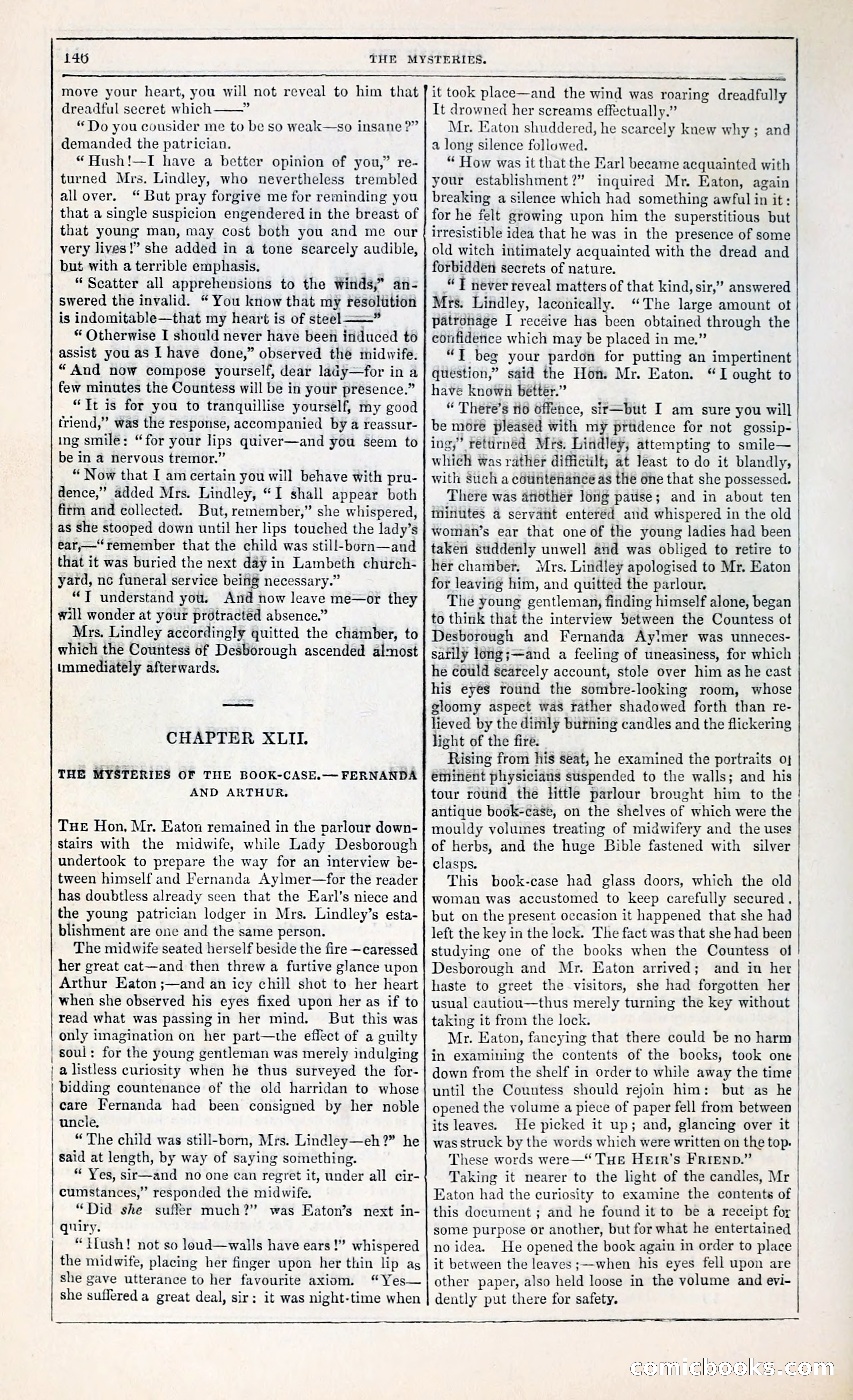
A restored page from Penny Dreadfuls, 1849. Page through the whole issue in the reader above.
📄 Transcribed text from this page (OCR, searchable)
Machine-transcribed from the original scan — historical spelling and the odd misread are preserved.
— ee ee 146 THE MYSTERIES. at IR nt et . move your heart, you will not reveal to him that | it took place—and the wind was roaring dreadfully 39 dreadful secret which —— * Do you consider me to be so weak—so insane ?” demanded the patrician. “ Hush!—I have a better opinion of you,” re- turned Mrs. Lindley, who nevertheless trembled allover. “ But pray forgive me for reminding you that a single suspicion engendered in the breast of that young man, may cost both you and me our very lives!’ she added in a tone scarcely audible, but with a terrible emphasis. “Scatter all apprehensions to the winds,” an- swered the invalid. “ You know that my resolution is indomitable—that my heart is of steel ——” * Otherwise I should never have been induced to assist you as Ihave done,” observed the midwife. “And now compose yourself, dear lady—for in a few minutes the Countess will be in your presence.” “Tt is for you to tranquillise yourself, my good triend,” was the response, accompanied by a reassur- ing smile: “for your lips quiver—and you seem to be in a nervous tremor.” “ Now that I am certain you will behave with pru- dence,” added Mrs. Lindley, “I shall appear both firm and collected. But, remember,” she whispered, as she stooped down until her lips touched the lady’s ear,—“‘ remember that the child was still-born—and that it was buried the next day in Lambeth church- yard, nc funeral service being necessary.” “T understand you. And now leave me—or they wall wonder at your protracted absence.” Mrs. Lindley accordingly quitted the chamber, to which the Countess of Desborough ascended almost immediately afterwards. CHAPTER XLII. THE MYSTERIES OF THE BOOK-CASE.—FERNANDA AND ARTHUR. THE Hon, Mr. Eaton remained in the parlour down- stairs with the midwife, while Lady Desborough undertook to prepare the way for an interview be- tween himself and Fernanda Aylmer—for the reader has doubtless already seen that the Earl’s niece and the young patrician lodger in Mrs. Lindley’s esta- blishment are one and the same person. The midwife seated herself beside the fire —earessed her great cat—and then threw a furtive glance upon Arthur Eaton ;—and an icy chill shot to her heart when she observed his eyes fixed upon her as if to read what was passing in her mind. But this was only imagination on her part—the effect of a guilty soul: for the young gentleman was merely indulging a listless curiosity when he thus surveyed the for- bidding countenance of the old harridan to whose care Fernanda had been consigned by her noble uncle. “The child was still-born, Mrs. Lindley—eh 2” he said at length, by way of saying something. “ Yes, sir—and no one can regret it, under all cir- cumstances,” responded the midwife. “Did she suffer much?” was Eaton’s next in- quiry. “Tfush! not so loud—walls have ears !” whispered the midwife, placing her finger upon her thin lip as she gave utterance to her favourite axiom. “™Yes— she suffered a great deal, sir: it was night-time when It drowned her screams effectually.” Mr. Eaton shuddered, he scarcely knew why; and a long silence followed. “ How was it that the Earl became acquainted with your establishment?” inquired Mr. Eaton, again breaking a silence which had something awful in it: for he felt growing upon him the superstitious but irresistible idea that he was in the presence of some old witch intimately acquainted with the dread and forbidden secrets of nature. “ ¥ never reveal matters of that kind, sir,” answered Mrs. Lindley, laconically. ‘The large amount ot patronage I receive has been obtained through the confidence which may be placed in me.” “JY beg your pardon for putting an impertinent question,” said the Hon. Mr. Eaton. “I ought to have known better.” “ There’s no offence, sir—but I am sure you will be more pleased with my prudence for not gossip- ing,” rettirned Mrs. Lindley; attempting to smile— which was rather diffictilt; at least to do it blandly, with such a countenance as the one that she possessed. There was attother long pause; and in about ten minutes a servant entered and whispered in the old woman’s ear that one of the young ladies had been taken suddenly unwell and was obliged to retire to her chamber. Mrs. Lindley apologised to Mr. Eaton for leaving him, and quitted the parlour. The young gentleman, finding himself alone, began to think that the interview between the Countess of Desborough and Fernanda Ayimer was unneces- sarily long;—and a feeling of uneasiness, for which he could scarcely account, stole over him as he cast his eyes round the sombre-looking room, whose eloomy aspect was rather shadowed forth than re- lieved by the dimly burning candles and the flickering light of the fire. Rising from his seat, he examined the portraits o} eminent physicians suspended to the walls; and his tour round the Hittle parlour brought him to the antique book-case, on the shelves of which were the mouldy volumes treating of midwifery and the uses of herbs, and the huge Bible fastened with silver clasps. This book-case had glass doors, which the old woman was accustomed to keep carefully secured. but on the present occasion it happened that she had left the key in the lock. The fact was that she had been studying one of the books when the Countess of Desborough and Mr. Eaton arrived; and iu her haste to greet the visitors, she had forgotten her usual cautiou—thus merely turning the key without taking it from the lock. Mr. Eaton, fancying that there could be no harm in examining the contents of the books, took one down from the shelf in order to while away the time until the Countess should rejoin him: but as he opened the volume a piece of paper fell from between its leaves. He picked it up; and, glancing over it was struck by the words which were written on the top. These words were—‘ THE HErr's FRIEND.” Taking it nearer to the light of the candles, Mr Eaton had the curiosity to examine the contents of this document ; and he found it to be a receipt for some purpose or another, but for what he entertained no idea. He opened the book again in order to place it between the leaves ;—when his eyes fell upon are other paper, also held loose in the volume and evi- dently put there for safety. eee meet lat ttt CC ll, eee ee SS... 2.5... }h} =~. COMA EloOOKS. COR