
Penny Dreadfuls, 1849 · page 113 of 394
The Mysteries of the Court of London — page 113: what you’re looking at
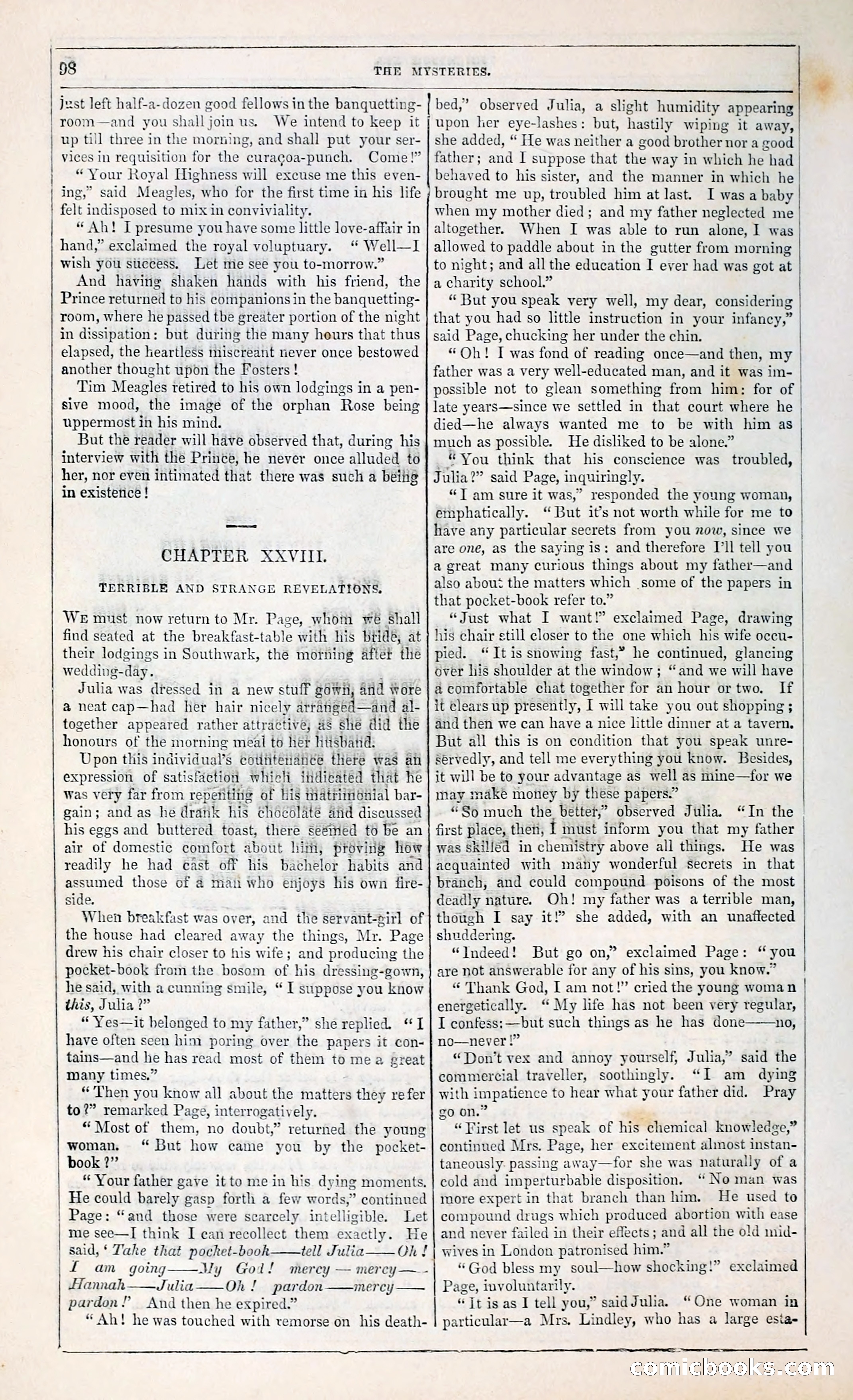
A restored page from Penny Dreadfuls, 1849. Page through the whole issue in the reader above.
📄 Transcribed text from this page (OCR, searchable)
Machine-transcribed from the original scan — historical spelling and the odd misread are preserved.
58 THE MYSTERIES. ee Jest left half-a-dozen good fellows in the banquetting- bed,’ observed Julia, a slight humidity appearing room—and you shall join us. We intend to keep it up till three in the morning, and shall put your ser- vices in requisition for the curacoa-punch. Come!” “ Your Royal Highness will excuse me this even- ing,’ said Meagles, who for the first time in his life felt indisposed to mix in conviviality. “Ah! I presume you have some little love-affair in hand,” exclaimed the royal voluptuary. “ Well—I wish you siiccess. Let me see you to-morrow.” And having shaken hands with his friend, the Prince returned to his companions in the banquetting- room, where he passed tbe greater portion of the night in dissipation: but during the many heurs that thus elapsed, the heartless miscreant never once bestowed another thought upon the Fosters! Tim Meagles retired to his own lodgings in a pen- sive mood, the image of the orphan Rose being uppermost in his mind. But the reader will have observed that, during his interview with the Prince, he never once alluded to her, nor even intimated that there was such a bethe in existence! oa <=> CHAPTER XXVIII. TERRIBLE AND STRANGE REVELATIONS. WE must now return to Mr. Page, whom we Shall find seated at the breakfast-table with his btide, at their lodgings in Southwark, the morning aftet the wedding-day. Julia was dressed in a new stuff gown and aa @ neat cap—had her hair nicely arrange —and al- together appeared rather attractive; a8 she did the honours of the morning meal to her Htishatid: Upon this individual’s cotititenancte there was an expression of satisfaction whicli tidieated that he was very far from repetititig of hig mattinonial bar- gain; and as he drank his chocolaté and discussed his eggs and buttered toast, there seéined to be an air of domestic comfort about lit, proving How readily he had east off his bachelor habits and assumed those of a mati who enjoys his own fire- side. | When breakfast was over, and the servant-tirl of the house had cleared away the things, Mr. Page drew his chair closer to his wife; and producing the pocket-book from the bosom of his dressing-gown, he said, with a cunning smile, “I suppose you know this, Julia ?” “ Yes—it belonged to my father,” she replied. “I have often seen him poring over the papers it con- tains—and he has read most of them to mea great Many times.” “Then you know all about the matters they refer to?” remarked Page, interrogatively. “Most of them, no doubt,” returned the young woman. “ But how came you by the pocket- book 2” “ Your father gave it to me in his dying moments. He could barely gasp forth a few words,” continued | Page: “and those were scarcely intelligible. Let me see—I think I ean recollect them exactly. He said, ‘ Take that pochet-booh tell Julia Oh! £ am going——My God! mercy — mercy—- Hannah ——Julia —-Oh !_ pardon ——mercy—— pardon!’ And then he expired.” “Ah! he was touched with remorse on his death- | upon her eye-lashes: but, hastily Wiping it away, she added, “ He was neither a good brother nor a good father; and I suppose that the way in which he had behaved to his sister, and the manner in which he brought me up, troubled him at last. I was a baby when my mother died; and my father neglected me altogether. When I was able to run alone, I was allowed to paddle about in the gutter from morning to night; and all the education I ever had was got at a charity school.” “ But you speak very well, my dear, considering that you had so little instruction in your infancy,” said Page, chucking her under the chin. “Oh! I was fond of reading once—and then, my father was a very well-educated man, and it was im- possible not to glean something from him: for of late years—since we settled in that court where he died—he always wanted me to be with him as much as possible. He disliked to be alone.” “You think that his conscience was troubled, Julia?” said Page, inquiringly. “T am sure it was,” responded the young woman, emphatically. “ But it’s not worth while for me to have any particular secrets from you now, since we are one, as the saying is: and therefore I'll tell you a great many curious things about my father—and also abou‘ the matters which some of the papers in that pocket-book refer to.” “Just what I want!” exclaimed Page, drawing his chair still closer to the one which his wife oceu- pied. “ It is snowing fast,” he continued, glancing over his shoulder at the window; “and we will have a comfortable chat together for an hour ortwo. If it clears up presently, I will take you out shopping and then we can have a nice little dinner at a tavern. But all this is on condition that you speak unre- servedly, and tell me everything you know. Besides, it will be to your advantage as wel. as mine—for we may make money by these papers.” “So much the bettet,’? observed Julia. “In the first place, then, must inform you that my father was skilled in chemistry above all things. He was acquainted with many wonderful Secrets in that branch, and could compound poisons of the most deadly nature. Oh! my father was a terrible man, though I say it!” she added, with an unaffected shuddering. “Indeed! But go on,” exclaimed Page: “you are not answerable for any of his sins, you know.” “ Thank God, I am not!” cried the young woman energetically. “ My life has not been very regular, I confess: —but such things as he has done——no, no—never !” “Don’t vex and annoy yourself, Julia,’ said the commercial traveller, soothingly. “I am dying with impatience to hear what your father did. Pray go on.” “First let us speak of his chemical knowledge,” continued Mrs. Page, her excitement almost instan- taneously. passing away—for she was naturally of a cold and imperturbable disposition. ‘“ Noman was more expert in that branch than him. He used to compound drugs which produced abortion with ease and never failed in their effects; and all the old mid- wives in London patronised him.” “God bless my soul—how shocking!” exclaimed Page, inv oluntarily : “Jt is as I tell you,” saidJulia. “One woman in particular—a Mrs. Lindley, who has a large esta- we —— ae Ssh Ce meee LLL LL LL COLMA (El NOON KS,COM