
Penny Dreadfuls, 1860 · page 49 of 394
The Mysteries of the Court of London — page 49: what you’re looking at
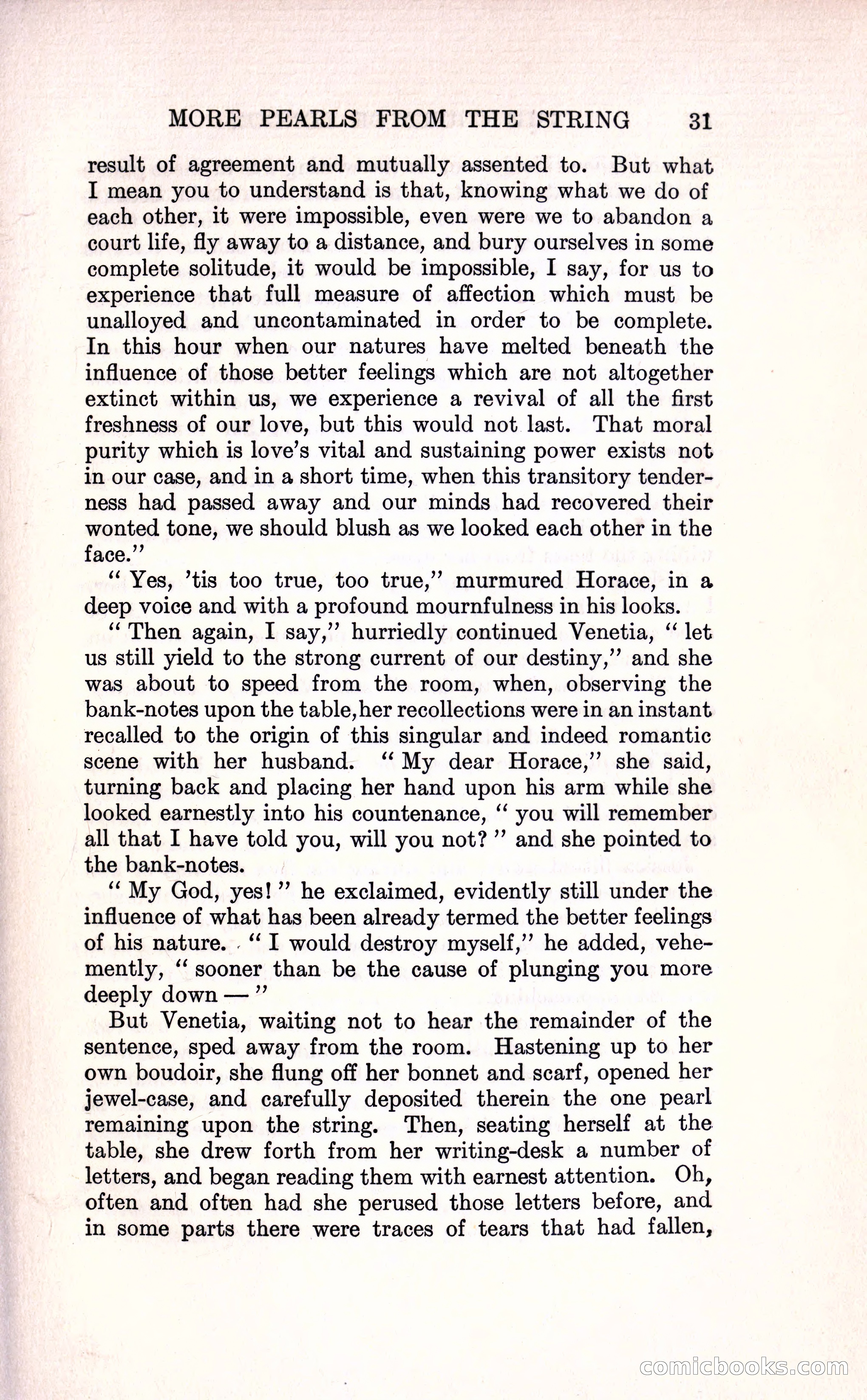
A restored page from Penny Dreadfuls, 1860. Page through the whole issue in the reader above.
📄 Transcribed text from this page (OCR, searchable)
Machine-transcribed from the original scan — historical spelling and the odd misread are preserved.
MORE PEARLS FROM THE STRING 31 result of agreement and mutually assented to. But what I mean you to understand is that, knowing what we do of each other, it were impossible, even were we to abandon a court life, fly away to a distance, and bury ourselves in some complete solitude, it would be impossible, I say, for us to experience that full measure of affection which must be unalloyed and uncontaminated in order to be complete. In this hour when our natures have melted beneath the influence of those better feelings which are not altogether extinct within us, we experience a revival of all the first freshness of our love, but this would not last. That moral purity which is love’s vital and sustaining power exists not in our case, and in a short time, when this transitory tender- ness had passed away and our minds had recovered their wonted tone, we should blush as we looked each other in the face.” ‘““ Yes, ’tis too true, too true,’”’ murmured Horace, in a deep voice and with a profound mournfulness in his looks. “Then again, I say,” hurriedly continued Venetia, ‘‘ let us still yield to the strong current of our destiny,”’ and she was about to speed from the room, when, observing the bank-notes upon the table, her recollections were in an instant recalled to the origin of this singular and indeed romantic scene with her husband. ‘‘ My dear Horace,” she said, turning back and placing her hand upon his arm while she looked earnestly into his countenance, “‘ you will remember all that I have told you, will you not? ”’ and she pointed to the bank-notes. ‘“ My God, yes! ”’ he exclaimed, evidently still under the influence of what has been already termed the better feelings of his nature. . ‘‘ I would destroy myself,’’ he added, vehe- mently, “‘ sooner than be the cause of plunging you more deeply down — ”’ But Venetia, waiting not to hear the remainder of the sentence, sped away from the room. Hastening up to her own boudoir, she flung off her bonnet and scarf, opened her jewel-case, and carefully deposited therein the one pearl remaining upon the string. Then, seating herself at the table, she drew forth from her writing-desk a number of letters, and began reading them with earnest attention. Oh, often and often had she perused those letters before, and in some parts there were traces of tears that had fallen, ] (C(O) nn) GDoOo «Si nin