
Penny Dreadfuls, 1860 · page 388 of 394
The Mysteries of the Court of London — page 388: what you’re looking at
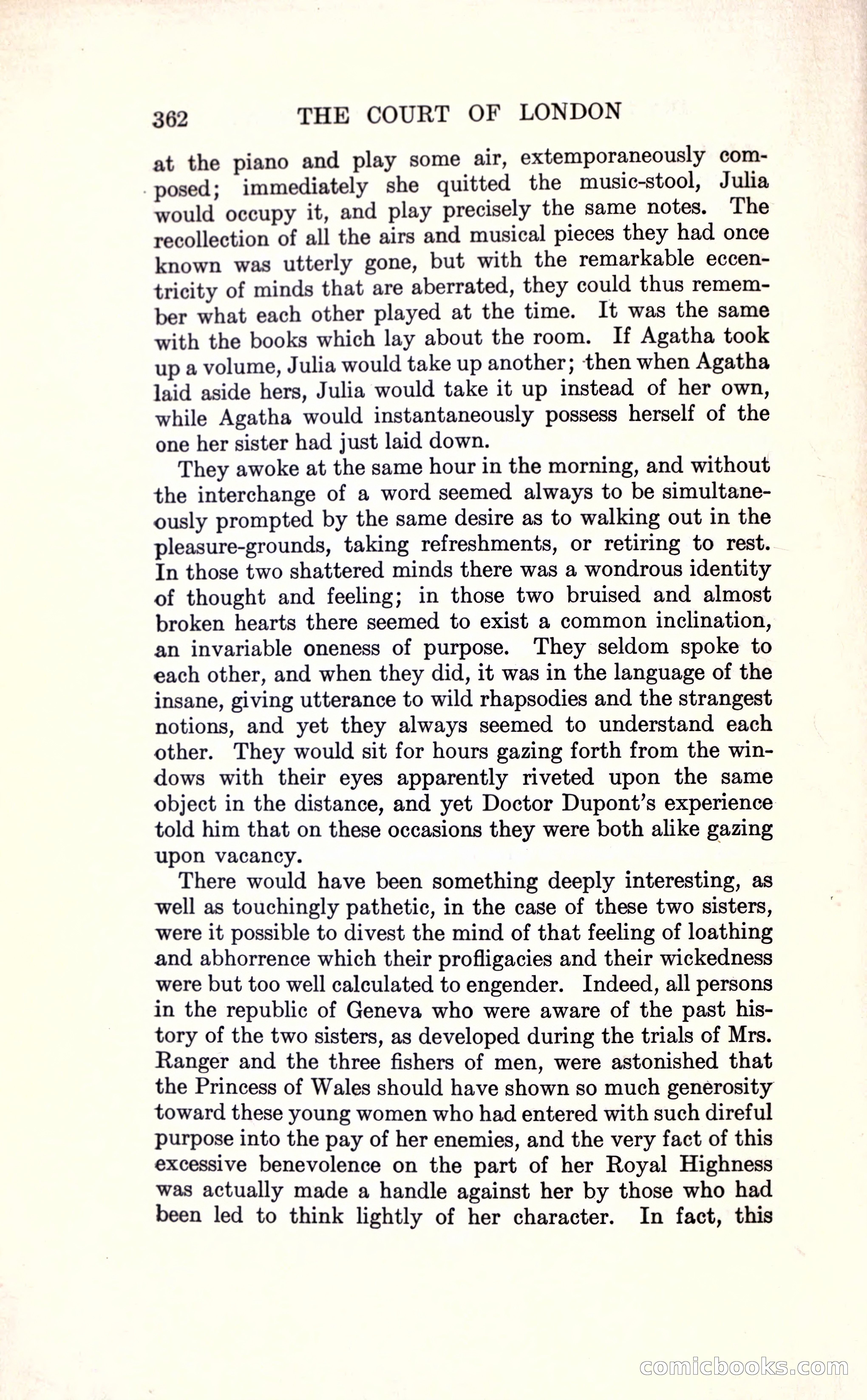
A restored page from Penny Dreadfuls, 1860. Page through the whole issue in the reader above.
📄 Transcribed text from this page (OCR, searchable)
Machine-transcribed from the original scan — historical spelling and the odd misread are preserved.
362 THE COURT OF LONDON at the piano and play some air, extemporaneously com- posed; immediately she quitted the music-stool, Julia would occupy it, and play precisely the same notes. The recollection of all the airs and musical pieces they had once known was utterly gone, but with the remarkable eccen- tricity of minds that are aberrated, they could thus remem- ber what each other played at the time. It was the same with the books which lay about the room. If Agatha took up a volume, Julia would take up another; then when Agatha laid aside hers, Julia would take it up instead of her own, while Agatha would instantaneously possess herself of the one her sister had just laid down. They awoke at the same hour in the morning, and without the interchange of a word seemed always to be simultane- ously prompted by the same desire as to walking out in the pleasure-grounds, taking refreshments, or retiring to rest. In those two shattered minds there was a wondrous identity of thought and feeling; in those two bruised and almost broken hearts there seemed to exist a common inclination, an invariable oneness of purpose. They seldom spoke to each other, and when they did, it was in the language of the insane, giving utterance to wild rhapsodies and the strangest notions, and yet they always seemed to understand each other. They would sit for hours gazing forth from the win- dows with their eyes apparently riveted upon the same object in the distance, and yet Doctor Dupont’s experience told him that on these occasions they were both alike gazing upon vacancy. There would have been something deeply interesting, as well as touchingly pathetic, in the case of these two sisters, were it possible to divest the mind of that feeling of loathing and abhorrence which their profligacies and their wickedness were but too well calculated to engender. Indeed, all persons in the republic of Geneva who were aware of the past his- tory of the two sisters, as developed during the trials of Mrs. Ranger and the three fishers of men, were astonished that the Princess of Wales should have shown so much generosity toward these young women who had entered with such direful purpose into the pay of her enemies, and the very fact of this excessive benevolence on the part of her Royal Highness was actually made a handle against her by those who had been led to think lightly of her character. In fact, this comicloooks (C@ im