
Penny Dreadfuls, 1860 · page 347 of 394
The Mysteries of the Court of London — page 347: what you’re looking at
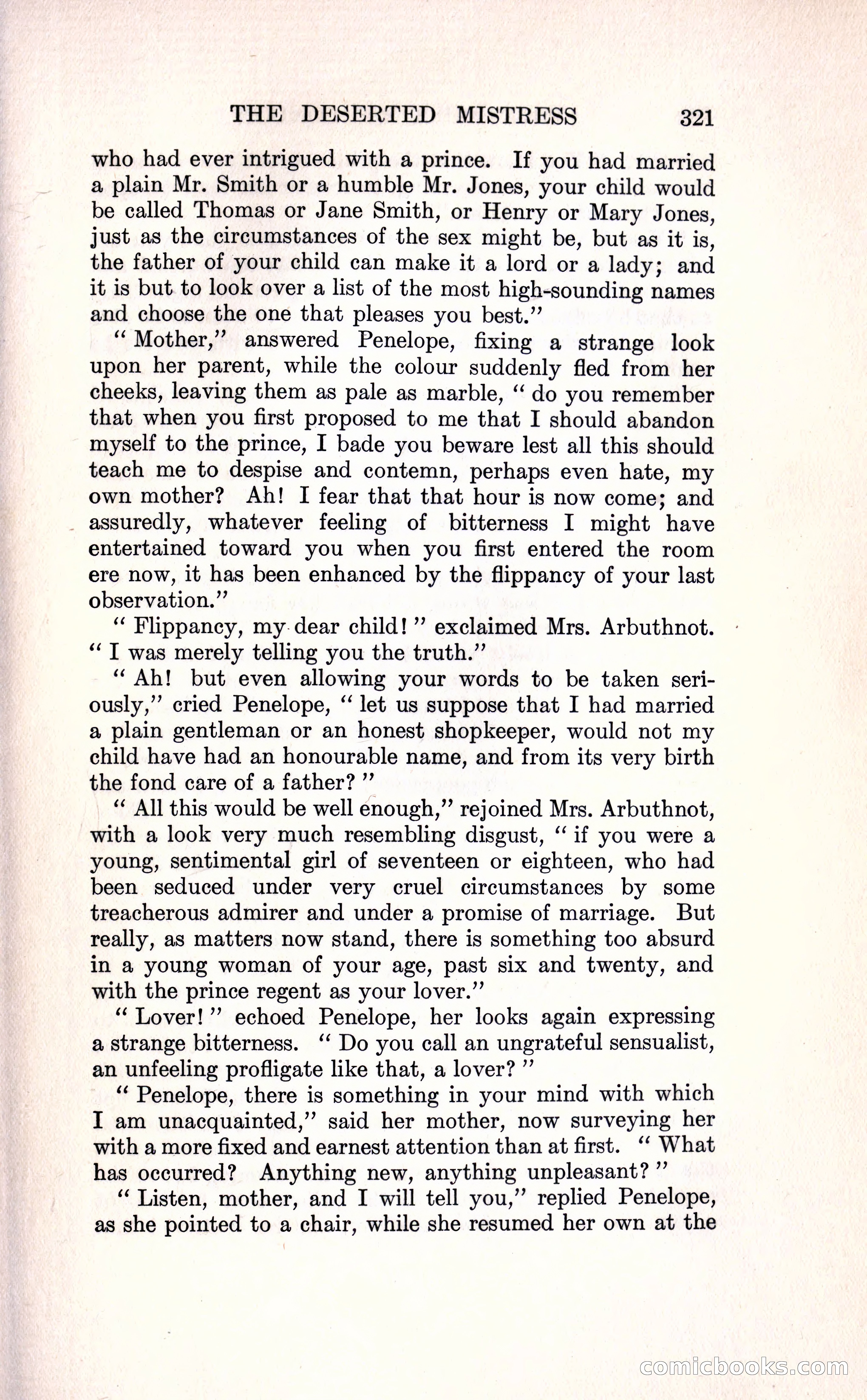
A restored page from Penny Dreadfuls, 1860. Page through the whole issue in the reader above.
📄 Transcribed text from this page (OCR, searchable)
Machine-transcribed from the original scan — historical spelling and the odd misread are preserved.
THE DESERTED MISTRESS 321 who had ever intrigued with a prince. If you had married a plain Mr. Smith or a humble Mr. Jones, your child would be called Thomas or Jane Smith, or Henry or Mary Jones, just as the circumstances of the sex might be, but as it is, the father of your child can make it a lord or a lady; and it is but to look over a list of the most high-sounding names and choose the one that pleases you best.” “Mother,” answered Penelope, fixing a strange look upon her parent, while the colour suddenly fled from her cheeks, leaving them as pale as marble, ‘“‘ do you remember that when you first proposed to me that I should abandon myself to the prince, I bade you beware lest all this should teach me to despise and contemn, perhaps even hate, my own mother? Ah! I fear that that hour is now come; and _ assuredly, whatever feeling of bitterness I might have entertained toward you when you first entered the room ere now, it has been enhanced by the flippancy of your last observation.” ‘“ Flippancy, my-dear child! ”’ exclaimed Mrs. Arbuthnot. ‘‘T was merely telling you the truth.” “Ah! but even allowing your words to be taken seri- ously,’’ cried Penelope, ‘‘ let us suppose that I had married a plain gentleman or an honest shopkeeper, would not my child have had an honourable name, and from its very birth the fond care of a father? ”’ ‘ All this would be well enough,” rejoined Mrs. Arbuthnot, with a look very much resembling disgust, ‘‘ if you were a young, sentimental girl of seventeen or eighteen, who had been seduced under very cruel circumstances by some treacherous admirer and under a promise of marriage. But really, as matters now stand, there is something too absurd in a young woman of your age, past six and twenty, and with the prince regent as your lover.” ‘“‘ Lover! ’’ echoed Penelope, her looks again expressing a, strange bitterness. ‘“ Do you call an ungrateful sensualist, an unfeeling profligate like that, a lover? ”’ ‘“‘ Penelope, there is something in your mind with which I am unacquainted,” said her mother, now surveying her with a more fixed and earnest attention than at first. “‘ What has occurred? Anything new, anything unpleasant? ” ‘“ Listen, mother, and I will tell you,” replied Penelope, as she pointed to a chair, while she resumed her own at the (C(O) nn) Goo <Si in