
Penny Dreadfuls, 1860 · page 27 of 394
The Mysteries of the Court of London — page 27: what you’re looking at
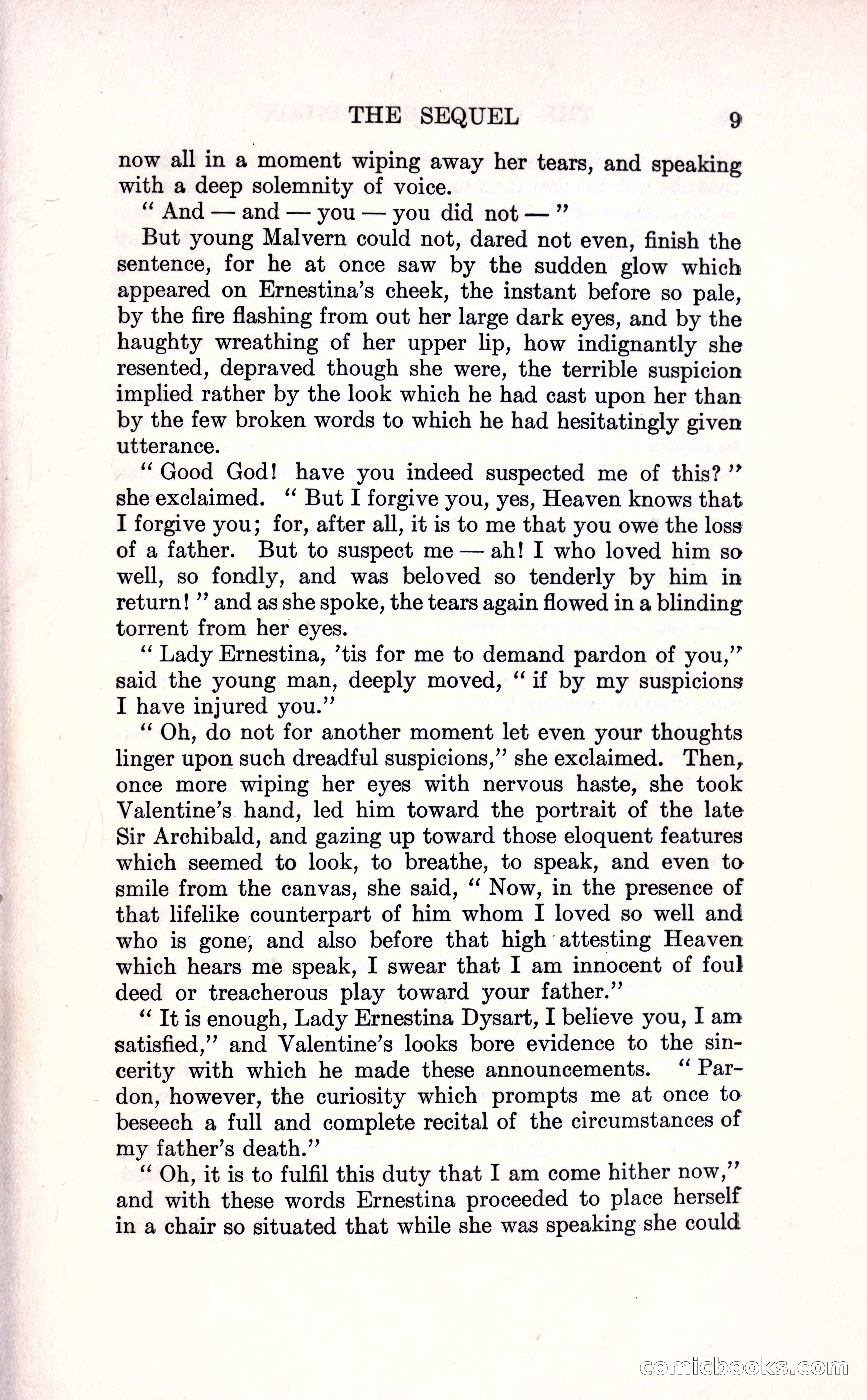
A restored page from Penny Dreadfuls, 1860. Page through the whole issue in the reader above.
📄 Transcribed text from this page (OCR, searchable)
Machine-transcribed from the original scan — historical spelling and the odd misread are preserved.
THE SEQUEL 9 now all in a moment wiping away her tears, and speaking with a deep solemnity of voice. ‘““ And — and — you — you did not —” But young Malvern could not, dared not even, finish the sentence, for he at once saw by the sudden glow which appeared on Ernestina’s cheek, the instant before so pale, by the fire flashing from out her large dark eyes, and by the haughty wreathing of her upper lip, how indignantly she resented, depraved though she were, the terrible suspicion implied rather by the look which he had cast upon her than by the few broken words to which he had hesitatingly given utterance. ‘““Good God! have you indeed suspected me of this? ”’ she exclaimed. ‘ But I forgive you, yes, Heaven knows that I forgive you; for, after all, it is to me that you owe the loss of a father. But to suspect me — ah! I who loved him so well, so fondly, and was beloved so tenderly by him in return! ’’ and as she spoke, the tears again flowed in a blinding torrent from her eyes. ‘“‘ Lady Ernestina, ’tis for me to demand pardon of you,” said the young man, deeply moved, “if by my suspicions I have injured you.” ‘Oh, do not for another moment let even your thoughts linger upon such dreadful suspicions,”’ she exclaimed. Then, once more wiping her eyes with nervous haste, she took Valentine’s hand, led him toward the portrait of the late Sir Archibald, and gazing up toward those eloquent features which seemed to look, to breathe, to speak, and even to smile from the canvas, she said, ‘“‘ Now, in the presence of that lifelike counterpart of him whom I loved so well and who is gone, and also before that high attesting Heaven which hears me speak, I swear that I am innocent of foul deed or treacherous play toward your father.” ‘“ It is enough, Lady Ernestina Dysart, I believe you, ] am satisfied,’ and Valentine’s looks bore evidence to the sin- cerity with which he made these announcements. “ Par- don, however, the curiosity which prompts me at once to beseech a full and complete recital of the circumstances of my father’s death.”’ ‘Oh, it is to fulfil this duty that I am come hither now,” and with these words Ernestina proceeded to place herself in a chair so situated that while she was speaking she could (C(O) nn) GDoOOo <Sii im