
Penny Dreadfuls, 1860 · page 242 of 394
The Mysteries of the Court of London — page 242: what you’re looking at
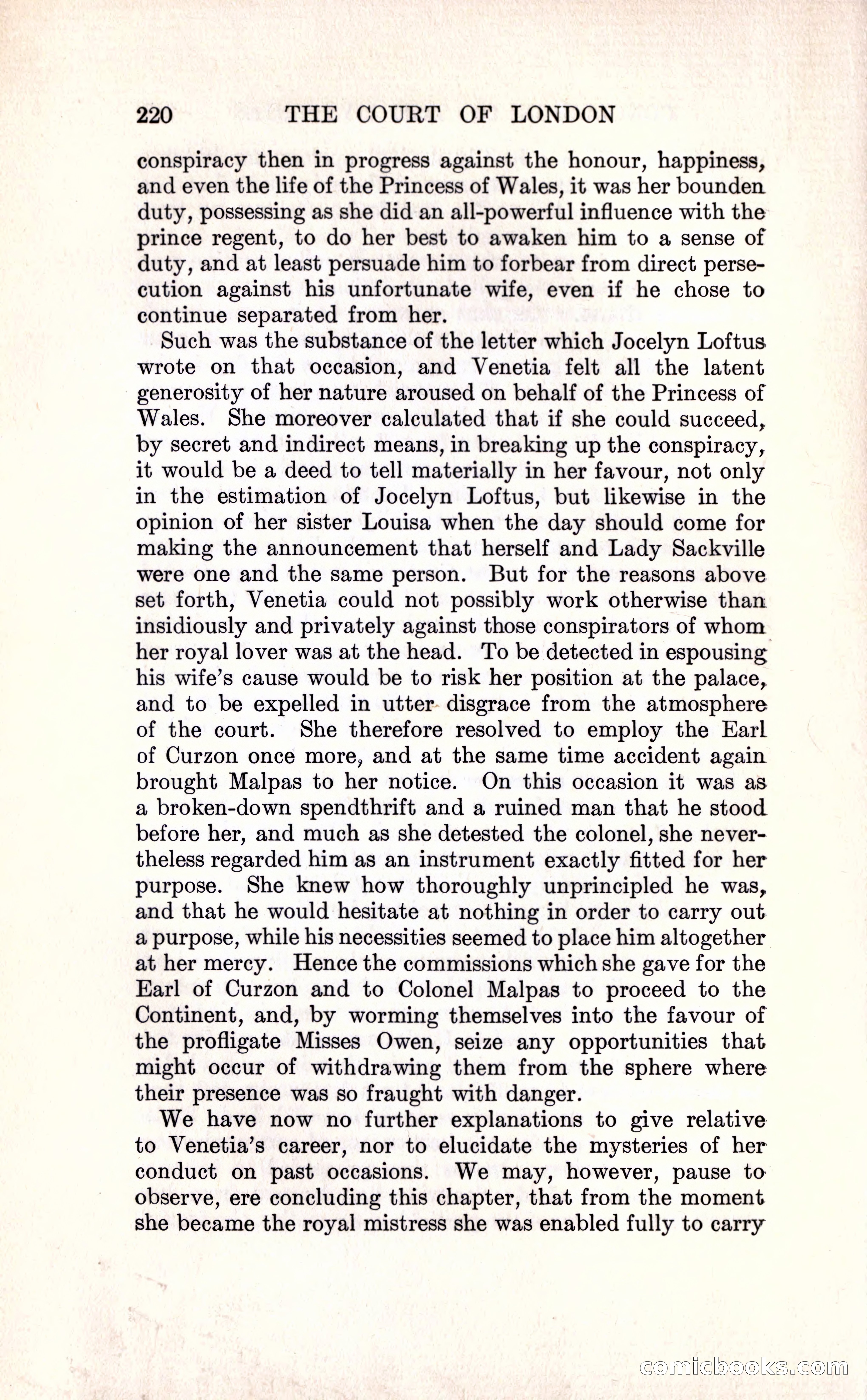
A restored page from Penny Dreadfuls, 1860. Page through the whole issue in the reader above.
📄 Transcribed text from this page (OCR, searchable)
Machine-transcribed from the original scan — historical spelling and the odd misread are preserved.
220 THE COURT OF LONDON conspiracy then in progress against the honour, happiness, and even the life of the Princess of Wales, it was her bounden duty, possessing as she did an all-powerful influence with the prince regent, to do her best to awaken him to a sense of duty, and at least persuade him to forbear from direct perse- cution against his unfortunate wife, even if he chose to continue separated from her. Such was the substance of the letter which Jocelyn Loftus wrote on that occasion, and Venetia felt all the latent generosity of her nature aroused on behalf of the Princess of Wales. She moreover calculated that if she could succeed, by secret and indirect means, in breaking up the conspiracy, it would be a deed to tell materially in her favour, not only in the estimation of Jocelyn Loftus, but likewise in the opinion of her sister Louisa when the day should come for making the announcement that herself and Lady Sackville were one and the same person. But for the reasons above set forth, Venetia could not possibly work otherwise than insidiously and privately against those conspirators of whom her royal lover was at the head. To be detected in espousing his wife’s cause would be to risk her position at the palace, and to be expelled in utter. disgrace from the atmosphere of the court. She therefore resolved to employ the Earl of Curzon once more, and at the same time accident again brought Malpas to her notice. On this occasion it was as a broken-down spendthrift and a ruined man that he stood before her, and much as she detested the colonel, she never- theless regarded him as an instrument exactly fitted for her purpose. She knew how thoroughly unprincipled he was, and that he would hesitate at nothing in order to carry out a purpose, while his necessities seemed to place him altogether at her mercy. Hence the commissions which she gave for the Earl of Curzon and to Colonel Malpas to proceed to the Continent, and, by worming themselves into the favour of the profligate Misses Owen, seize any opportunities that might occur of withdrawing them from the sphere where their presence was so fraught with danger. We have now no further explanations to give relative to Venetia’s career, nor to elucidate the mysteries of her conduct on past occasions. We may, however, pause to observe, ere concluding this chapter, that from the moment she became the royal mistress she was enabled fully to carry COMnniclooo© S GE in