
Penny Dreadfuls, 1860 · page 217 of 394
The Mysteries of the Court of London — page 217: what you’re looking at
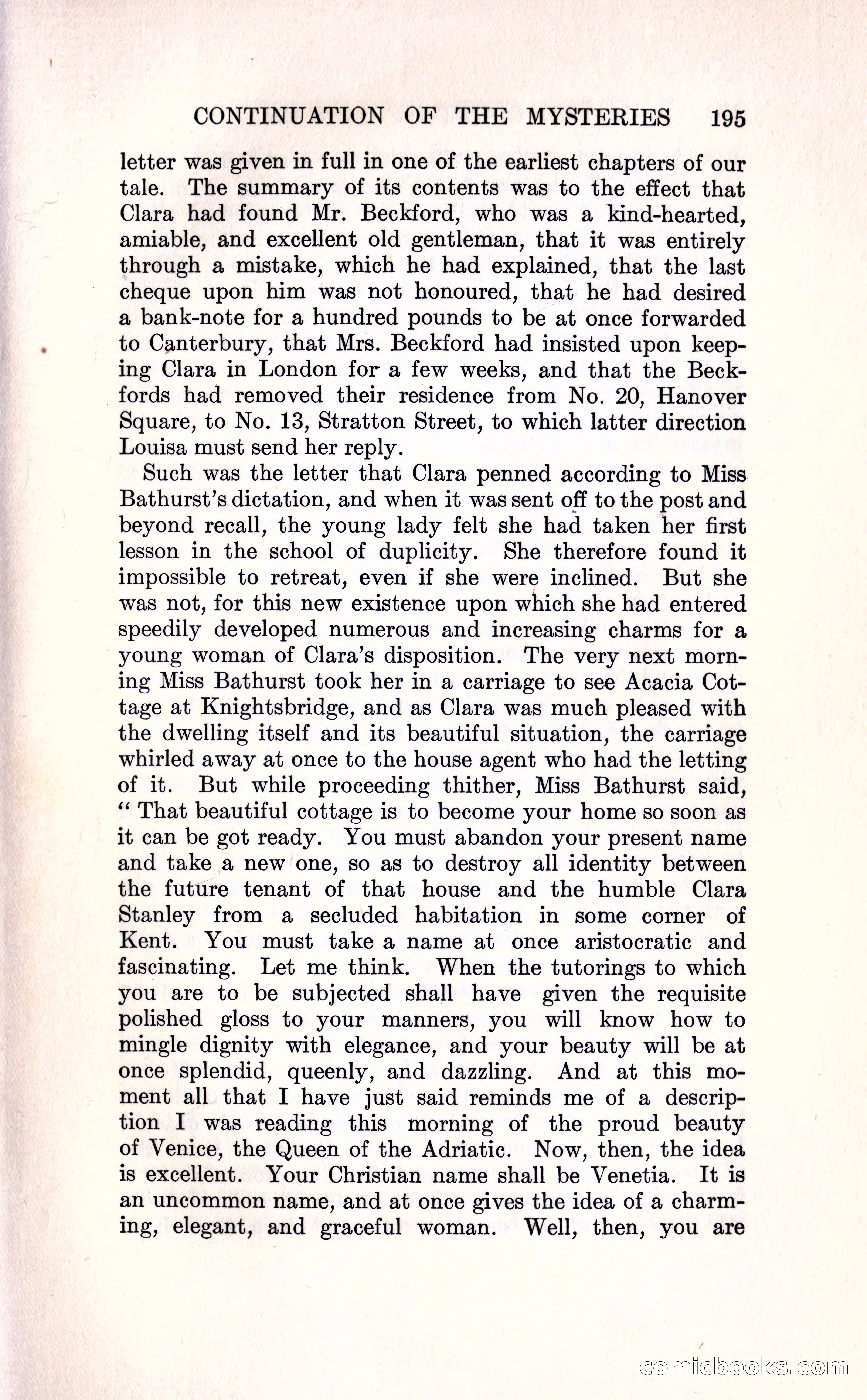
A restored page from Penny Dreadfuls, 1860. Page through the whole issue in the reader above.
📄 Transcribed text from this page (OCR, searchable)
Machine-transcribed from the original scan — historical spelling and the odd misread are preserved.
CONTINUATION OF THE MYSTERIES — 195 letter was given in full in one of the earliest chapters of our tale. The summary of its contents was to the effect that Clara had found Mr. Beckford, who was a kind-hearted, amiable, and excellent old gentleman, that it was entirely through a mistake, which he had explained, that the last cheque upon him was not honoured, that he had desired a bank-note for a hundred pounds to be at once forwarded to Canterbury, that Mrs. Beckford had insisted upon keep- ing Clara in London for a few weeks, and that the Beck- fords had removed their residence from No. 20, Hanover Square, to No. 13, Stratton Street, to which latter direction Louisa must send her reply. Such was the letter that Clara penned according to Miss Bathurst’s dictation, and when it was sent off to the post and beyond recall, the young lady felt she had taken her first lesson in the school of duplicity. She therefore found it impossible to retreat, even if she were inclined. But she was not, for this new existence upon which she had entered speedily developed numerous and increasing charms for a young woman of Clara’s disposition. The very next morn- ing Miss Bathurst took her in a carriage to see Acacia Cot- tage at Knightsbridge, and as Clara was much pleased with the dwelling itself and its beautiful situation, the carriage whirled away at once to the house agent who had the letting of it. But while proceeding thither, Miss Bathurst said, “That beautiful cottage is to become your home so soon as it can be got ready. You must abandon your present name and take a new one, so as to destroy all identity between the future tenant of that house and the humble Clara Stanley from a secluded habitation in some corner of Kent. You must take a name at once aristocratic and fascinating. Let me think. When the tutorings to which you are to be subjected shall have given the requisite polished gloss to your manners, you will know how to mingle dignity with elegance, and your beauty will be at once splendid, queenly, and dazzling. And at this mo- ment all that I have just said reminds me of a descrip- tion I was reading this morning of the proud beauty of Venice, the Queen of the Adriatic. Now, then, the idea is excellent. Your Christian name shall be Venetia. It is an uncommon name, and at once gives the idea of a charm- ing, elegant, and graceful woman. Well, then, you are (C(O) nn) GDOo <Si nin