
Penny Dreadfuls, 1850 · page 117 of 397
The Mysteries of the Court of London — page 117: what you’re looking at
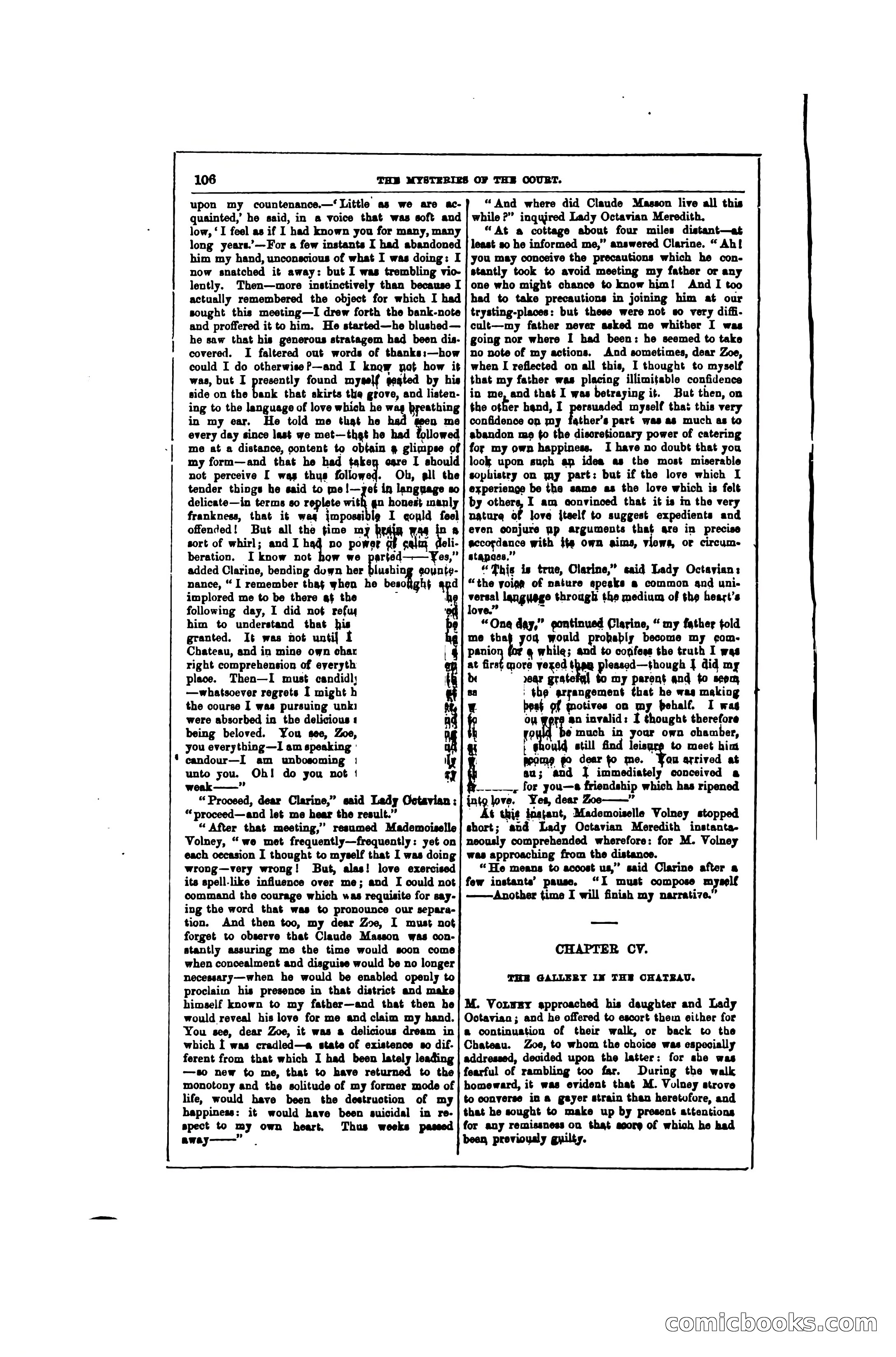
A restored page from Penny Dreadfuls, 1850. Page through the whole issue in the reader above.
📄 Transcribed text from this page (OCR, searchable)
Machine-transcribed from the original scan — historical spelling and the odd misread are preserved.
106 THS MYSTERIES OF THE COURT. “ Aud where did Claude Masson live all this while ?” inqujred Lady Octavian Meredith, “At a cottage about four miles distant—at least s0 he informed me,” answered Clarine. “ Ah! you may conceive the precautions which he con- stantly took to avoid meeting my father or any one who might chance to know him! And I too had to take precautions in joining him at our trysting-places: but these were not «o very diffi- cult—my father never asked me whither I was going nor where I had been: he seemed to take no note of my actions. And sometimes, dear Zoe, when I reflected on all this, I thought to myself that my father was placing illimitable confidence in me, and that I was betraying it. But then, on the other bend, I aes myself tha: this very confidence on yy father’s part was as much as to abandon me ¢o the discretionary power of catering for my own happiness. I have no doubt that you look upon such an idea as the most miserable sophistry on wy part: but if the love which I experience be the same as the love which is felt by others, I am aonvinced that it is im the very natura of love jteelf to suggest expedients and even conjure up arguments that are in precise sccordance with ie own aims, views, or circum. atapaes,” “ This in true, Clarine,” said Lady Octavian: “the voinn of nature apeske @ common and uni- yee langwege through the medium of the heart's love.” “Ona day,” pantinued Clarine, “ my father told me aay Ep would probably become my ¢om- eer while; on to cotifess the truth I was at fired ae ie) aye pleased—though J did my be to my parent and to seem upon my countenance.‘ Little as we are ac- quainted,’ he said, in a voice that was soft aud low, ‘I feel as if I had known you for many, many long years.’—For a few instants I had abandoned him my hand, unconscious of what I was doing: I now snatched it away: but I was trembling vio- lently. Then—more instinctively than because I actually remembered the object for which I had sought this meeting—I drew forth the bank-note and proffered it to him. He started—he blushed— he saw that his generous stratagem hed been dis- covered. I faltered out words of thanks:—how could I do otherwise P—and I know vat how i¢ was, but I presently found myself gegted by his side on the bank that skirts the grove, and liaten- ing to the language of love which he wag breathing in my ear, He told me that he had geen me every day since last we met—thgt he had followed me at a distance, content to obtain glimpee of my form—and that he had takeg care I should not perceive I was thys followed. Ob, gll the tender things he said to me!—y of in language so delicate—in terms so replete with gn honest manly frankness, that it wag jmpossi ‘ I gould feel offended! But all the time my ty sort of whirl; and I haq no rent tt li- beration. I know not how we arted—— Yes,” added Clarine, bending down her blushin, ae nance, “I remember tha¢ when he besotight implored me to be there af the t following day, I did not refuy r him to understand that his granted. I¢ was not until f Chateau, and in mine own char right comprehension of eyeryth place. Then—I must candid); —whatsoever regrets I might h the course I was pursuing unk: were absorbed in the delicious 1 being beloved. You see, Zoe, you everything—I am speaking ' candour—I am unbosoming : unto you. Oh! do you not | weak——” ‘Proceed, dear Clarine,” eaid Ledy Octavian : | ini “proceed—and let me hear the result.” “ After that meeting,” resumed Mademoiselle Volney, “we met frequently—frequently: yet on each occasion I thought to myself that I was doing wrong—very wrong! But, alas! love exercised ite epell-like influence over me; and I could not command the courage which was requisite for say- ing the word that was to pronounce our separa- tion. And then too, my dear Zoe, I must not forget to observe thet Claude Masson was con- stantly assuring me the time would soon come when concealment and disguise would be no longer necessary—when he would be enabled openly to proclaim his presence in that district and make himeelf known to my father—and that then he would reveal his love for me and claim my hand. You see, dear Zoe, it was a delicious dream in which I was cradled—a state of existence so dif- ferent from that which I had been lately leading —so new to me, that to have returned to the monotony and the solitude of my former mode of life, would have been the destruction of my happiness: it would have been suicidal in re- spect to my own heart. Thus weeks passed sa the prrangernent that he wae makiog " beat of gf motives on my behalf. I wag f ow rnp invalid: 1 thought therefore much in your own chamber, & F qno still find leis to meet him penme go dear fo me. t al au arrived at sa; and J immediately conceived a ———, for you—s friendship which has ripened love. Yes, dear Zoe 6 this inatant, Mademoiselle Volney stopped dents ‘aud Lady Octavian Meredith instanta- neously comprehended wherefore: for M. Volney was approaching from the distance. * He means to accost us,” said Clarine after a few instante’ pause. “I must compose myself ——-Another time I will finish my narrative.” AS ERE CHAPTER CY. THE GALLERY IN THE CHATEAU. M. Voxrwny spproached his daughter and Lady Octavian ; and he offered to escort them either for @ continuation of their walk, or back to the Chateau. Zoe, to whom the choice was especially addressed, decided upon the latter: for she was fearful of rambling too far. During the walk homeward, it was evident that M. Volney atrove to converse ina geyer atrain then heretofore, and that he sought to make up by present attentions for any remissness on that score of which be bad been previously guilty. away——” comicibooks.conm