
Penny Dreadfuls, 1850 · page 188 of 397
The Mysteries of the Court of London — page 188: what you’re looking at
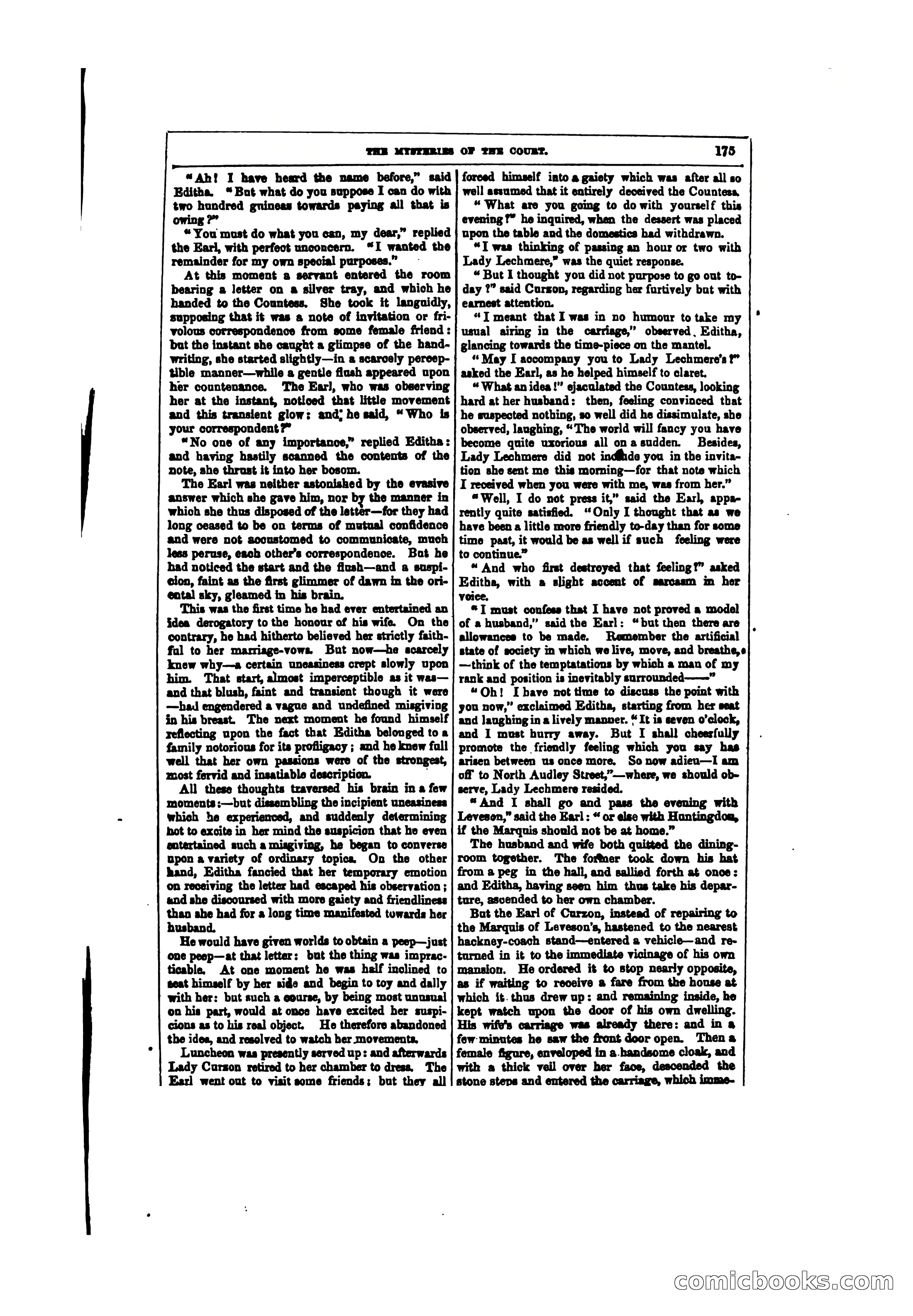
A restored page from Penny Dreadfuls, 1850. Page through the whole issue in the reader above.
📄 Transcribed text from this page (OCR, searchable)
Machine-transcribed from the original scan — historical spelling and the odd misread are preserved.
I THE MYSTERIES OF THE COURT. “Ah! I have heard the name before,” said Editha. “But what do you suppose I can do with two hundred guineas towards paying all that is owing ?” “You must do what you can, my dear,” replied the Earl, with perfect unconcern. “I wanted the remainder for my own special purposes.” At this moment a servant entered the room bearing a letter on a silver tray, and which he handed to the Countess, She took it languidly, supposing that it was a note of invitation or fri- volous correspondence from some female friend : bat the instant she caught a glimpse of the hand- writing, she started slightly—in a scarcely pereep- tible manner—while a gentle flash appeared upon her countenance. The Earl], who was observing her at the instant, noticed that little movement and this transient glow: and; he said, “Who is your correspondent ” “No one of any importance,” replied Editha : and having hastily scanned the contents of the note, she thrast it into her bosom. The Earl was neither astonished by the evasive answer which she gave him, nor by the manner in which she thus disposed of the letter—for they had long ceased to be on terms of mutual confidence and were not accustomed to communicate, much less peruse, each other’s correspondence. Bat he had noticed the start and the flush—and a suspi- cion, faint as the first glimmer of dawn im the ori- ental sky, gleamed in his brain. This was the first time he had ever entertained an Sdea derogatory to the honour of his wife. On the contrary, he had hitherto believed her strictly faith- fal to her marriage-vows. But now—he scarcely knew why—a certain uneasiness crept slowly upon him. That start, almost imperceptible as it was— and that blush, faint and transient though it were —had engendered a vague and undefined misgiving in his breast. The next moment he found himself reflecting upon the fact that Editha belonged to a family notorious for its profligacy ; and he knew fall well that her own passions were of the strongest, most fervid and insatiable description. . All these thoughts traversed his brain in a few moments :—but dissembling the incipient uneasiness which he experienced, and suddenly determining bot to excite in her mind the suspicion that he even entertained auch a misgiving, he began to converse upon a variety of ordinary topica. On the other hand, Editha fancied that her temporary emotion on receiving the letter had escaped his observation ; and she discoursed with more gaicty and friendliness than she had for a long time manifested towards her husband. He would have given worlds to obtain a peep—just one peep—at that letter: but the thing was imprac- ticable, At one moment he was half inclined to seat himself by her side and begin to toy and dally with her: but such a course, by being most unusual on his part, would at once have excited her suspi- cions as to his real object. He therefore abandoned the idea, and resolved to watch her movements. Luncheon was presently served up: and afterwards Lady Curzon retired to her chamber to dress, The Earl went ont to visit some friends; but they all 175 forced himself into a gaiety which was after all so well assumed that it entirely deceived the Countess, “What are you going to dowith yourself this evening f” he inquired, when the dessert was placed upon the table and the domestics had withdrawn. “IT was thinking of passing an hour or two with Lady Lechmere,” was the quiet response. “ But I thought you did not purpose to go out to- day ?” said Carson, regarding her furtively but with earnest attention. “T meant that I was in no humonr to take my usual airing in the carriage,” observed. Editha, glancing towards the time-piece on the mantel. “May I accompany you to Lady Lechmere’s ?” asked the Earl, as he helped himself to claret. “ What an idea!” ejaculated the Countess, looking hard at her husband: then, feeling convinced tbat he suspected nothing, so well did he dissimulate, she observed, laughing, “The world will fancy you have become quite uxorious all onasudden. Besides, Lady Lechmere did not ind@ide you in the invita- tion she sent me this morning—for that note which I received when you were with me, was from her.” “Well, I do not press it,” said the Earl, appa- rently quite satisfied. ‘Only I thought that as we have been a little more friendly to-day than for eome time past, it would be as well if such feeling were to continue.” “ And who first destroyed that feeling!” asked Editha, with a slight accent of sarcasm in her voice, *I must confess that I have not proved a model of a husband,” said the Earl: “but then there are allowances to be made. Remember the artificial state of society in which we live, move, and breathe,e —think of the temptatations by which a man of my rank and position is inevitably surrounded———” “Oh! I bave not time to discuss the point with you now,” exclaimed Editha, starting from her seat and laughing in a lively manner. “ It is seven o'clock, and I must hurry away. But I shall cheesfully promote the friendly feeling which you say has arisen between us once more. So now adieu—I am off to North Audley Street,”—where, we should ob- serve, Lady Lechmere resided. “And I shall go and pass the evening with Leveson,” said the Earl : “ or else with Hantingdoa, if the Marquis should not be at home.” The husband and wife both quitted the dining- room together. The former took down his hat from a peg in the hall, and sallied forth at onoe: and Editha, having seen him thus take his depar- ture, asvended to her own chamber. Bat the Earl of Curzon, instead of repairing to the Marquis of Leveson’s, hastened to the nearest hackney-coach stand—entered a vehicle—and re- turned in it to the immediate vicinage of his own mansion. He ordered it to stop nearly opposite, as if waiting to receive a fare from the house at which it.thus drew up: and remaining inside, he kept watch upon the door of his own dwelling. His wife’s carriage was already there: and in a few-minutes he saw the front door open. Thena female figure, enveloped in a handsome cloak, and with a thick veil over her face, descended the stone steps and entered the carriage, which imme- comliclbooks.com