
Penny Dreadfuls, 1900 · page 99 of 398
Moths by Ouida — page 99: what you’re looking at
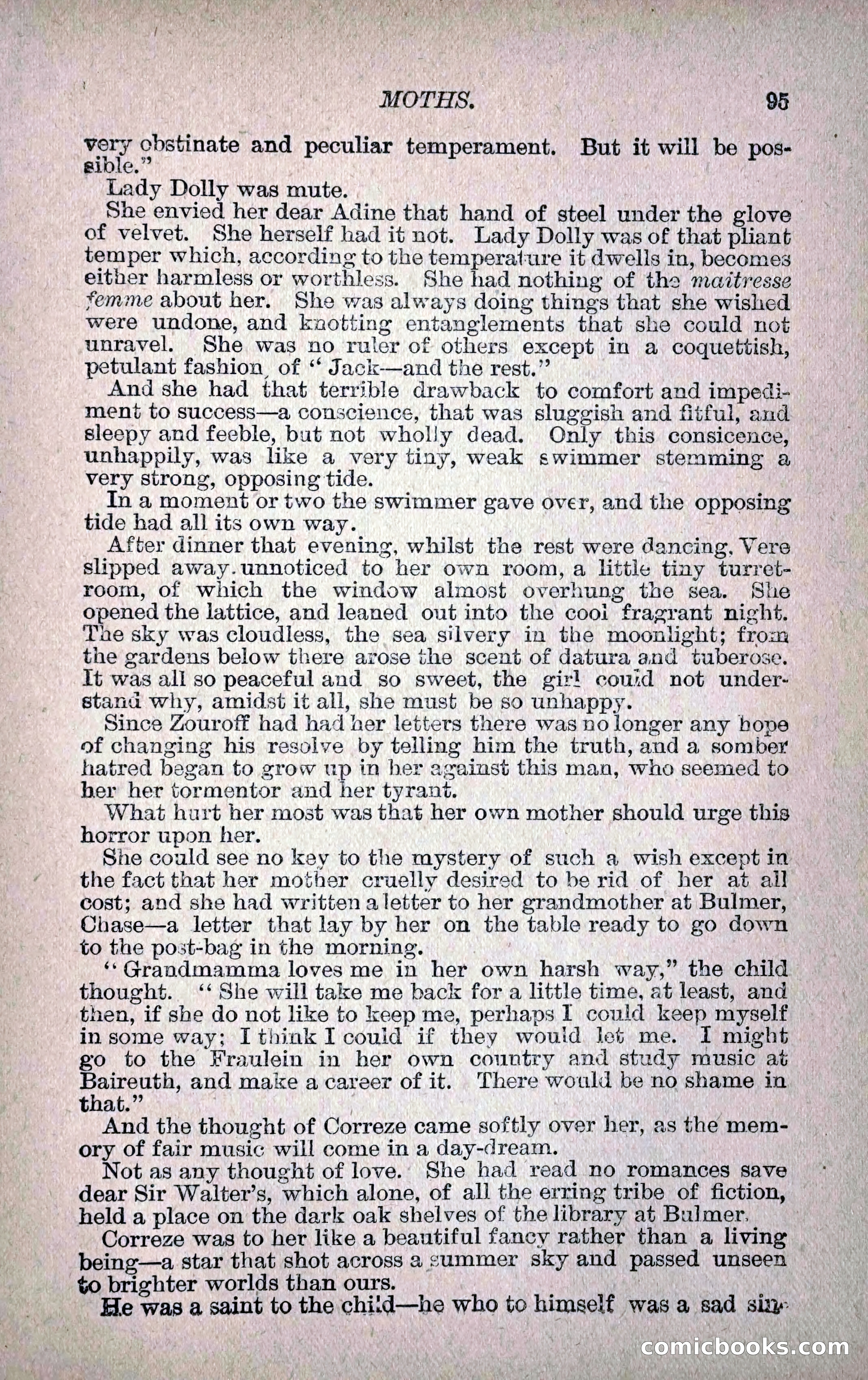
A restored page from Penny Dreadfuls, 1900. Page through the whole issue in the reader above.
📄 Transcribed text from this page (OCR, searchable)
Machine-transcribed from the original scan — historical spelling and the odd misread are preserved.
MOTHS. 9B Pe obstinate and peculiar temperament. But it will be pos- gible.” | Lady Dolly was mute. She envied her dear Adine that hand of steel under the glove of velvet. She herself had it not. Lady Dolly was of that pliant temper which, according to the temperature it dwells in, becomes either harmless or worthless. She had nothing of the maitresse femme about her. She was always doing things that she wished were undone, and knotting entanglements that she could not unravel. She was no ruler of others except in a coquettish, — petulant fashion of ‘ Jack-——and the rest.” And she had that terrible drawback to comfort and impedi- meni to success—a conscience, that was sluggish and fitful, and sleepy and feeble, but not wholly dead. Only this consicence, unhappily, was like a very tiny, weak swimmer stemming a very strong, opposing tide. In a moment or two the swimmer gave over, and the opposing tide had all its own way. After dinner that evening, whilst the rest were dancing, Vere slipped away.unnoticed to her own room, a little tiny turret- room, of which the window almost overhung the sea. She opened the lattice, and leaned out into the cooi fragrant night. Tae sky was cloudless, the sea silvery in the moonlight; from the gardens below there arose the scent of datura and tuberose. It was all so peaceful and so sweet, the gir! coud not under- stana why, amidst it all, she must be so unhappy. Since Zouroff had had her letters there was no longer any hope of changing his resolve by tellmg him the truth, and a somber hatred began to grow up in her against this man, who seemed to her her tormentor and her tyrant. } What hurt her most was that her own mother should urge this horror upon her. She could see no key to the mystery of such a wish except in the fact that her mother cruelly desired to be rid of her at ail cost; and she had written aletter to her grandmother at Bulmer, Chase—a letter that lay by her on the table ready to go down to the post-bag in the morning. ‘‘Grandmamma loves me in her own harsh way,” the child thought. ‘‘ She will take me back for a little time, at least, and then, if she do not like to keep me, perhaps I could keep myself in some way; I think I could if they wouid let me. I might go to the Fraulein in her own country and study music at Baireuth, and make a career of it. There would be no shame in that.” : And the thought of Correze came softly over her, as the mem- ory of fair music will come in a day-dream. Not as any thought of love. She had read no romances save dear Sir Walter’s, which alone, of all the erring tribe of fiction, held a place on the dark oak shelves of the library at Bulmer. Correze was to her like a beautiful fancy rather than a living being—a star that shot across a summer sky and passed unseen to brighter worlds than ours. ne He was a saint to the chi:\d—he who to himself was a sad site “comicbooks co