
Penny Dreadfuls, 1900 · page 69 of 398
Moths by Ouida — page 69: what you’re looking at
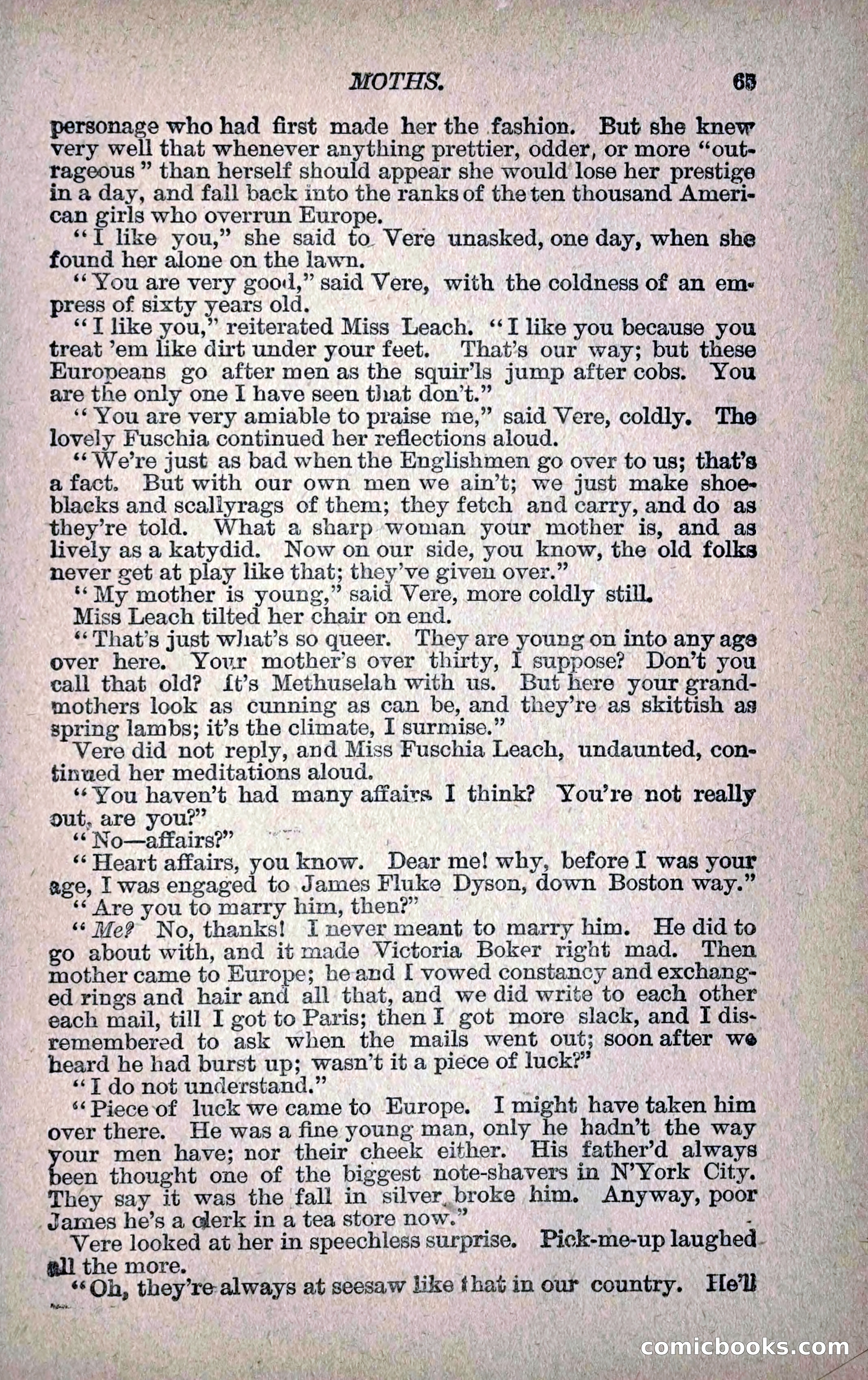
A restored page from Penny Dreadfuls, 1900. Page through the whole issue in the reader above.
📄 Transcribed text from this page (OCR, searchable)
Machine-transcribed from the original scan — historical spelling and the odd misread are preserved.
MOTHS. — gg personage who had first made her the fashion. But she knew very well that whenever anything prettier, odder, or more ‘‘out- tageous ” than herself should appear she would lose her prestige in a day, and fall back into the ranks of the ten thousand Ameri- can girls who overrun Kurope. ) ‘*] like you,” she said to Vere unasked, one day, when she found her alone on the lawn. **You are very good,” said Vere, with the coldness of an ems press of sixty years old. ‘I like you,” reiterated Miss Leach. ‘‘I like you because you treat ’em like dirt under your feet. That’s our way; but these Europeans go after men as the squir’ls jump after cobs. You are the only one I have seen that don’t.” ‘* You are very amiable to praise me,” said Vere, coldly. The lovely Fuschia continued her reflections aloud. ‘‘We’re just as bad when the Englishmen go over to us; that’s afact. But with our own men we ain’t; we just make shoe- blaeks and scallyrags of them; they fetch and carry, and do as they’re told. What a sharp woman your mother is, and as lively asa katydid. Now on our side, you know, the old folks never get at play like that; they’ve given over.” ‘‘ My mother is young,” said Vere, more coldly still. Miss Leach tilted her chair on end. | “‘That’s just what’s so queer. They are young on into any age over here. Your mother’s over thirty, Il suppose? Don’t you call that old? {t’s Methuselah with us. But here your grand- mothers look as cunning as can be, and they’re as skittish ag spring lambs; it’s the climate, 1 surmise.” Vere did not reply, and Miss Fuschia Leach, undaunted, con- finued her meditations aloud. ‘¢ You haven’t had many affairs I think? You’re not reall out, are you?’ : ‘‘ No—affairs?” ~~ . ‘¢ Heart affairs, you know. Dear me! why, before I was yo age, Iwas engaged to James Fluke Dyson, down Boston way.” ‘‘ Are you to marry him, then?” ‘¢ Me? No, thanks! I never meant to marry him. He did to go about with, and it made Victoria Boker right mad. Then mother came to Europe; heand I vowed constancy and exchang- ed rings and hair and all that, and we did write to each other each mail, till I got to Paris; then I got more slack, and I dis- remembered to ask when the mails went out; soon after we - heard he had burst up; wasn’t it a piece of luck?” ‘‘T do not understand.” ‘‘Piece of luck we came to Europe. I might have taken him over there. He was a fine young man, only he hadn’t the way our men have; nor their cheek either. His father’d always een thought one of the biggest note-shavers in N’York City. They say it was the fall in silver,broke him. Anyway, poor James he’s a clerk in a tea store now.” Vere looked at her in speechless surprise. Pick-me-up laughed. the more. , ue Oh, they’re always at seesaw like that in our country. Hell \ SAR, HAN Citic PAR Coty WRN es CONTE chook if “om. =f tig id bad t ' * 4 / ’ 7 a 4