
Penny Dreadfuls, 1900 · page 49 of 398
Moths by Ouida — page 49: what you’re looking at
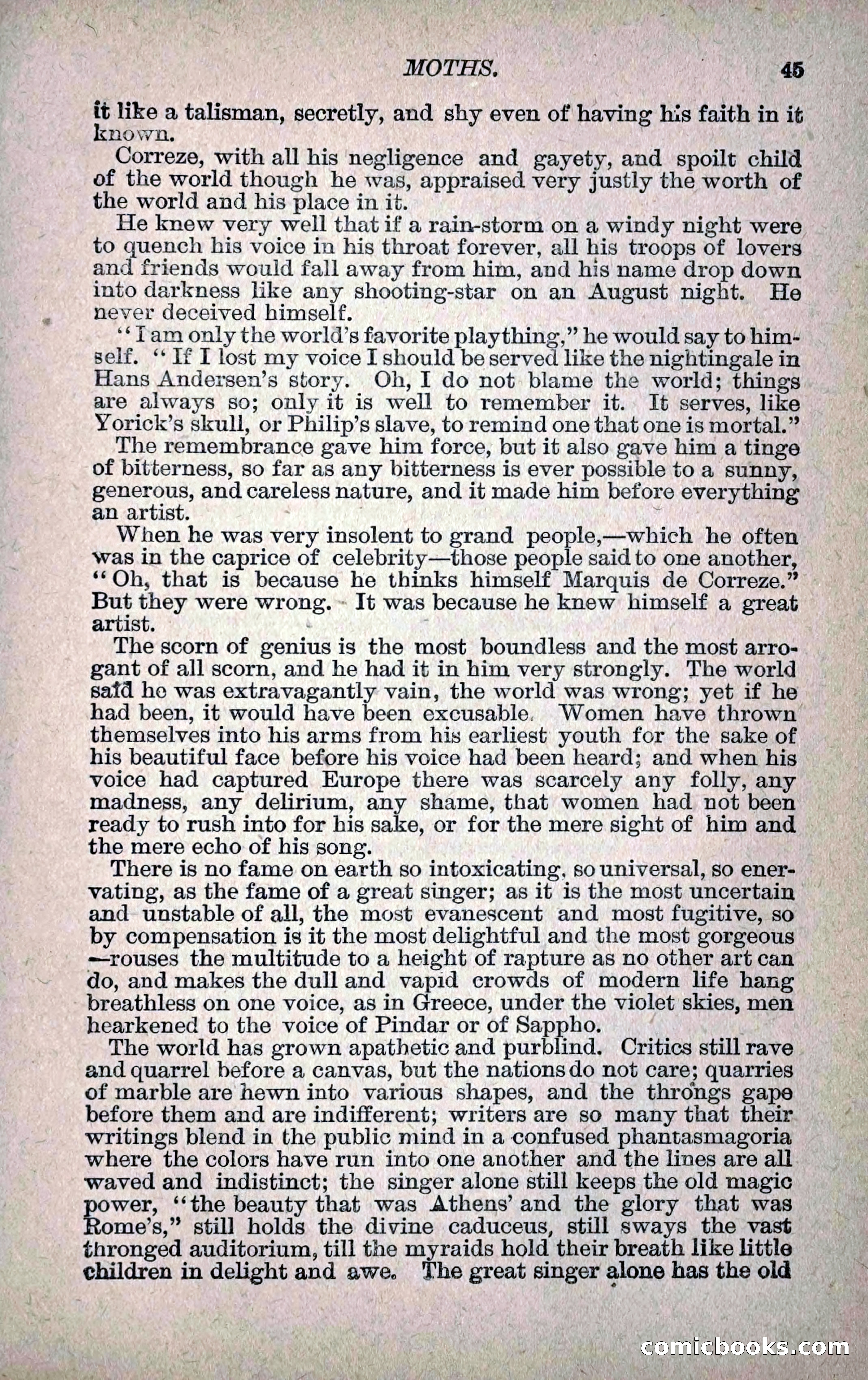
A restored page from Penny Dreadfuls, 1900. Page through the whole issue in the reader above.
📄 Transcribed text from this page (OCR, searchable)
Machine-transcribed from the original scan — historical spelling and the odd misread are preserved.
> Ae . %? 1 | MOTHS. | | 45 “4 like a talisman, secretly, and shy even of having his faith in i¢ nown, Correze, with all his negligence and gayety, and spoilt child of the world though he was, appraised very justly the worth of the world and his place in it. He knew very well that if a rain-storm on a windy night were to quench his voice in his throat forever, all his troops of lovers and friends would fall away from him, and his name drop down into darkness like any shooting-star on an August night. He never deceived himself. ‘*}am only the world’s favorite plaything,” he would say to him- self. ‘* If I lost my voice I should be served like the nightingale in Hans Andersen’s story. Oh, I do not blame the world; things are always so; only it is well to remember it. It serves, like Yorick’s skull, or Philip’s slave, to remind one that one is mortal.” The remembrance gave him force, but it also gave him a tinge of bitterness, so far as any bitterness is ever possible to a sunny, generous, and careless nature, and it made him before everything an artist. , | ' When he was very insolent to grand people,—which he often was in the caprice of celebrity—those people said to one another, ‘‘Oh, that is because he thinks himself Marquis de Correze.” But they were wrong. It was because he knew himself a great artist. | The scorn of genius is the most boundless and the most arro- gant of all scorn, and he had it in him very strongly. The world said he was extravagantly vain, the world was wrong; yet if he had been, it would have been excusable. Women have thrown themselves into his arms from his earliest youth for the sake of his beautiful face before his voice had been heard; and when his voice had captured Europe there was scarcely any folly, any madness, any delirium, any shame, that women had not been ready to rush into for his sake, or for the mere sight of him and the mere echo of his song. There is no fame on earth so intoxicating, so universal, so ener- vating, as the fame of a great singer; as it is the most uncertain ~ and unstable of all, the most evanescent and most fugitive, so by compensation is it the most delightful and the most gorgeous —rouses the multitude to a height of rapture as no other art can do, and makes the dull and vapid crowds of modern life hang breathless on one voice, as in Greece, under the violet skies, men hearkened to the voice of Pindar or of Sappho. The world has grown apathetic and purblind. Critics still rave and quarrel before a canvas, but the nations do not care; quarries of marble are hewn into various shapes, and the throngs gape before them and are indifferent; writers are so many that their writings blend in the public mind in a confused phantasmagoria where the colors have run into one another and the lines are all waved and indistinct; the singer alone still keeps the old magic ower, ‘‘the beauty that was Athens’ and the glory that was me’s,” still holds the divine caduceus, still sways the vast thronged auditorium, till the myraids hold their breath like little children in delight and awe. The great singer alone has the old comicbooks co