
Penny Dreadfuls, 1900 · page 378 of 398
Moths by Ouida — page 378: what you’re looking at
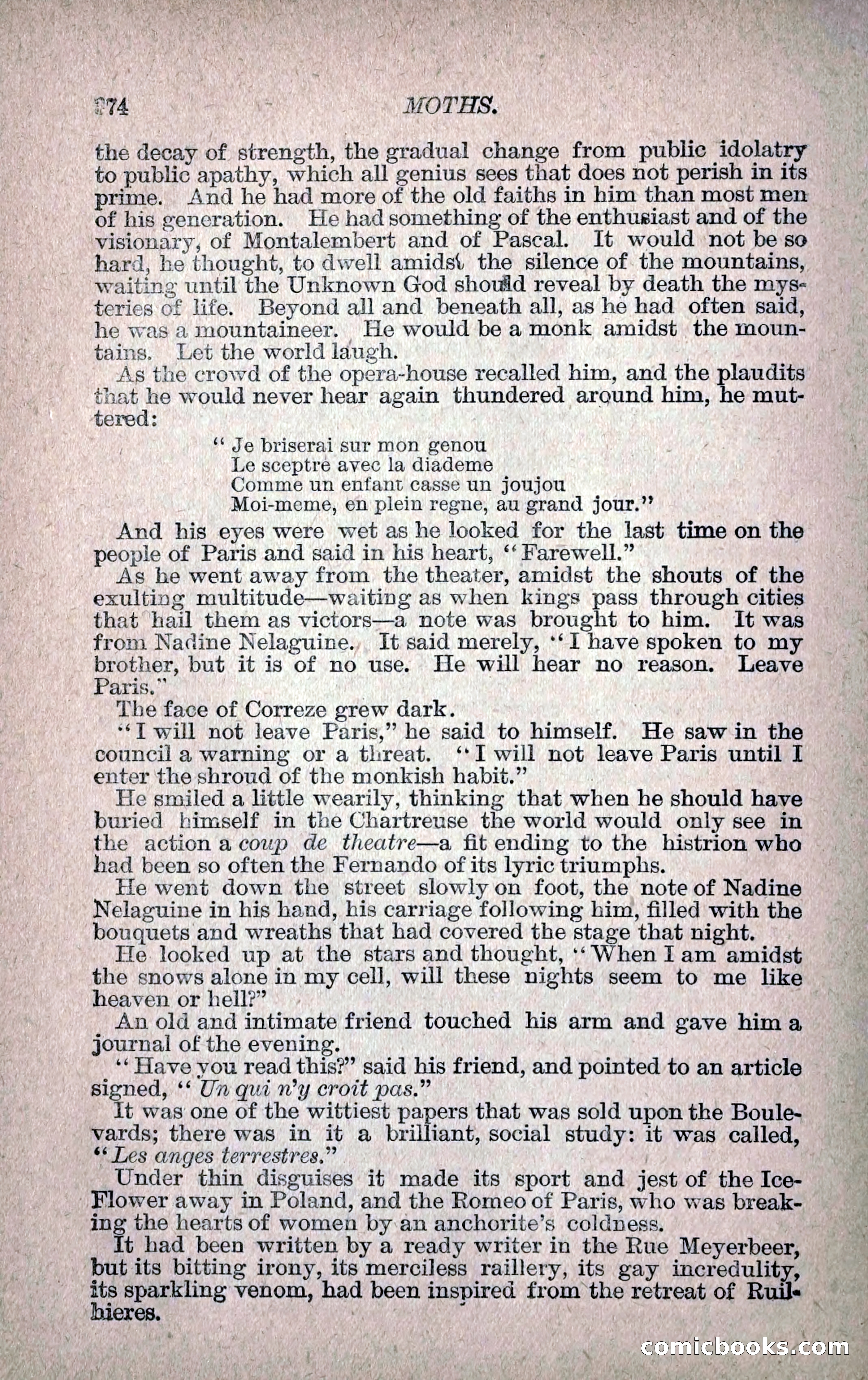
A restored page from Penny Dreadfuls, 1900. Page through the whole issue in the reader above.
📄 Transcribed text from this page (OCR, searchable)
Machine-transcribed from the original scan — historical spelling and the odd misread are preserved.
: a ’ : t hp Nea Deana: MOTHS. the decay of strength, the gradual change from public idolatry — to public apathy, which all genius sees that does not perish in its prime. And he had more of the old faiths in him than most men of his generation. He had something of the enthusiast and of the — visionary, of Montalembert and of Pascal. It would not beso hard, he thought, to dwell amidst the silence of. the mountains, waiting until the Unknown God should reveal by death the mys- teries of life. Beyond all and beneath all, as he had often said, he was a mountaineer. He would be a monk amidst the moun- tains. Let the world laugh. | As the crowd of the opera-house recalled him, and the plaudits that he would never hear again thundered around him, he mut- tered: ‘¢ Je briserai sur mon genou Le sceptre avec la diademe Comme un enfant casse un joujou Moi-meme, en plein regne, au grand jour.”? And his eyes were wet as he looked for the last time on the people of Paris and said in his heart, ‘‘ Farewell.” As be went away from the theater, amidst the shouts of the exulting multitude—waiting as when kings pass through cities that hail them as victors—a note was brought to him. It was from Nadine Nelaguine., It said merely, *‘ I have spoken to my brother, but it is of no use. He will hear no reason. Leave Paris.” The face of Correze grew dark. : **T will not leave Paris,’ he said to himself. He saw in the council a warning or a threat. ‘I will not leave Paris until I enter the shroud of the monkish habit.” : He smiled a little wearily, thinking that when he should have buried himself in the Chartreuse the world would only see in the action a coup de theatre—a fit ending to the histrion who had been so often the Fernando of its lyric triumphs. He went down the street slowly on foot, the note of Nadine Nelaguine in his hand, his carriage following him, filled with the bouguets and wreaths that had covered the stage that night. Ie looked up at the stars and thought, ‘‘When I am amidst the snows alone in my cell, will these nights seem to me like heaven or hell?” An old and intimate friend touched his arm and gave him a journal of the evening. | ‘« Have you read this?” said his friend, and pointed to an article signed, ‘‘ Un qui n’y croit pas.” it was one of the wittiest papers that was sold upon the Boule- vards; there was in it a brilliant, social study: it was called, ‘* Les anges terrestres.” | | Under thin disguises it made its sport and jest of the Ice- Flower away in Poland, and the Romeo of Paris, who was break- ing the hearts of women by an anchorite’s coldness. It had been written by a ready writer in the Rue Meyerbeer, but its bitting irony, its merciless raillery, its gay incredulity, its sparkling venom, had been inspired from the retreat of Ruils Gah hieres. | . A Fade! 4 | . es ws Ai K ") ' : : yt) BU WIR hee mi comicbooks.co