
Penny Dreadfuls, 1900 · page 322 of 398
Moths by Ouida — page 322: what you’re looking at
A restored page from Penny Dreadfuls, 1900. Page through the whole issue in the reader above.
📄 Transcribed text from this page (OCR, searchable)
Machine-transcribed from the original scan — historical spelling and the odd misread are preserved.
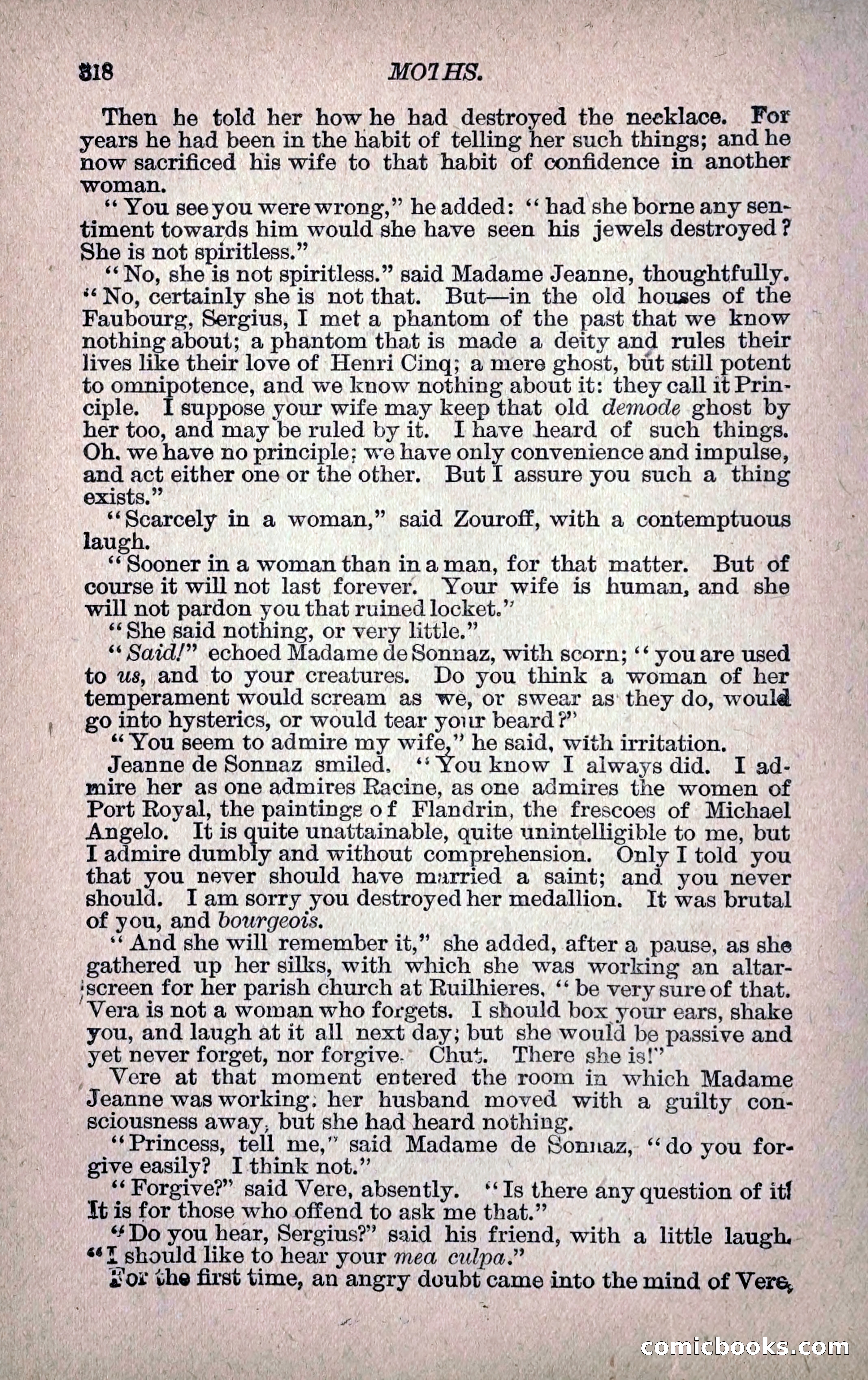
318 _ MOTHS. Then he told her how he had destroyed the necklace. For years he had been in the habit of telling her such things; and he now sacrificed his wife to that habit of confidence in another woman. ‘* You see you were wrong,” headded: ‘‘ had she borne any sen- timent towards him would she have seen his jewels destroyed ? She is not spiritless.” ‘<'No, she is not spiritless.” said Madame Jeanne, thoughtfully. ‘*No, certainly she is not that. But—in the old houses of the Faubourg, Sergius, I met a phantom of the past that we know nothing about; a phantom that is made a deity and rules their lives like their love of Henri Cing; a mere ghost, but still potent to omnipotence, and we know nothing about it: they call it Prin- ciple. I suppose your wife may keep that old demode ghost by her too, and may be ruled by it. Ihave heard of such things. Oh. we have no principle; we have only convenience and impulse, and act either one or the other. ButI assure you such a thing exists.” he aa ad in a woman,” said Zouroff, with a contemptuous augh. ; ae Sooner in a woman than ina man, for that matter. But of course it will not last forever. Your wife is human, and she will not pardon you that ruined locket.” «* She said nothing, or very little.” “Said!” echoed Madame de Sonnaz, with scorn; ‘‘ you are used to us, and to your creatures. Do you think a woman of her temperament would scream as we, or swear as’ they do, would go into hysterics, or would tear your beard ?”’ «You seem to admire my wife,” he said, with irritation. Jeanne de Sonnaz smiled. ‘You know I always did. I ad- mire her as one admires Racine, as one admires the women of Port Royal, the paintings of Flandrin, the frescoes of Michael Angelo. It is quite unattainable, quite unintelligible to me, but I admire dumbly and without comprehension. Only I told you that you never should have married a saint; and you never should. I am sorry you destroyed her medallion. It was brutal of you, and bourgeois. ‘** And she will remember it,” she added, after a pause, as she gathered up her silks, with which she was working an altar- _iscreen for her parish church at Ruilhieres, ‘‘ be very sure of that. Vera is not a woman who forgets. I should box your ears, shake you, and laugh at it all next day; but she would be passive and yet never forget, nor forgive. Chut. There she is!” _. Vere at that moment entered the room in which Madame Jeanne was working: her husband moved with a guilty con- sciousness away, but she had heard nothing. ‘*Princess, tell me,” said Madame de Sonnaz, ‘‘do you for- give easily? I think not.’ ‘‘ Forgive?” said Vere, absently. ‘‘Is there any question of itf tt is for those who offend to ask me that.” ‘**Do you hear, Sergius?” said his friend, with a little laugh. «¢T should like to hear your mea culpa.” 20x the first time, an angry doubt came into the mind of Vere, ~ ac , = (e(@) \ ¥e - chooks (E(@) A Ca >> e we) . ~~