
Penny Dreadfuls, 1900 · page 246 of 398
Moths by Ouida — page 246: what you’re looking at
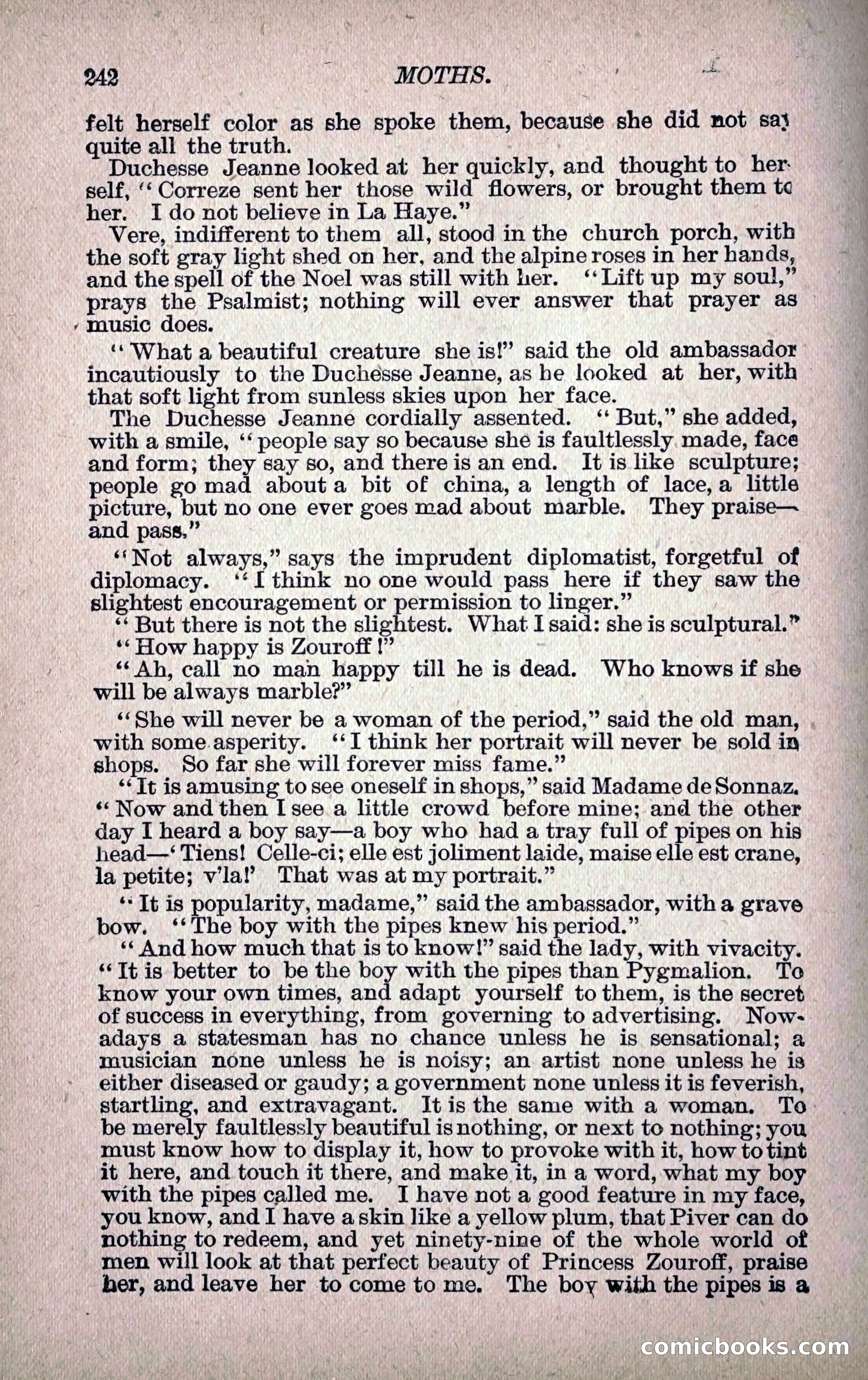
A restored page from Penny Dreadfuls, 1900. Page through the whole issue in the reader above.
📄 Transcribed text from this page (OCR, searchable)
Machine-transcribed from the original scan — historical spelling and the odd misread are preserved.
949 ; MOTHS. 5 Ve 4 felt herself color as she spoke them, because she did not sai quite all the truth. Duchesse Jeanne looked at her quickly, and thought to her. self, ‘‘Correze sent her those wild flowers, or brought them t¢ her. Ido not believe in La Haye.” Vere, indifferent to them all, stood in the church porch, with the soft gray light shed on her, and the alpine roses in her hands, and the spell of the Noel was still with her. ‘Lift up my soul,” prays the Psalmist; nothing will ever answer that prayer as © music does. ‘What a beautiful creature she is!” said the old ambassador incautiously to the Ducheésse Jeanne, as he looked at her, with that soft light from sunless skies upon her face. The Duchesse Jeanne cordially assented. ‘‘ But,” she added, with a smile, ‘‘ people say so because she is faultlessly, made, face and form; they say so, and thereis anend. Itis like sculpture; people go mad abouta bit of china, a length of lace, a little picture, but no one ever goes mad about marble. They praise— and pass.” ‘‘Not always,” says the imprudent diplomatist, forgetful of diplomacy. ‘‘I think no one would pass here if they saw the slightest encouragement or permission to linger.” ‘¢ But there is not the slightest. What I said: she is sculptural.” ‘¢ How happy is Zouroff !” ‘* Ah, call no man happy till he is dead. Who knows if she will be always marble?’ ‘‘She will never be a woman of the period,” said the old man, , with some.asperity. ‘‘I think her portrait will never be sold in shops. So far she will forever miss fame.” ‘‘It is amusing to see oneself in shops,” said Madame de Sonnaz. ‘¢Now and then [see a little crowd before mine; and the other day I heard a boy say—a boy who had a tray full of pipes on his head—‘ Tiens! Celle-ci; elle est joliment laide, maise elle est crane, la petite; vila!’ That was at my portrait.” ‘* It is popularity, madame,” said the ambassador, witha grave bow. ‘‘The boy with the pipes knew his period.” ‘‘ And how much that is to know!” said the lady, with vivacity. ‘‘Tt is better to be the boy with the pipes than Pygmalion. To know your own times, and adapt yourself to them, is the secret of success in everything, from governing to advertising. Now: adays a statesman has no chance unless he is sensational; a musician none unless he is noisy; an artist none unless he is either diseased or gaudy; a government none unless it is feverish, startling, and extravagant. Itis the same with a woman. To be merely faultlessly beautiful is nothing, or next to nothing; you must know how to display it, how to provoke with it, how to tint it here, and touch it there, and make it, in a word, what my boy with the pipes called me. I have not a good feature in my face, you know, and I have askin like a yellow plum, that Piver can do nothing to redeem, and yet ninety-nine of the whole world of men will look at that perfect beauty of Princess Zouroff, praise her, and leave her to come tome. The boy with the pipes is a mM f ~ €omicbooks.ca . : PY : ‘t }! - 4 . Mi oi), ate