
Penny Dreadfuls, 1900 · page 233 of 398
Moths by Ouida — page 233: what you’re looking at
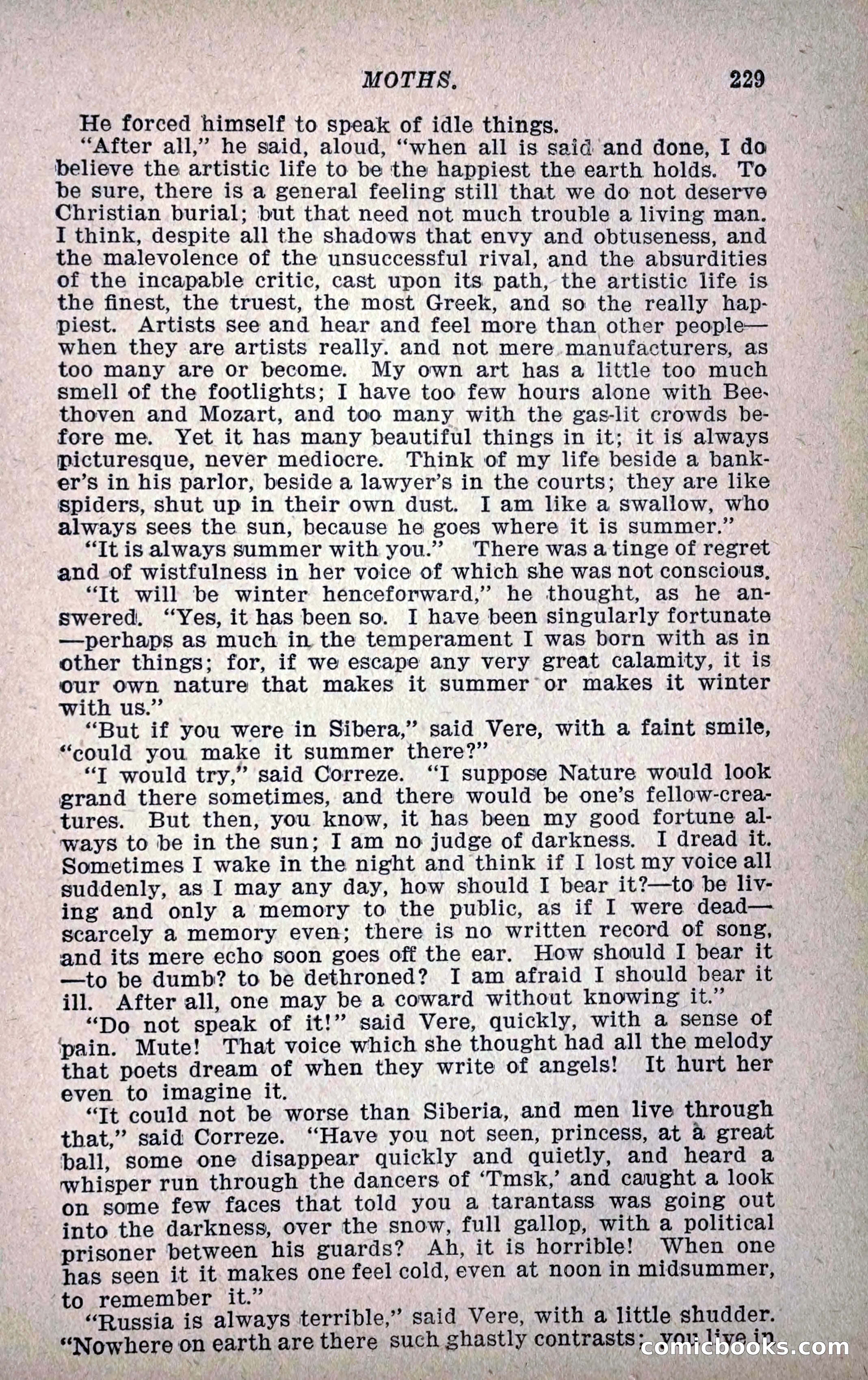
A restored page from Penny Dreadfuls, 1900. Page through the whole issue in the reader above.
📄 Transcribed text from this page (OCR, searchable)
Machine-transcribed from the original scan — historical spelling and the odd misread are preserved.
MOTHS, : 929 He forced himself to speak of idle things. “After all,” he said, aloud, “when all is said and done, I do believe the artistic life to be the happiest the earth holds. To be sure, there is a general feeling still that we do not deserve Christian burial; but that need not much trouble a living man. I think, despite all the shadows that envy and obtuseness, and the malevolence of the unsuccessful rival, and the absurdities of the incapable critic, cast upon its path, the artistic life is the finest, the truest, the most Greek, and so the really hap- piest. Artists see and hear and feel more than other people— when they are artists really. and not mere manufacturers, as too many are or become. My own art has a little too much smell of the footlights; I have too few hours alone with Bee. thoven and Mozart, and too many with the gas-lit crowds be- fore me. Yet it has many beautiful things in it; it is always picturesque, never mediocre. Think of my life beside a bank- er’s in his parlor, beside a lawyer’s in the courts; they are like spiders, shut up in their own dust. I am like a swallow, who always sees the sun, because he goes where it is Summer,” “Itis always summer with you.” ‘There was a tinge of regret and of wistfulness in her voice of which she was not conscious, “It will be winter henceforward,” he thought, as he an- swered. “Yes, it has been so. I have been singularly fortunate —perhaps as much in the temperament I was born with as in other things; for, if we escape any very great calamity, it is our Own nature that makes it summer’or makes it winter with us.” “But if you were in Sibera,” said Vere, with a faint smile, “could you make it summer there?” “T would try,” said Correze. “I suppose Nature would look grand there sometimes, and there would be one’s fellow-crea- tures. But then, you know, it has been my good fortune al- “ways to be in the sun; I am no judge of darkness. I dread it. Sometimes I wake in the night and think if I lost my voice all suddenly, as I may any day, how should I bear it?—to be liv- ing and only a memory to the public, as if I were dead— scarcely a memory even; there is no written record of song, and its mere echo soon goes off the ear. How should I bear it —to be dumb? to be dethroned? I am afraid I should bear it ill. After all, one may be a coward without knowing Leste “Do not speak of it!” said Vere, quickly, with a sense of pain. Mute! That voice which she thought had all the melody that poets dream of when they write of angels! It hurt her even to imagine it. “Tt could not be worse than Siberia, and men live through that,” said Correze. “Have you not seen, princess, at a great ball, some one disappear quickly and quietly, and heard a whisper run through the dancers of “I'msk,’ and caught a look on some few faces that told you a tarantass was going out into the darkness, over the snow, full gallop, with a political prisoner between his guards? Ah, it is horrible! When one has seen it it makes one feel cold, even at noon in midsummer, remember it.” ueenaata is always terrible,” said Vere, with a little shudder. “Nowhere on earth are there such ghastly contrasts 4 - . 7 & we) UR Ah a ae gS, ithe, Wage ta ue vat