
Penny Dreadfuls, 1900 · page 231 of 398
Moths by Ouida — page 231: what you’re looking at
A restored page from Penny Dreadfuls, 1900. Page through the whole issue in the reader above.
📄 Transcribed text from this page (OCR, searchable)
Machine-transcribed from the original scan — historical spelling and the odd misread are preserved.
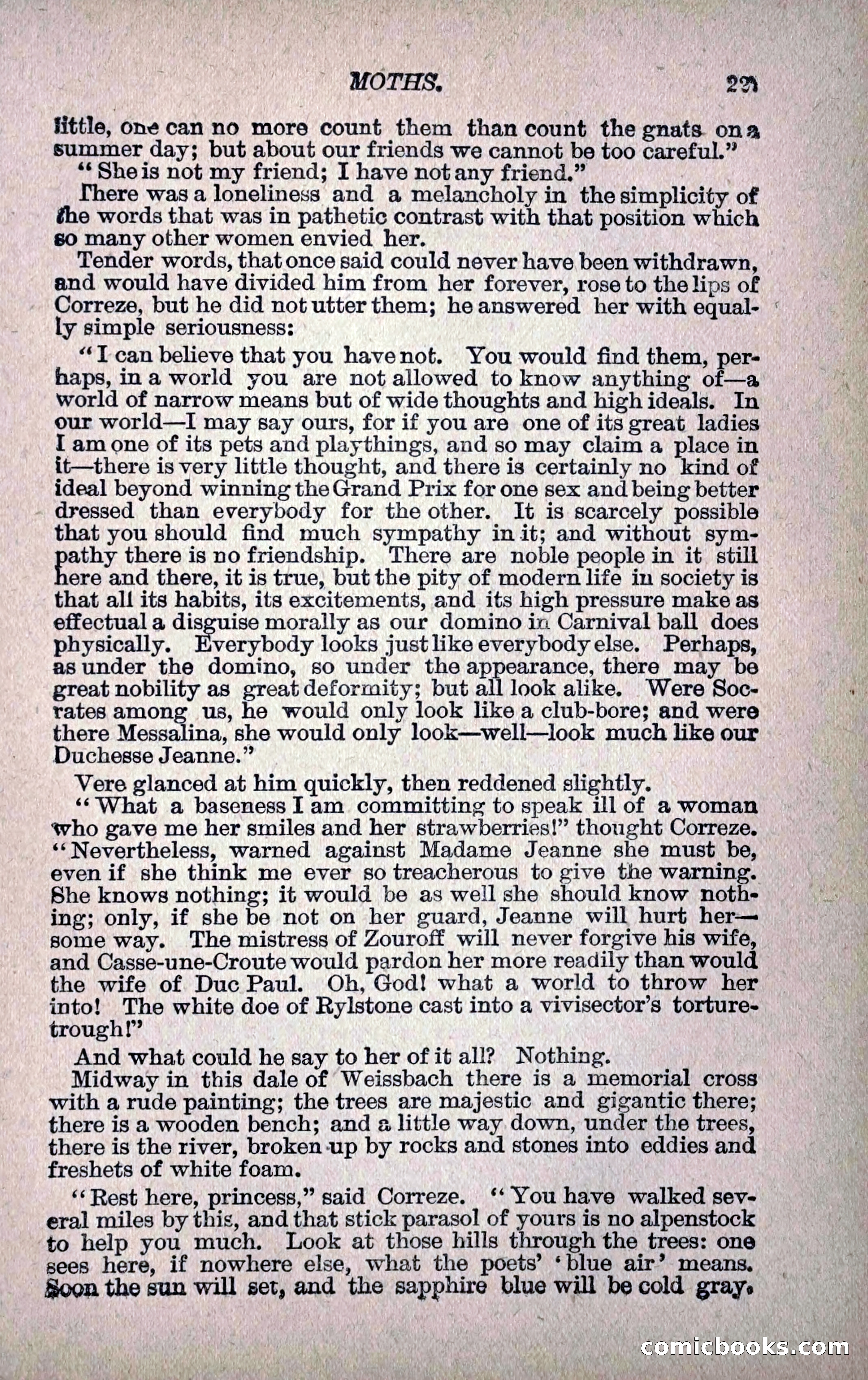
MOTHS. ee Som little, one can no more count them than count the gnats. ona Summer day; but about our friends we cannot be too careful.” **Sheis not my friend; I have notany friend.” There was a loneliness and a melancholy in the simplicity of the words that was in pathetic contrast with that position which s0 many other women envied her. Tender words, that once said could never have been withdrawn, and would have divided him from her forever, rose to the lips of Correze, but he did not utter them; he answered her with equal- : ly simple seriousness: “I can believe that you havenot. You would find them, per- haps, ina world you are not allowed to know anything of—a world of narrow means but of wide thoughts and high ideals. In our world—lIl may say ours, for if you are one of its great ladies I am one of its pets and playthings, and so may claim a place in it—there is very little thought, and there is certainly no kind of ideal beyond winning the Grand Prix for one sex and being better dressed than everybody for the other. It is scarcely possible that you should find much sympathy init; and without sym- peachy there is no friendship. There are noble people in it still ere and there, it is true, but the pity of modern life in society is that all its habits, its excitements, and its high pressure make as effectual a disguise morally as our domino in Carnival ball does physically. Everybody looks just like everybodyelse. Perhaps, asunder the domino, so under the appearance, there may be great nobility as great deformity; but all look alike. Were Soc- rates among us, he would only look like a club-bore; and were there Messalina, she would only look—well—look much like our Duchesse Jeanne.” Vere glanced at him quickly, then reddened slightly. ‘¢ What a baseness lam committing to speak ill of a woman who gave me her smiles and her strawberries!” thought Correze. ‘‘Nevertheless, warned against Madame Jeanne she must be, even if she think me ever so treacherous to give the warning. She knows nothing; it would be as well she should know noth- ing; only, if she be not on her guard, Jeanne will hurt her— some way. The mistress of Zouroff will never forgive his wife, and Casse-une-Croute would pardon her more readily than would the wife of Duc Paul. Oh, God! what a world to throw her into! The white doe of Rylstone cast into a vivisector’s torture- trough!” And what could he say to her of it all? Nothing. Midway in this dale of Weissbach there is a memorial cross with a rude painting; the trees are majestic and gigantic there; there is a wooden bench; and a little way down, under the trees, there is the river, broken -up by rocks and stones into eddies and freshets of white foam. ‘‘Rest here, princess,” said Correze. ‘‘ You have walked sev- eral miles by this, and that stick parasol of yours is no alpenstock to help you much. Look at those hills through the trees: one sees here, if nowhere else, what the poets’ ‘blue air’ means. Soon the sun will set, and the sapphire blue will be cold gray. Ccomicboo Rre \ ' "4 Aled 8s ie iM