
Penny Dreadfuls, 1900 · page 226 of 398
Moths by Ouida — page 226: what you’re looking at
A restored page from Penny Dreadfuls, 1900. Page through the whole issue in the reader above.
📄 Transcribed text from this page (OCR, searchable)
Machine-transcribed from the original scan — historical spelling and the odd misread are preserved.
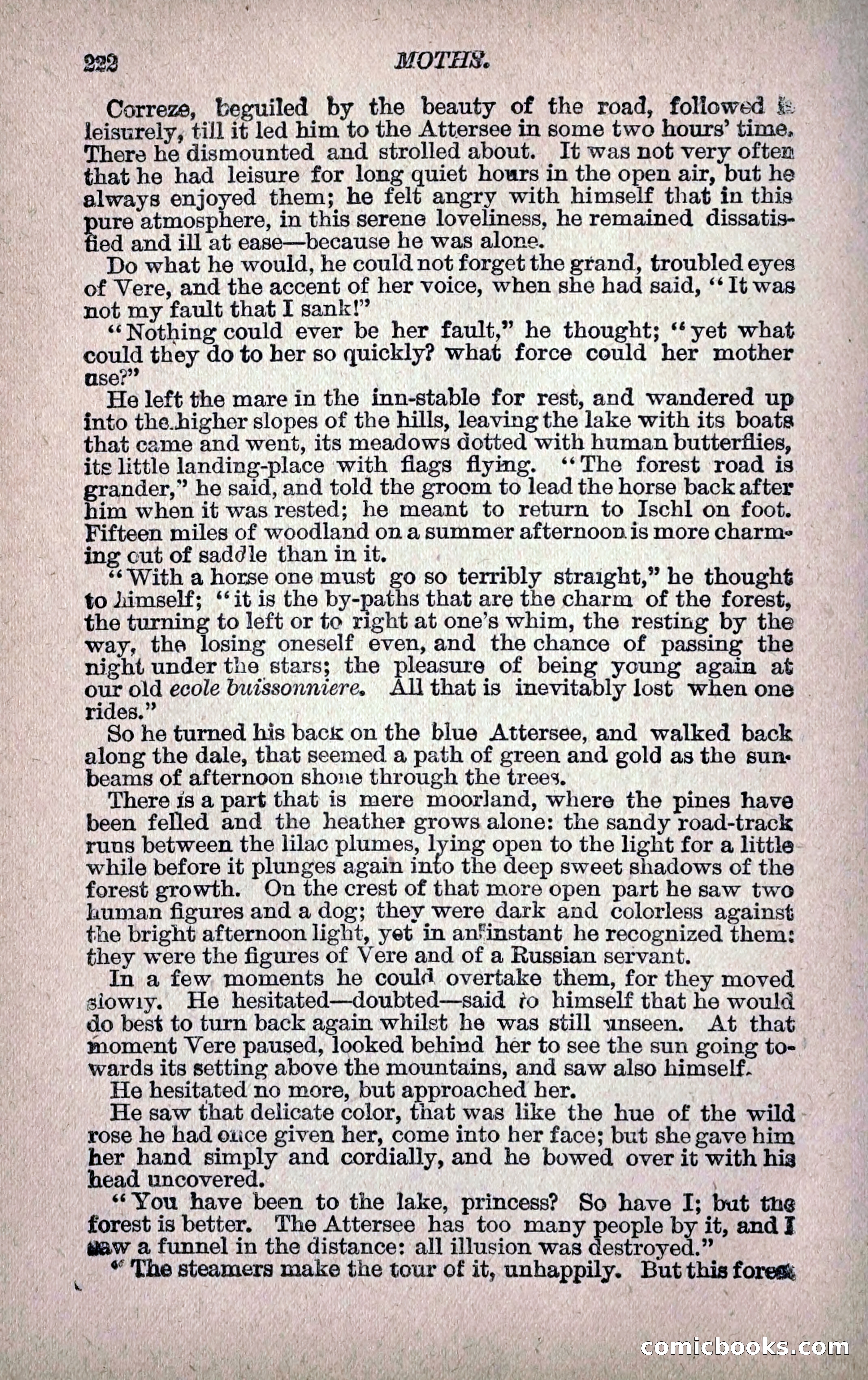
929 MOTHS. Correze, beguiled by the beauty of the road, followed & leisurely, till it led him to the Attersee in some two hours’ time, There he dismounted and strolled about. It was not very often that he had leisure for long quiet hours in the open air, but he always enjoyed them; he felt angry with himself that in this ure atmosphere, in this serene loveliness, he remained dissatis- fied and ill at ease—because he was alone. Do what he would, he could not forget the grand, troubled eyes of Vere, and the accent of her voice, when she had said, ‘‘ It was not my fault that I sank!” ‘¢ Nothing could ever be her fault,” he thought; ‘* yet what could they do to her so quickly? what force could her mother use?” He left the mare in the inn-stable for rest, and wandered up into the.higher slopes of the hills, leaving the lake with its boats that came and went, its meadows dotted with human butterflies, its little landing-place with flags flymg. ‘‘The forest road is grander,” he said, and told the groom to lead the horse back after him when it was rested; he meant to return to Ischl on foot. Fifteen miles of woodland on a summer afternoon is more charme — ing out of saddle than in it. ‘¢ With a horse one must go so terribly straight,” he thought to himself; ‘‘it is the by-paths that are the charm of the forest, the turning to left or to right at one’s whim, the resting by the way, the losing oneself even, and the chance of passing the night under the stars; the pleasure of being young again at our old ecole buissonniere. All thatis inevitably lost when one | rides.” So he turned his back on the blue Attersee, and walked back along the dale, that seemed a path of green and gold as the suns beams of afternoon shone through the trees. There is a part that is mere moorland, where the pines have been felled and the heather grows alone: the sandy road-track ruus between the lilac plumes, lying open to the light for a little while before it plunges again into the deep sweet shadows of the forest growth. On the crest of that more open part he saw two human figures and a dog; they were dark and colorless against the bright afternoon light, yet in an‘instant he recognized them: they were the figures of Vere and of a Russian servant. In a few moments he could overtake them, for they moved siow1y. He hesitated—doubted—said to himself that he would do best to turn back again whilst he was still unseen. At that moment Vere paused, looked behind her to see the sun going to- wards its setting above the mountains, and saw also himself. He hesitated no more, but approached her. He saw that delicate color, that was like the hue of the wild - rose he had otice given her, come into her face; but she gave him her hand simply and cordially, and he bowed over it with his head uncovered. ‘*You have been to the lake, princess? So have I; but the forest is better. The Attersee has too many people by it, and J gaw a funnel in the distance: all illusion was destroyed.” * The steamers make the tour of it, unhappily. But this fores: (EO) nm (C 100 CS. EO