
Penny Dreadfuls, 1900 · page 222 of 398
Moths by Ouida — page 222: what you’re looking at
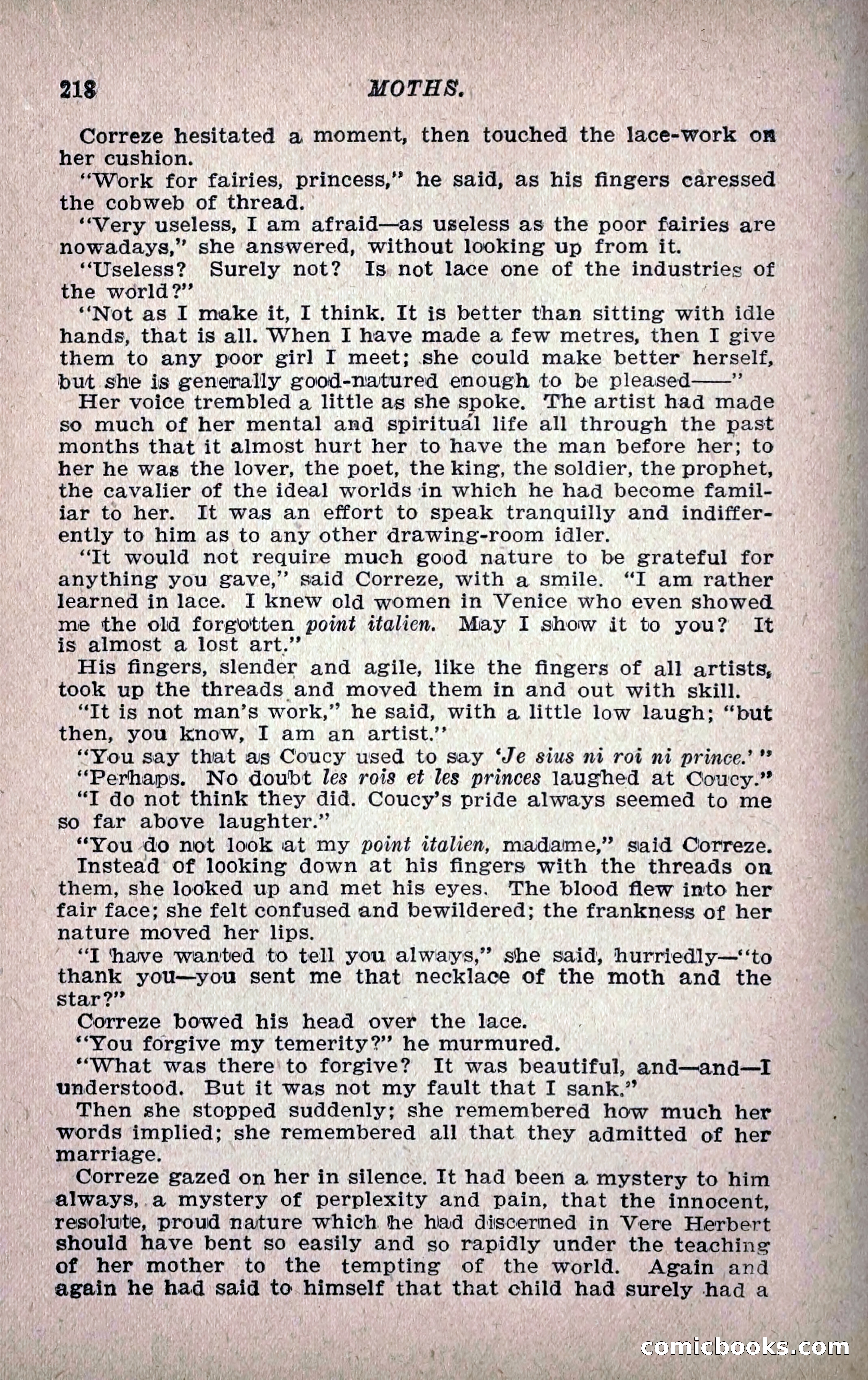
A restored page from Penny Dreadfuls, 1900. Page through the whole issue in the reader above.
📄 Transcribed text from this page (OCR, searchable)
Machine-transcribed from the original scan — historical spelling and the odd misread are preserved.
218 | MOTHS. Correze hesitated a moment, then touched the lace-work on her cushion. ‘Work for fairies, princess,” he said, as his fingers caressed the cobweb of thread. ‘‘Very useless, I am afraid—as useless as the poor fairies are nowadays,” she answered, without looking up from it. ‘Useless? Surely not? Is not lace one of the industries of the world?’’ ‘‘Not as I make it, I think. It is better than sitting with idle hands, that is all. When I have made a few metres, then I give them to any poor girl I meet; she could make better herself, but she is generally good-natured enough to be pleased——”’ Her voice trembled a little as she spoke, The artist had made so much of her mental and spiritual life all through the past months that it almost hurt her to have the man before her; to her he was the lover, the poet, the king, the soldier, the prophet, the cavalier of the ideal worlds in which he had become famil- iar to her. It was an effort to speak tranquilly and indiffer- ently to him as to any other drawing-room idler. “It would not require much good nature to be grateful for anything you gave,’ said Correze, with a smile. “I am rather learned in lace. I Knew old women in Venice who even showed me the old forgotten poimt italien. May I show it to you? It is almost a lost art.’ His fingers, slender and agile, like the fingers of all artists, took up the threads and moved them in and out with skill. “Tt is not man’s work,” he said, with a little low laugh: “but then, you know, I am an artist.’’ “You say that as Coucy used to say ‘Je sius ni rot ni prince.’ ” “Perhaps. No doubt les rois et les princes laughed at Coucy.” “T do not think they did. Coucy’s pride always seemed to me so far above laughter.” “You do not look at my point italien, madame,” said Correze. Instead of looking down at his fingers with the threads on them, she looked up and met his eyes. The blood flew into her fair face; she felt confused and bewildered; the frankness of her nature moved her lips. “IT ‘have wanted to tell you always,” she said, hurriedly—‘‘to thank you—you sent me that necklace of the moth and the star?” ) Correze bowed his head over the lace. “You forgive my temerity?’ he murmured. ‘‘What was thereto forgive? It was beautiful, and—and—I understood. But it was not my fault that I sank,” Then she stopped suddenly; she remembered how much her words implied; she remembered all that they admitted of her marriage. Correze gazed on her in silence. It had been a mystery to him always,.a mystery of perplexity and pain, that the innocent, resolute, proud nature which he hiad discerned in Vere Herbert should have bent so easily and so rapidly under the teaching of her mother to the tempting of the world. Again and again he had said te himself that that child had surely had a | comicbooks com