
Penny Dreadfuls, 1900 · page 211 of 398
Moths by Ouida — page 211: what you’re looking at
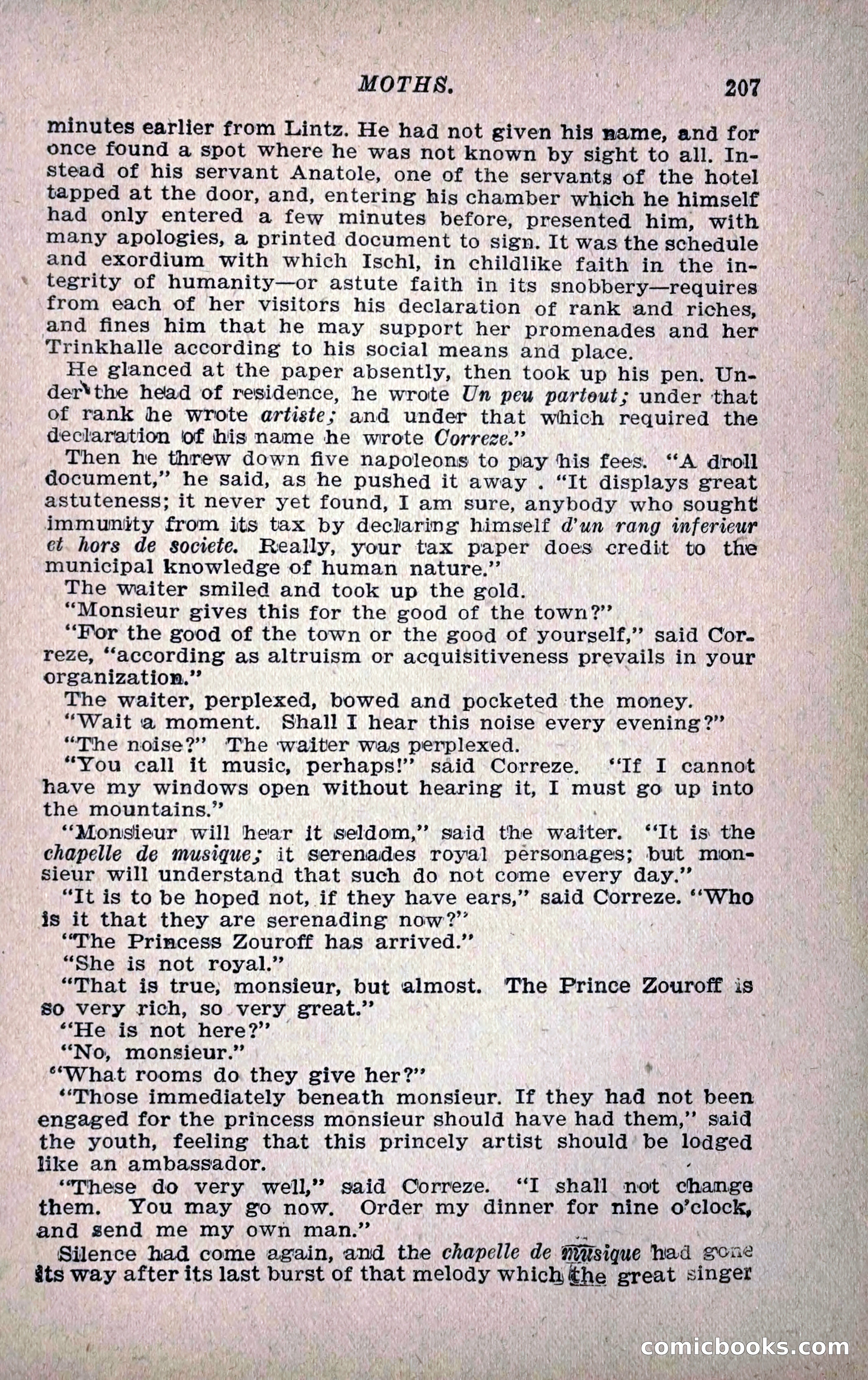
A restored page from Penny Dreadfuls, 1900. Page through the whole issue in the reader above.
📄 Transcribed text from this page (OCR, searchable)
Machine-transcribed from the original scan — historical spelling and the odd misread are preserved.
MOTHS. ee 207 minutes earlier from Lintz. He had not given his name, and for once found a spot where he was not known by sight to all. In- stead of his servant Anatole, one of the servants of the hotel tapped at the door, and, entering his chamber which he himself had only entered a few minutes before, presented him, with many apologies, a printed document to sign. It was the schedule and exordium with which Ischl, in childlike faith in the in- tegrity of humanity—or astute faith in its snobbery—requires from each of her visitors his declaration of rank and riches, and fines him that he may support her promenades and her Trinkhalle according to his social means and place. fie glanced at the paper absently, then took up his pen, Un- der‘the head of residence, he wrote Un peu parteut; under that of rank he wrote artiste; and under that which required the declaration of his name he wrote Correze.’’ Then he threw down five napoleons to pay his fees. ‘“‘A droll document,” he said, as he pushed it away . “It displays great astuteness; it never yet found, I am sure, anybody who sought immunity from its tax by declaring himself d’un rang inferieur et. hors de societe. Really, your tax paper does credit to the municipal knowledge of human nature.,’’ The waiter smiled and took up the gold. “Monsieur gives this for the good of the town?” “For the good of the town or the good of yourself,” said Cor. reze, “according as altruism or acquisitiveness prevails in your organization.’’ The waiter, perplexed, bowed and pocketed the money. “Wait amoment. Shall I hear this noise every evening?” “The noise?’ The waiter was perplexed. “You call it music, perhaps!’ said Correze. ‘If I cannot have my windows open without hearing it, I must go up into the mountains.”’ “Monsieur will hear it seldom,” said the waiter. ‘‘It is the chapelle de musique; it serenades royal personages; but mon- Sieur will understand that such do not come every day.’’ “It is to be hoped not, if they have ears,” said Correze. ‘‘Who is it that they are serenading now?”’’ | “The Princess Zouroff has arrived.”’ | “She is not royal.’ “That is true; monsieur, but almost. The Prince Zouroff is $0 very rich, so very great.”’ ‘‘He is not here?’ “No, monsieur.”’ *“‘What rooms do they give her?’’ ‘‘Those immediately beneath monsieur. If they had not been engaged for the princess monsieur should have had them,” said the youth, feeling that this princely artist should be lodged like an ambassador. , ‘These do very well,” said Correze. “I shall not change them. You may go now. Order my dinner for nine o’clock, and send me my own man.” “t | Silence had come again, and the chapelle de nisique had gone sts way after its last burst of that melody whichthe great singer 4, com t a ; “Eom J ~! Wh! ae Vs Ww) 4) Re é - : : ri ; 900ks her a “4 yoy ,, er | Pat: re & vei ' iy e : i > ot nh, al