
Penny Dreadfuls, 1900 · page 188 of 398
Moths by Ouida — page 188: what you’re looking at
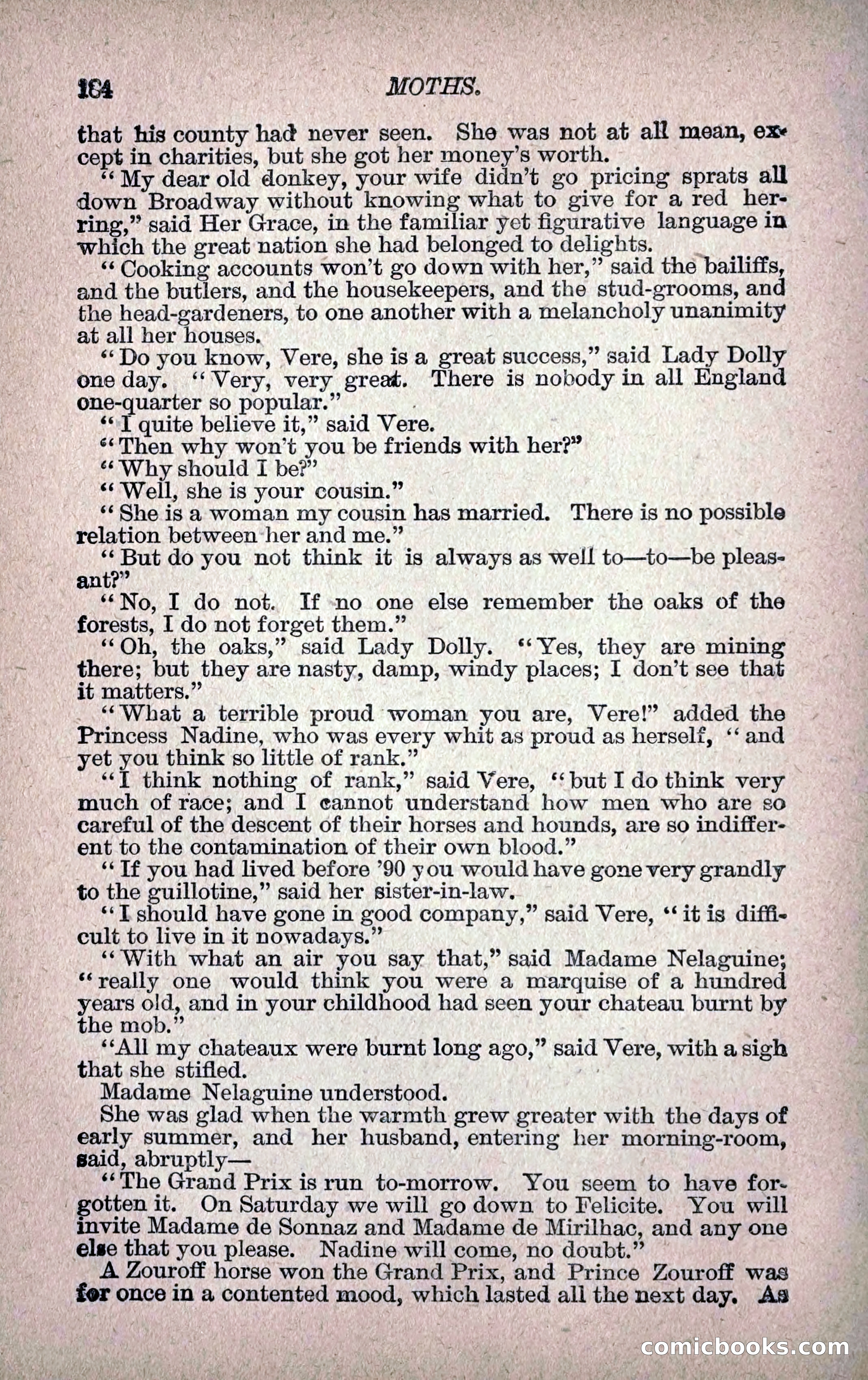
A restored page from Penny Dreadfuls, 1900. Page through the whole issue in the reader above.
📄 Transcribed text from this page (OCR, searchable)
Machine-transcribed from the original scan — historical spelling and the odd misread are preserved.
164 MOTHS. | that his county had never seen. She was not at all mean, exe cept in charities, but she got her money’s worth. _ _ My dear old donkey, your wife didn’t go pricing sprats all down Broadway without knowing what to give for a red her- ring,” said Her Grace, in the familiar yet figurative language in which the great nation she had belonged to delights. ak ‘¢ Cooking accounts won’t go down with her,” said the bailiffs, and the butlers, and the housekeepers, and the stud-grooms, and the head-gardeners, to one another with a melancholy unanimity at all her houses, ‘‘Do you know, Vere, she is a great success,” said Lady Dolly one day. ‘‘ Very, very greaté. There is nobody in all England one-quarter so popular.” , ‘*] quite believe it,” said Vere. ‘«*Then why won’t you be friends with her?” ¢¢Why should I be?” ‘‘ Well, she is your cousin.” ‘‘ She is a woman my cousin has married. There is no possible relation between her and me.” i But do you not think it is always as well to—to—be pleas- ant?’ ‘*No, I do not. If no one else remember the oaks of the forests, I do not forget them.” “Oh, the oaks,” said Lady Dolly. ‘‘ Yes, they are mining there; but they are nasty, damp, windy places; I don’t see that it matters.” _. “What a terrible proud woman you are, Vere!” added the Princess Nadine, who was every whit as proud as herself, ‘‘ and yet you think so little of rank.” “1 think nothing of rank,” said Vere, ‘‘ but I do think very much of race; and I eannot understand how men who are so careful of the descent of their horses and hounds, are so indiffer- ent to the contamination of their own blood.” ‘Tf you had lived before ’90 you would have gone very grandly to the guillotine,” said her sister-in-law. *‘T should have gone in good company,” said Vere, ‘*‘it is diffi- cult to live in it nowadays.” “With what an air you say that,” said Madame Nelaguine; ‘really one would think you were a marquise of a hundred years old, and in your childhood had seen your chateau burnt by the mob.” : ‘‘All my chateaux were burnt long ago,” said Vere, with a sigh that she stifled. : Madame Nelaguine understood. _ She was glad when the warmth grew greater with the days of early summer, and her husband, entering her morning-room, said, abruptly — ‘The Grand Prix is run to-morrow. You seem to have for- otten it. On Saturday we will go down to Felicite. You will invite Madame de Sonnaz and Madame de Mirilhac, and any one — else that you please. Nadine will come, no doubt.” A Zouroff horse won the Grand Prix, and Prince Zouroff was for once in a contented mood, which lasted all the next day. As ' -GOMIEE 200KS (ef o)]