
Penny Dreadfuls, 1900 · page 179 of 398
Moths by Ouida — page 179: what you’re looking at
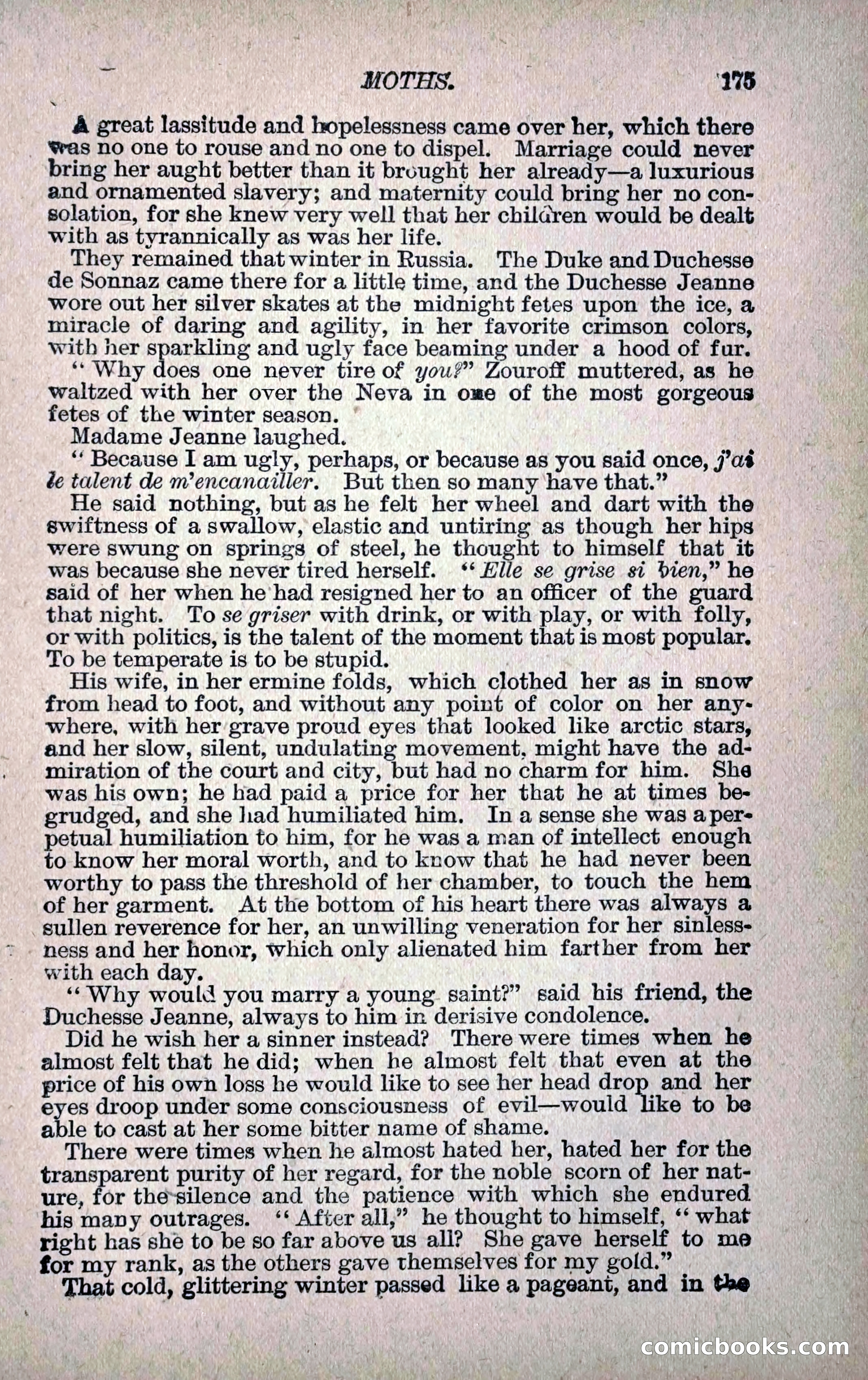
A restored page from Penny Dreadfuls, 1900. Page through the whole issue in the reader above.
📄 Transcribed text from this page (OCR, searchable)
Machine-transcribed from the original scan — historical spelling and the odd misread are preserved.
i" | MOTHS. | 1% A great lassitude and hopelessness came over her, which there _ ¥ras no one to rouse and. no one to dispel. Marriage could never bring her aught better than it brought her already—a luxurious and ornamented slavery; and maternity could bring her no con-. solation, for she knew very well that her chilaren would be dealt with as tyrannically as was her life. They remained that winter in Russia. The Duke and Duchesse de Sonnaz came there for a little time, and the Duchesse Jeanne wore out her silver skates at the midnight fetes upon the ice, a miracle of daring and agility, in her favorite crimson colors, with her sparkling and ugly face beaming under a hood of fur. ‘‘ Why does one never tire of you?” Zouroff muttered, as he waltzed with her over the Neva in ome of the most gorgeous fetes of the winter season. Madame Jeanne laughed. “‘ Because I am ugly, perhaps, or because as you said once, 7’a% ée talent de m’encanailler. But then so many have that.” He said nothing, but as he felt her wheel and dart with the swiftness of a swallow, elastic and untiring as though her hips were swung on springs of steel, he thought to himself that it was because she never tired herself. ‘* Hille se grise si Dien,” he said of her when he'‘had resigned her to an officer of the guard that night. To se griser with drink, or with play, or with folly, or with politics, is the talent of the moment that is most popular, To be temperate is to be stupid. His wife, in her ermine folds, which clothed her as in snow from head to foot, and without any point of color on her any- where, with her grave proud eyes that looked like arctic stars, and her slow, silent, undulating movement, might have the ad- miration of the court and city, but had no charm for him. She was his own; he had paid a price for her that he at times be- grudged, and she had humiliated him. In asense she was apers petual humiliation to him, for he was a man of intellect enough to know her moral worth, and to know that he had never been worthy to pass the threshold of her chamber, to touch the hem of her garment. At the bottom of his heart there was always a sullen reverence for her, an unwilling veneration for her sinless- ness and her honor, which only alienated him farther from her with each day. Yi toes ‘‘Why would you marry a young. saint?” said his friend, the Duchesse Jeanne, always to him in derisive condolence. Did he wish her a sinner instead? There were times when he almost felt that he did; when he almost felt that even at the price of his own loss he would like to see her head edt and her eyes droop under some consciousness of evil—would like to be able to cast at her some bitter name of shame. There were times when he almost hated her, hated her for the transparent purity of her regard, for the noble scorn of her nat- ure, for the-silence and the patience with which she endured his many outrages. ‘‘ After all,” he thought to himself, ‘‘ what right has she to be so far above us all? She gave herself to me for my rank, as the others gave themselves for my gold.” That cold, glittering winter passed like a pageant, and in the (S J Ecomichoo (Eo)