
Penny Dreadfuls, 1900 · page 176 of 398
Moths by Ouida — page 176: what you’re looking at
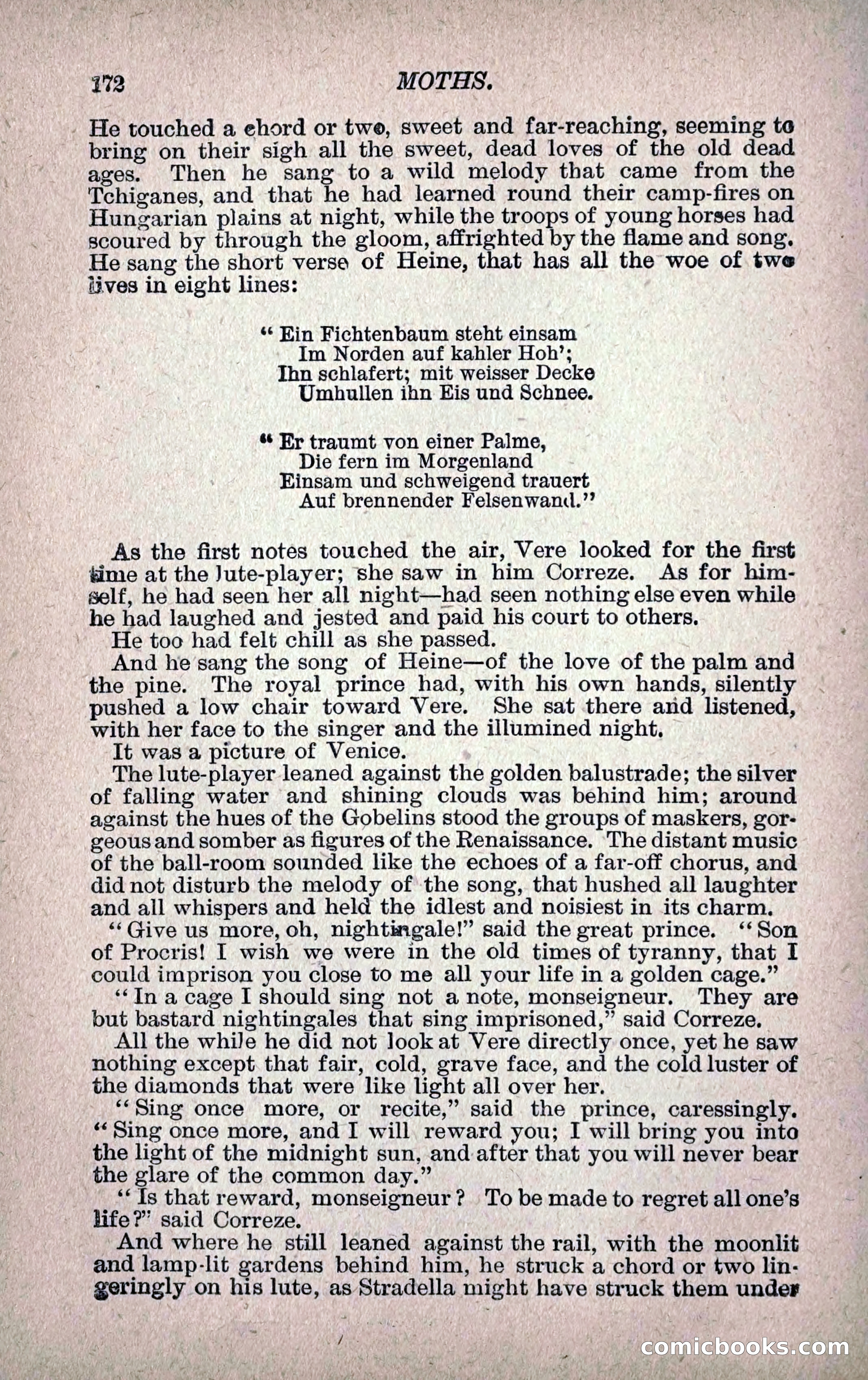
A restored page from Penny Dreadfuls, 1900. Page through the whole issue in the reader above.
📄 Transcribed text from this page (OCR, searchable)
Machine-transcribed from the original scan — historical spelling and the odd misread are preserved.
1%2 MOTHS. _ He touched a chord or two, sweet and far-reaching, seeming te bring on their sigh all the sweet, dead loves of the old dead. ages. Then he sang to a wild melody that came from the Tchiganes, and that he had learned round their camp-fires on Hungarian plains at night, while the troops of young horses had scoured by through the gloom, affrighted by the flame and song, He sang the short verse of Heine, that has all the woe of twe lives in eight lines: ‘‘ Kin Fichtenbaum steht einsam Im Norden auf kahler Hoh’; Ihn schlafert; mit weisser Decke Umbullen ihn Eis und Schnee. Er traumt von einer Palme, Die fern im Morgenland Einsam und schweigend trauert Auf brennender Felsenwani.”’ As the first notes touched the air, Vere looked for the first time at the Jute-player; she saw in him Correze. As for him- self, he had seen her all night—had seen nothing else even while he had laughed and jested and paid his court to others, He too had felt chill as she passed. And he’sang the song of Heine—of the love of the palm and the pine. The royal prince had, with his own hands, silently pushed a low chair toward Vere. She sat there and listened, with her face to the singer and the illumined night, It was a picture of Venice. | The lute-player leaned against the golden balustrade; the silver of falling water and shining clouds was behind him; around against the hues of the Gobelins stood the groups of maskers, gor- geousand somber as figures of the Renaissance. The distant music of the ball-room sounded like the echoes of a far-off chorus, and did not disturb the melody of the song, that hushed all laughter and all whispers and held the idlest and noisiest in its charm. ‘‘Give us more, oh, nightingale!” said the great prince. ‘*Son of Procris! I wish we were in the old times of tyranny, that I could imprison you close to me all your life in a golden cage.” ‘‘In a cage I should sing not a note, monseigneur. They are but bastard nightingales that sing imprisoned,” said Correze. All the while he did not Jookat Vere directly once, yet he saw nothing except. that fair, cold, grave face, and the cold luster of the diamonds that were like light all over her. ‘‘Sing once more, or recite,” said the prince, caressingly. “Sing once more, and I will reward you; I will bring you into the light of the midnight sun, and after that you will never bear the glare of the common day.” | ‘‘ Is that reward, monseigneur? To be made to regret all one’s life?’ said Correze. And where he still leaned against the rail, with the moonlit and lamp-lit gardens behind him, he struck a chord or two lin: geringly on his lute, as Stradella might have struck them under Ue Aye a (eo) mi Ebooks. co ‘a