
Penny Dreadfuls, 1900 · page 173 of 398
Moths by Ouida — page 173: what you’re looking at
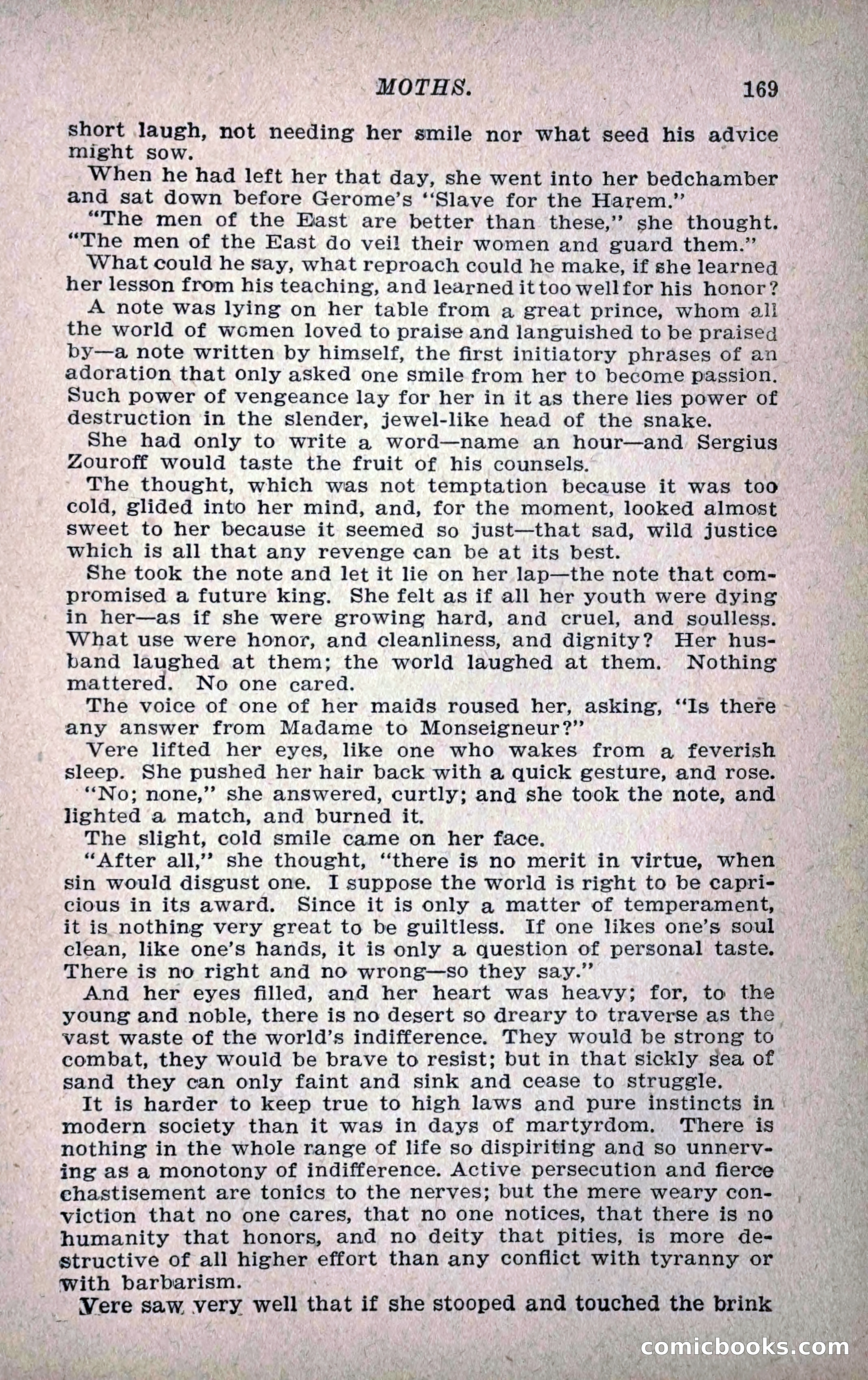
A restored page from Penny Dreadfuls, 1900. Page through the whole issue in the reader above.
📄 Transcribed text from this page (OCR, searchable)
Machine-transcribed from the original scan — historical spelling and the odd misread are preserved.
MOTHS. : | 169 short laugh, not needing her smile nor what seed his advice might sow. When he had left her that day, she went into her bedchamber and sat down before Gerome’s ‘‘Slave for the Harem.’’ “The men of the Hast are better than these,” she thought. “The men of the East do veil their women and guard them.” What could he say, what reproach could he make, if she learned her lesson from his teaching, and learned it too wellfor his honor? A note was lying on her table from a great prince, whom all the world of women loved to praise and languished to be praised by—a note written by himself, the first initiatory phrases of an adoration that only asked one smile from her to become passion. Such power of vengeance lay for her in it as there lies power of destruction in the slender, jewel-like head of the snake. She had only to write a word—name an hour—and Sergius Zouroff would taste the fruit of his counsels. The thought, which was not temptation because it was too cold, glided into her mind, and, for the moment, looked almost sweet to her because it seemed so just—that sad, wild justice which is all that any revenge can be at its best. She took the note and let it lie on her lap—the note that com- promised a future king. She felt as if all her youth were dying in her—as if she were growing hard, and cruel, and soulless. What use were honor, and cleanliness, and dignity? Her hus- band laughed at them; the world laughed at them. Nothing mattered. No one cared. The voice of one of her maids roused her, asking, “‘Is there - any answer from Madame to Monseigneur?”’ Vere lifted her eyes, like one who wakes from a feverish sleep. She pushed her hair back with a quick gesture, and rose. “No; none,’”’ she answered, curtly; and she took the note, and lighted a match, and burned it. The slight, cold smile came on her face. “After all,’’ she thought, ‘‘there is no merit in virtue, when Sin would disgust one. I suppose the world is right to be capri- cious in its award. Since it is only a matter of temperament, it is nothing very great to be guiltless. If one likes one’s soul clean, like one’s hands, it is only a question of personal taste. There is no right and no wrong—so they say.” And her eyes filled, and her heart was heavy; for, to the young and noble, there is no desert so dreary to traverse as the vast waste of the world’s indifference. They would be strong to combat, they would be brave to resist; but in that sickly sea of sand they can only faint and sink and cease to struggle. It is harder to keep true to high laws and pure instincts in | modern society than it was in days of martyrdom. ‘There is nothing in the whole range of life so dispiriting and so unnery- ing as a monotony of indifference. Active persecution and fierce ehastisement are tonics to the nerves; but the mere weary con- viction that no one cares, that no one notices, that there is no humanity that honors, and no deity that pities, is more de- structive of all higher effort than any conflict hint tyranny or with barbarism. . Were saw, very well that if she stooped and esecned the brink comic 200 (S.Ct op ; tere Hy aha MD: