
Penny Dreadfuls, 1900 · page 167 of 398
Moths by Ouida — page 167: what you’re looking at
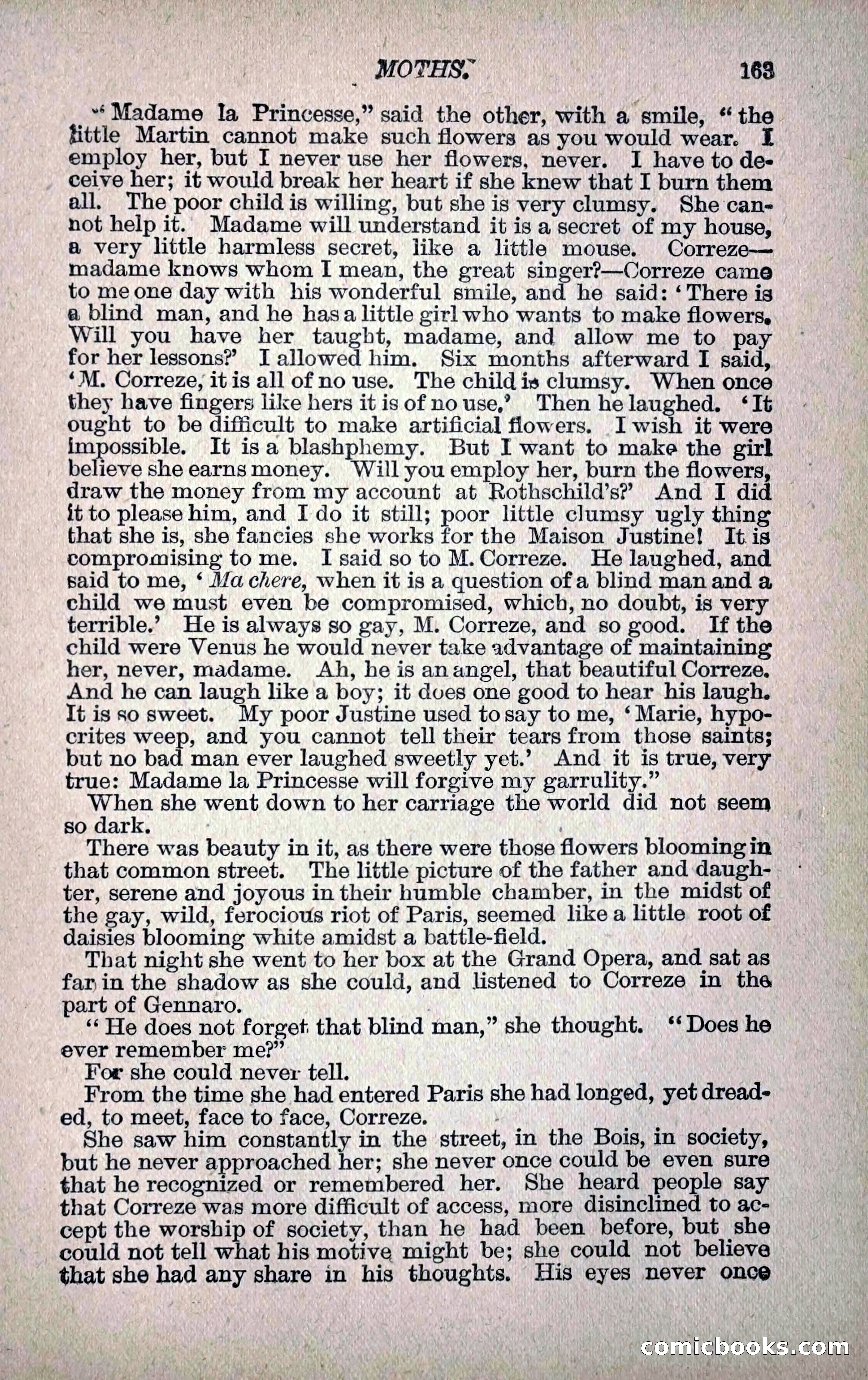
A restored page from Penny Dreadfuls, 1900. Page through the whole issue in the reader above.
📄 Transcribed text from this page (OCR, searchable)
Machine-transcribed from the original scan — historical spelling and the odd misread are preserved.
_ MOTHS, 168 “Madame la Princesse,” said the other, with a smile, “ the. tittle Martin cannot make such flowers as you would wear. employ her, but I never use her flowers, never. I have to de- ceive her; it would break her heart if she knew that I burn them all. The poor child is willing, but she is very clumsy. She can- not help it. Madame will understand it is a secret of my house, a very little harmless secret, like a little mouse. Correze— madame knows whom I mean, the great singer?—Correze came to meone day with his wonderful smile, and he said: ‘ There is a blind man, and he hasalittle girl who wants to make flowers, Will you have her taught, madame, and allow me to pay for her lessons?’ LIallowed him. Six months afterward I said, ‘M. Correze, itis allofno use. The childis clumsy. When once they have fingers like hers itisofnouse,? Then helaughed. ‘It ought to be difficult to make artificial flowers. I wish it were impossible. It isa blashphemy. But I want to make the girl believe she earnsmoney. Will you employ her, burn the flowers, draw the money from my account at Rothschild’s? And I did it to please him, and I do it still; poor little clumsy ugly thing that she is, she fancies she works for the Maison Justine! It is compromising tome. I said so to M.Correze. He laughed, and said to me, ‘ Ma chere, when it is a question ofa blind man and a child we must even be compromised, which, no doubt, is very terrible.’ He is always so gay, M. Correze, and so good. If the child were Venus he would never take advantage of maintaining her, never, madame. Ah, he is anangel, that beautiful Correze. And he can laugh like a boy; it dues one good to hear his laugh. It is so sweet. My poor Justine used tosay to me, ‘ Marie, hypo- crites weep, and you cannot tell their tears from those saints; but no bad man ever laughed sweetly yet.’ And it is true, very true: Madame la Princesse will forgive my garrulity.” When she went down to her carriage the world did not seem so dark. | There was beauty in it, as there were those flowers blooming in that common street. The little picture of the father and daugh- ter, serene and joyous in their humble chamber, in the midst of the gay, wild, ferocious riot of Paris, seemed like a little root of daisies blooming white amidst a battle-field. That night she went to her box at the Grand Opera, and sat as far in the shadow as she could, and listened to Correze in the part of Gennaro. ‘He does not forget that blind man, * she thought. ‘‘ Does he ever remember me?” For she could never tell. From the time she had entered Paris she had longed, yet dread- ed, to meet, face to face, Correze. th Bae She saw him constantly in the street, in the Bois, in society, but he never approached her; she never once could be even sure that he recognized or remembered her. She heard people say that Correze was more difficult of access, more disinclined to ac- cept the worship of society, than he had been before, but she could not tell what his motive might be; she could not believe that she had any share in his thoughts. His eyes never once comicbooks co , an! vy ’ laid i Lae