
Penny Dreadfuls, 1900 · page 163 of 398
Moths by Ouida — page 163: what you’re looking at
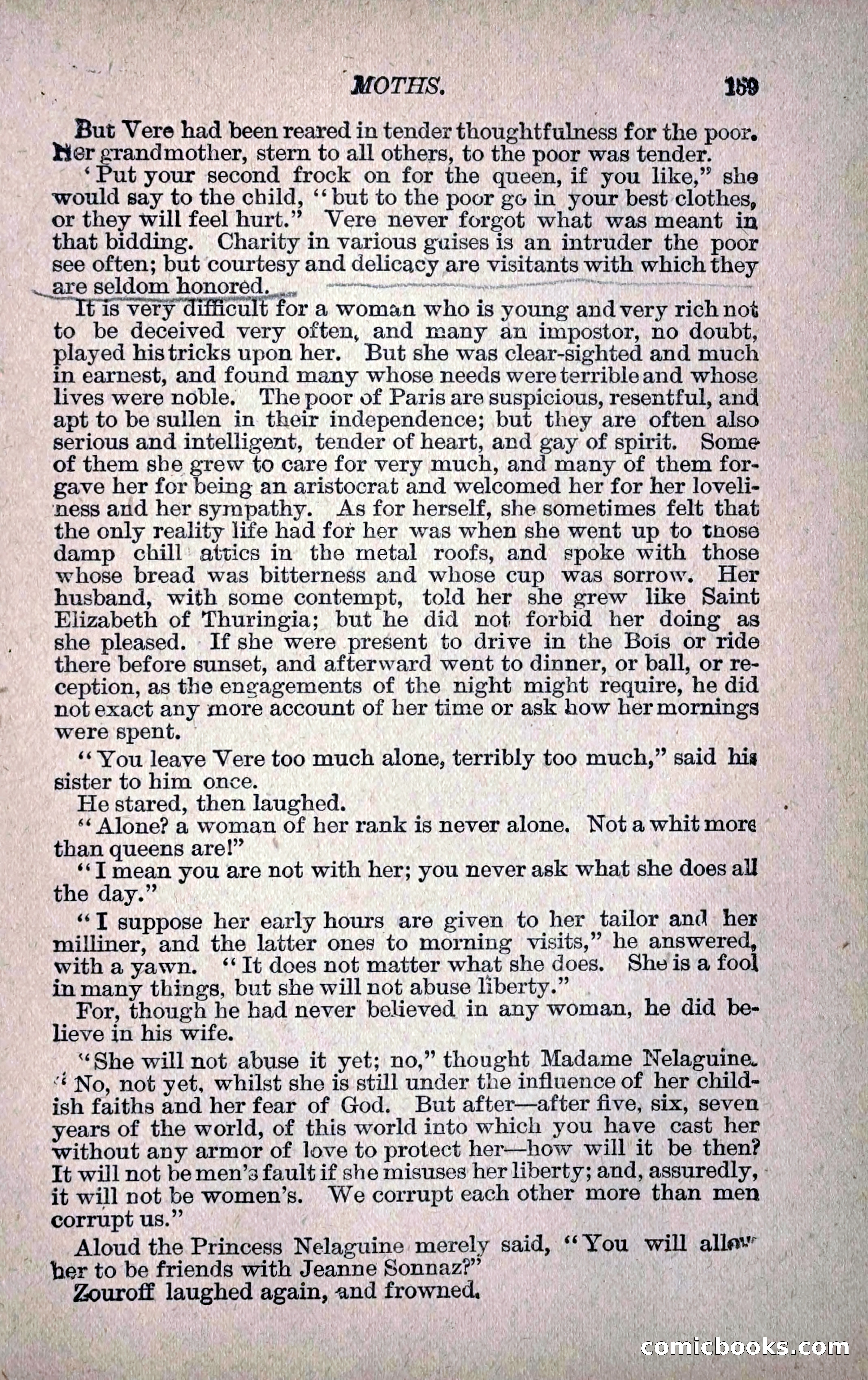
A restored page from Penny Dreadfuls, 1900. Page through the whole issue in the reader above.
📄 Transcribed text from this page (OCR, searchable)
Machine-transcribed from the original scan — historical spelling and the odd misread are preserved.
| MOTHS. 159 But Vere had been reared in tender thoughtfulness for the poor. er grandmother, stern to all others, to the poor was tender. ‘Put your second frock on for the queen, if you like,” she would say to the child, ‘‘ but to the poor go in your best clothes, or they will feel hurt.” Vere never forgot what was meant in that bidding. Charity in various guises is an intruder the poor see often; but courtesy and delicacy are visitants with which they It is very ditiicult for a woman who is young and very rich not to be deceived very often, and many an impostor, no doubt, played histricks upon her. But she was clear-sighted and much in earnest, and found many whose needs were terrible and whose lives were noble. The poor of Paris are suspicious, resentful, and apt to be sullen in their independence; but they are often also serious and intelligent, tender of heart, and gay of spirit. Some of them she grew to care for very much, and many of them for- gave her for being an aristocrat and welcomed her for her loveli- ness and her sympathy. As for herself, she sometimes felt that the only reality life had for her was when she went up to those damp chill’ attics in the metal roofs, and spoke with those whose bread was bitterness and whose cup was sorrow. Her husband, with some contempt, told her she grew like Saint Elizabeth of Thuringia; but he did not forbid her doing as she pleased. If she were present to drive in the Bois or ride there before sunset, and afterward went to dinner, or ball, or re- ception, as the engagements of the night might require, he did not exact any more account of her time or ask how her mornings were spent, — : : ‘¢You leave Vere too much alone, terribly too much,” said hig sister to him once. He stared, then laughed. ‘¢ AJone? a woman of her rank is never alone. Not a whit more than queens are!” ‘‘T mean you are not with her; you never ask what she does all the day.” ‘‘T suppose her early hours are given to her tailor and her milliner, and the latter ones to morning visits,” he answered, with a yawn. ‘‘It does not matter what she does. She is a fool in many things, but she will not abuse liberty.” For, though he had never believed in any woman, he did be- lieve in his wife. _ “She will not abuse it yet; no,” thought Madame Nelaguine. ‘© No, not yet, whilst she is still under the influence of her child- ish faiths and her fear of God. But after—after five, six, seven years of the world, of this world into which you have cast her without any armor of love to protect her—how will’ it be then? It will not be men’s fault if she misuses her liberty; and, assuredly, - it will not be women’s. We corrupt each other more than men corrupt us.” Aloud the Princess Nelaguine merely said, ‘You will alle - her to be friends with Jeanne Sonnaz?”’ | Zouroft laughed again, and frowned, ‘Ss =) - ‘ = : rr (e(e) | ) vt “ 3 45%) hy’. : | + te ® > i a> 4 br ih ir | as K