
Penny Dreadfuls, 1895 · page 31 of 150
The King of the School, or, Who will Win? — page 31: what you’re looking at
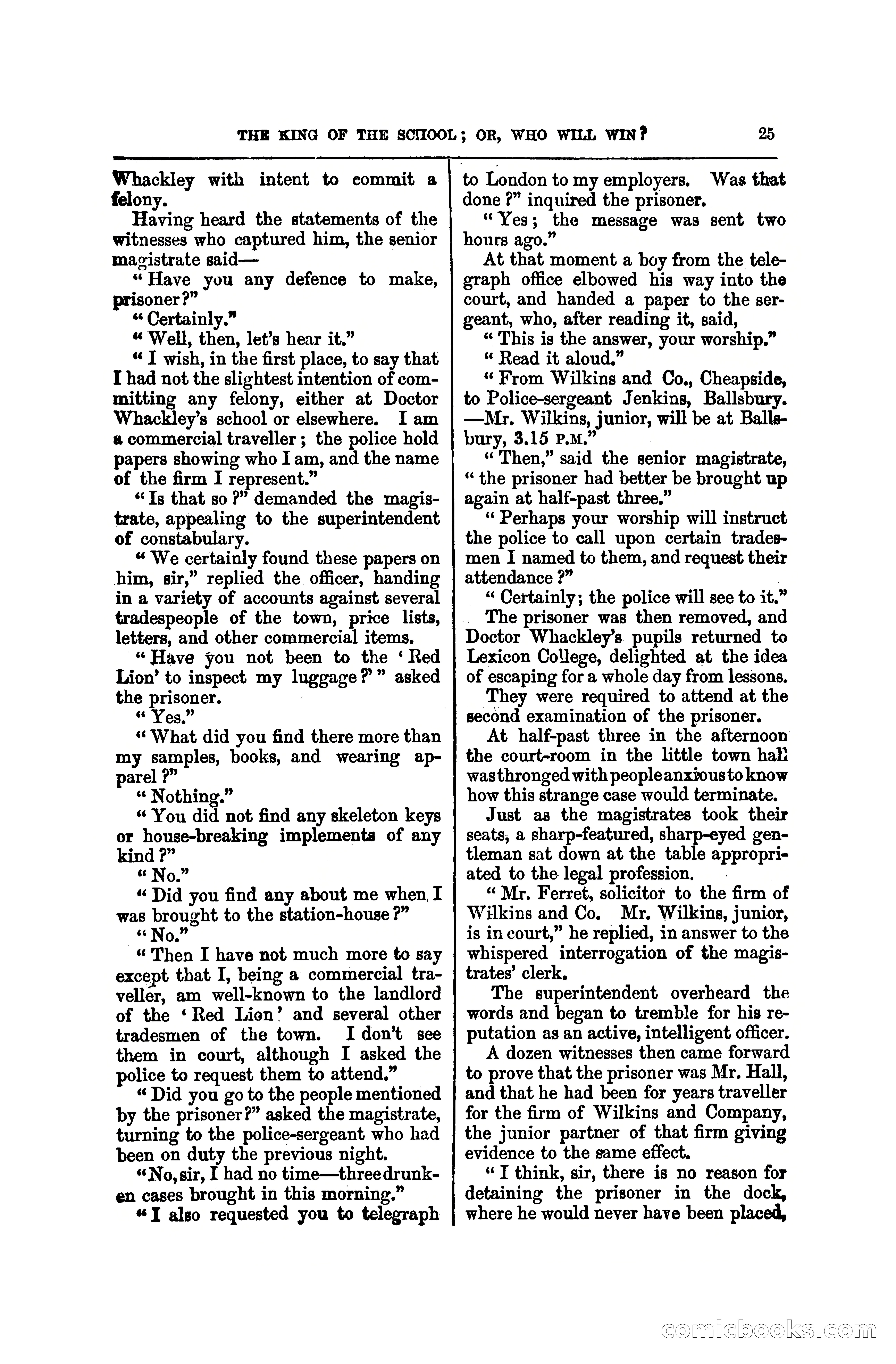
A restored page from Penny Dreadfuls, 1895. Page through the whole issue in the reader above.
📄 Transcribed text from this page (OCR, searchable)
Machine-transcribed from the original scan — historical spelling and the odd misread are preserved.
THE KING OF THE SCIIOOL; OR, WHO WILL WIN? Whackley with intent to commit a felony. Having heard the statements of the witnesses who captured him, the senior mavcistrate said— “Have you any defence to make, prisoner?” “ Certainly.” “ Well, then, let’s hear it.” ‘I wish, in the first place, to say that I had not the slightest intention of com- mitting any felony, either at Doctor Whackley’s school or elsewhere. I am a commercial traveller ; the police hold papers showing who I am, and the name of the firm I represent.” “Ts that so?” demanded the magis- trate, appealing to the superintendent of constabulary. “We certainly found these papers on him, sir,” replied the officer, handing in a variety of accounts against several tradespeople of the town, price lists, letters, and other commercial items, “ Have you not been to the ‘ Red Lion’ to inspect my luggage?” asked the prisoner. : “ Yes,” “What did you find there more than my samples, books, and wearing ap- parel ?” “ Nothing.” “ You did not find any skeleton keys or house-breaking implements of any kind ?” | “ No.” | “ Did you find any about me when I was brought to the station-house ?” “No.” | “Then I have not much more to say except that I, being a commercial tra- veller, am well-known to the landlord of the ‘Red Lion’ and several other tradesmen of the town. I don’t see them in court, although I asked the police to request them to attend.” “Did you go to the people mentioned by the prisoner?” asked the magistrate, turning to the police-sergeant who had been on duty the previous night. “No, sir, I had no time—threedrunk- en cases brought in this morning.” “T also requested you to telegraph 20 to London to my employers. Was that done ?” inquired the prisoner. “Yes; the message was sent two hours ago.” At that moment a boy from the tele- graph office elbowed his way into the court, and handed a paper to the ser- geant, who, after reading it, said, “ This is the answer, your worship.” “ Read it aloud.” “From Wilkins and Co., Cheapside, to Police-sergeant Jenkins, Ballsbury. —Mr, Wilkins, junior, will be at Balls- bury, 3.15 P.M.” | “Then,” said the senior magistrate, “the prisoner had better be brought up again at half-past three.” | “ Perhaps your worship will instruct the police to call upon certain trades- men I named to them, and request their attendance ?” | _ “Certainly; the police will see to it.” . The prisoner was then removed, and Doctor Whackley’s. pupils returned to Lexicon College, delighted at the idea of escaping for a whole day from lessons. _ They were required to attend at the second examination of the prisoner. At half-past three in the afternoon the court-room in the little town hak wasthronged with peopleanxtousto know how this strange case would terminate. Just as the magistrates took their seats, a sharp-featured, sharp-eyed gen- tleman sat down at the table appropri- ated to the legal profession. | “Mr, Ferret, solicitor to the firm of Wilkins and Co. Mr. Wilkins, junior, is in court,” he replied, in answer to the whispered interrogation of the magis- trates’ clerk. The superintendent overheard the words and began to tremble for his re- putation as an active, intelligent officer. A dozen witnesses then came forward to prove that the prisoner was Mr. Hall, and that he had been for years traveller for the firm of Wilkins and Company, the junior partner of that firm giving evidence to the same effect. “7 think, sir, there is no reason for detaining the prisoner in the dock, where he would never have been placed, EO DOC EO mn