
Penny Dreadfuls, 1900 · page 22 of 38
Marion Marlowe's True Heart, or, How a Daughter Forgave — page 22: what you’re looking at
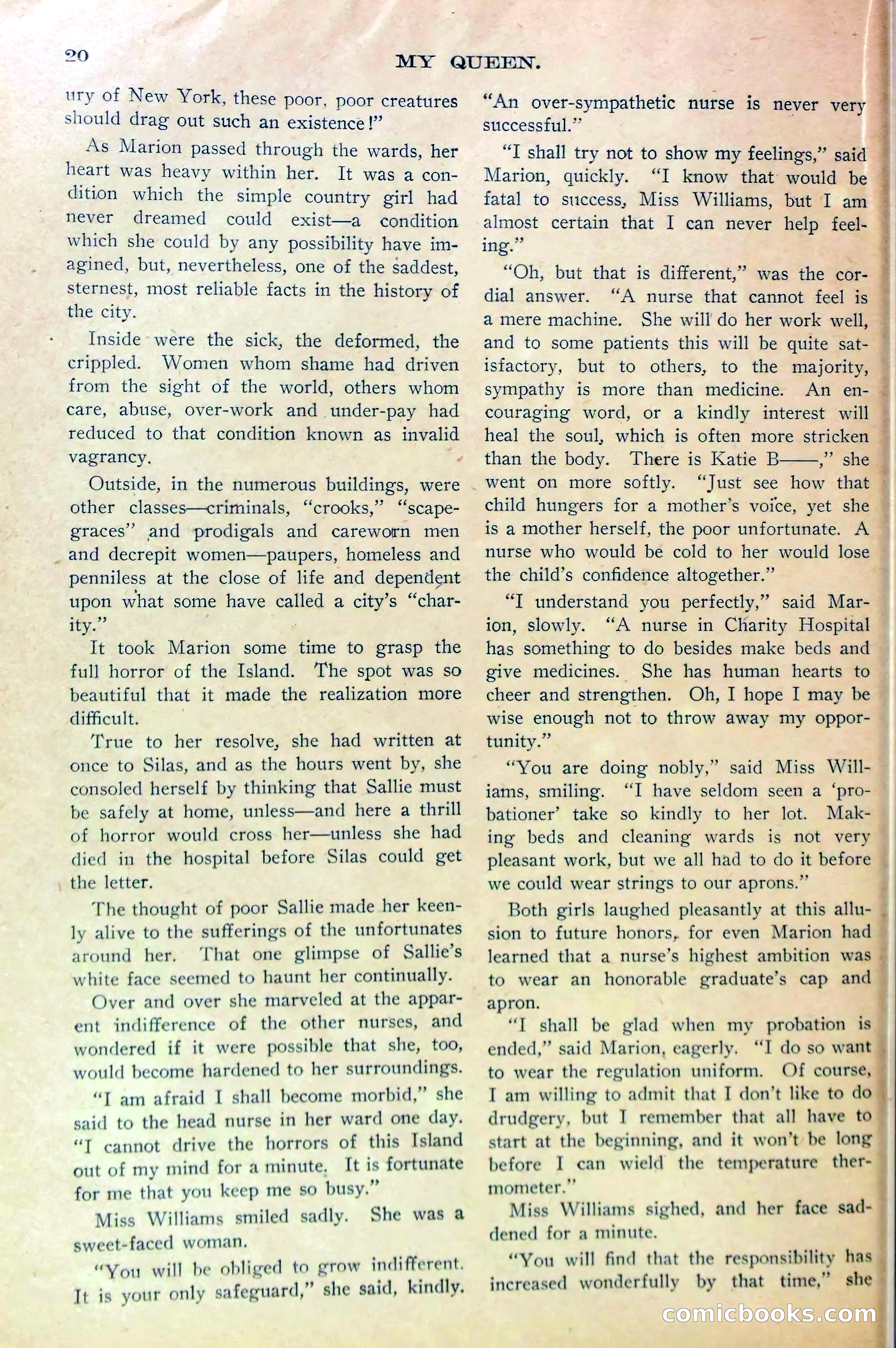
A restored page from Penny Dreadfuls, 1900. Page through the whole issue in the reader above.
📄 Transcribed text from this page (OCR, searchable)
Machine-transcribed from the original scan — historical spelling and the odd misread are preserved.
20 ry of New York, these poor, poor creatures should drag out such an existence!” As Marion passed through the wards, her heart was heavy within her. It was a con- dition which the simple country girl had never dreamed could exist—a _ condition which she could by any possibility have im- agined, but, nevertheless, one of the saddest, sternest, most reliable facts in the history of the city. Inside were the sick, the deformed, the crippled. Women whom shame had driven from the sight of the world, others whom care, abuse, over-work and under-pay had reduced to that condition known as invalid vagrancy, : Outside, in the numerous buildings, were other classes—criminals, “crooks,” “scape- graces’ and prodigals and careworn men _and decrepit women—paupers, homeless and penniless at the close of life and dependent upon what some have called a city’s “char- ity.” . It took Marion some time to grasp the full horror of the Island. The spot was so beautiful that it made the realization more difficult. | True to her resolve, she had written at once to Silas, and as the hours went by, she consoled herself by thinking that Sallie must be safely at home, unless—and here a thrill of horror would cross her—unless she had died in the hospital before Silas could get the letter. The thought of poor Sallie made her keen- ly alive to the sufferings of the unfortunates around her, That one glimpse of Sallie’s white face seemed to haunt her continually. Over and over she marveled at the appar- ent indifference of the other nurses, and wondered if it were possible that she, too, would become hardened to her surroundings. “T am afraid I shall become morbid,” she said to the head nurse in her ward one day. “T cannot drive the horrors of this Island out of my mind for a minute, It is fortunate for me that you keep me so busy.” Miss Williams smiled sadly. She was a sweet-faced woman, “Vou will be obliged to grow indifferent. It is your only safeguard,” she said, kindly. MY QUEEN. “An over-sympathetic nurse is never very successful.” “I shall try not to show my feelings,” said Marion, quickly. “I know that would be fatal to success, Miss Williams, but I am — almost certain that I can never help feel-— ing.” “Oh, but that is different,” was the cor- dial answer. “A nurse that cannot feel is a mere machine. She will do her work well, — and to some patients this will be quite sat- isfactory, but to others, to the majority, sympathy is more than medicine. An en- | couraging word, or a kindly interest will heal the soul, which is often more stricken than the body. There is Katie B , she went on more softly. “Just see how that child hungers for a mother’s voice, yet she is a mother herself, the poor unfortunate. A nurse who would be cold to her would lose — the child’s confidence altogether.” “T understand you perfectly,” said Mar- ion, slowly. “A nurse in Charity Hospital — has something to do besides make beds and give medicines. She has human hearts to | cheer and strengthen. Oh, I hope I may be | wise enough not to throw away my oppor- tunity.” “You are doing nobly,” said Miss Will- iams, smiling. “I have seldom seen a ‘pro- — bationer’ take so kindly to her lot. Mak- ing beds and cleaning wards is not very pleasant work, but we all had to do it before { we could wear strings to our aprons.” : Both girls laughed pleasantly at this allu- sion to future honors, for even Marion had learned that a nurse’s highest ambition was to wear an honorable graduate’s cap and apron. “T shall be glad when my probation is — ended,” said Marion, eagerly, “I do so want to wear the regulation uniform. Of course, I am willing to admit that I don’t like to do drudgery, but I remember that all have to start at the beginning, and it won’t be long — before I can wield the temperature ther- mometer.”’ Miss Williams sighed, and her face sad- dened for a minute. “You will find that the responsibility has increased wonderfully by that time,” she Eomicbooks..com