
Penny Dreadfuls, 1900 · page 24 of 38
Marion Marlowe's Noble Work, or, The Tragedy at the Hospital — page 24: what you’re looking at
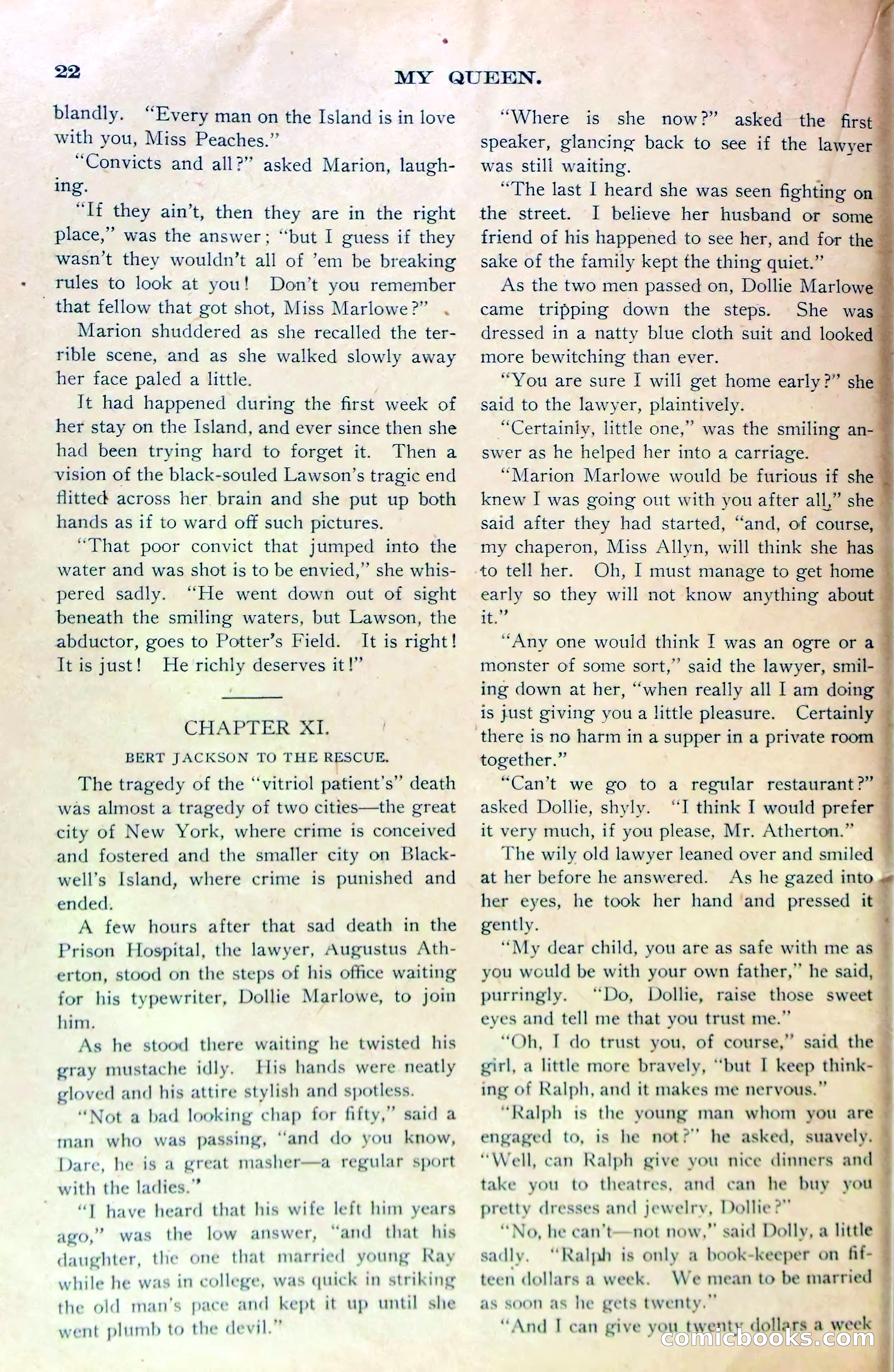
A restored page from Penny Dreadfuls, 1900. Page through the whole issue in the reader above.
📄 Transcribed text from this page (OCR, searchable)
Machine-transcribed from the original scan — historical spelling and the odd misread are preserved.
22 blandly. “Every man on the Island is in love with you, Miss Peaches.”’ “Convicts and all?” asked Marion, laugh- ing. “If they ain’t, then they are in the right place,” was the answer; “but I guess if they wasn't they wouldn’t all of ’em be breaking rules to look at you! Don’t you remember that fellow that got shot, Miss Marlowe?” Marion shuddered as she recalled the ter- rible scene, and as she walked slowly away her face paled a little. It had happened during the first week of her stay on the Island, and ever since then she had been trying hard to forget it. Then a vision of the black-souled Lawson’s tragic end flitted across her brain and she put up both hands as if to ward off such pictures. “That poor convict that jumped into the water and was shot is to be envied,” she whis- pered sadly. “He went down out of sight beneath the smiling waters, but Lawson, the abductor, goes to Potter’s Field. It is right! It is just! He richly deserves it!” CHAPTER XI, BERT JACKSON TO THE RESCUE. The tragedy of the “vitriol patient's” death was almost a tragedy of two cittes—the great city of New York, where crime is conceived and fostered and the smaller city on Black- well’s Island, where crime is punished and ended. A few hours after that sad death in the Prison Hospital, the lawyer, Augustus Ath- erton, stood on the steps of his office waiting for his typewriter, Dollie Marlowe, to join him. As he stood there waiting he twisted his gray mustache idly. His hands were neatly gloved and his attire stylish and spotless. “Not a bad looking chap for fifty,” said a tnan who was passing, “and do you know, a regular sport Dare, he is a great masher with the ladies.” ~ “T have heard that his wife left him years ago,’ was the low “and that his daughter, the one that married young Ray while he was in college, was quick in striking the old man’s pace and kept it up until she answer, went plumb to the devil.” MY QUEEN. -to tell her. ‘there is no harm in a supper in a private room “Where is she now?” asked the first speaker, glancing back to see if the lawyer was still waiting. | “The last I heard she was seen fighting on the street. I believe her husband or some friend of his happened to see her, and for the sake of the family kept the thing quiet.” As the two men passed on, Dollie Marlowe came tripping down the steps. She was dressed in a natty blue cloth suit and looked more bewitching than ever. “You are sure I will get home early?” she said to the lawyer, plaintively. | “Certainly, little one,” was the smiling an- swer as he helped her into a carriage. “Marion Marlowe would be furious if she knew I was going out with you after all,” she said after they had started, “and, of course, my chaperon, Miss Allyn, will think she has. Oh, I must manage to get home early so they will not know anything about i | ‘Any one would think I was an ogre or a monster of some sort,’’ said the lawyer, smil- ing down at her, “when really all | am doing is just giving you a little pleasure. Certainly together.” | “Can’t we go to a regular restaurant?” asked Dollie, shyly. “I think I would prefer it very much, if you please, Mr. Atherton.” The wily old lawyer leaned over and smiled at her before he answered. As he gazed into her eyes, he took her hand and pressed it gently. | ‘“My dear child, you are as safe with me as you would be with your own father,” he said, purringly. “Do, Dollie, raise those sweet. eyes and tell me that you trust me.” “Oh, I do trust you, of course,” said the girl, a little more bravely, “but I keep think- ing of Ralph, and it makes me neryous.” “Ralph is the young man whom you are engaged to, is he not?” he asked, suavely. “Well, can Ralph give you nice dinners and take you to theatres, and can he buy you pretty dresses and jewelry, Dollie?” ‘No, he can’t—not now,” said Dolly, a little sadly. “Ralph is only a book-keeper on fif- teen dollars a week. We mean to be married | as soon as he gets twenty.” “And I can give you.t wenty dollars. & weet —_