
Penny Dreadfuls, 1901 · page 23 of 38
Marion Marlowe on the Prairie, or, A Thrilling Ride Across Kansas — page 23: what you’re looking at
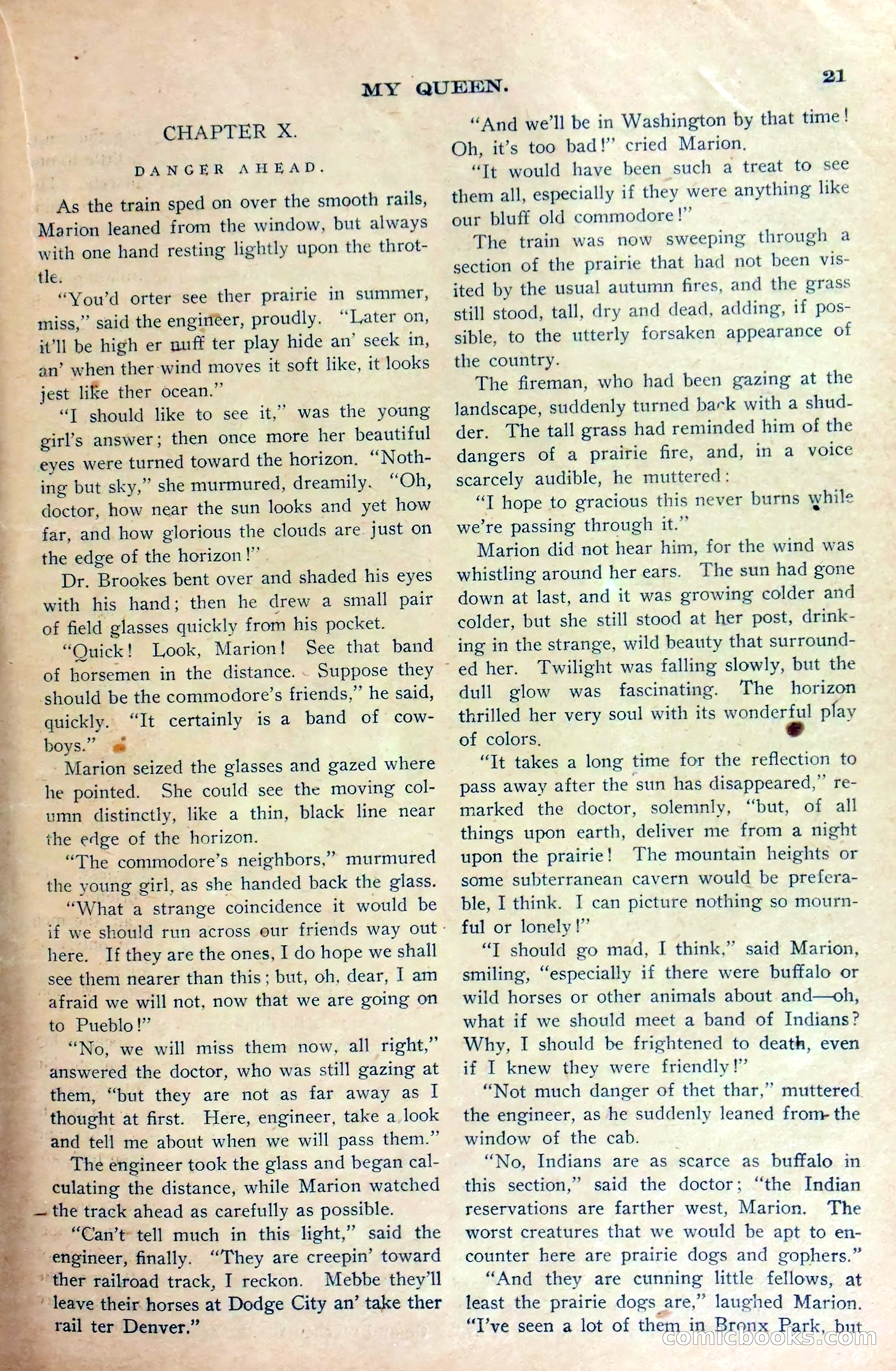
A restored page from Penny Dreadfuls, 1901. Page through the whole issue in the reader above.
📄 Transcribed text from this page (OCR, searchable)
Machine-transcribed from the original scan — historical spelling and the odd misread are preserved.
MY QUEEN. CHAPTER X. DANGER AHEAD. As the train sped on over the smooth rails, Marion leaned from the window, but always with one hand resting lightly upon the throt- tle. | “You'd orter see ther prairie in summer, miss,” said the engiréer, proudly. “Later on, | ill be high er uuff ter play hide an’ seek in, an’ when ther wind moves it soft like, it looks jest like ther ocean.” { “T should like to see it,’ was the young girl’s answer; then once more her beautiful eyes were turned toward the horizon. “Noth- ing but sky,” she murmured, dreamily. “Oh, doctor, how near the sun looks and yet how far, and how glorious the clouds are. just on the edge of the horizon!” | Dr. Brookes bent over and shaded his eyes with his hand; then he drew a small pair of field glasses quickly from his pocket. “Quick! Look, Marion! See that band of horsemen in the distance. . Suppose they should be the commodore’s friends,” he said, quickly. “It certainly is a band of cow- boys.” @ _- Marion seized the glasses and gazed where he pointed. She could see the moving col- umn distinctly, like a thin, black line near the edge of the horizon. “The commodore’s neighbors,” murmured the young girl, as she handed back the glass. “What a strange coincidence it would be ——=_— = ——-— = > here. If they are the ones, I do hope we shall see them nearer than this; but, oh, dear, I am afraid we will not, now that we are going on to Pueblo!” | ; “No, we will miss them now, all right,”’ “answered the doctor, who was still gazing at them, “but they are not as far away as I thought at first. Here, engineer, take a look and tell me about when we will pass them.” _ The engineer took the glass and began cal- _ culating the distance, while Marion watched _— the track ahead as carefully as possible. _ -“Can’t tell much in this light,” said the _ engineer, finally. “They are creepin’ toward _ ther railroad track, I reckon. Mebbe they'll _ ’ leave their horses at Dodge City an’ take ther _ rail ter Denver,” , if we should run across our friends way out: 21 “And we'll be in Washington by that time! Oh, it’s too bad!’’ cried Marion. “Tt would have been such a treat to see them all, especially if they were anything like our bluff old commodore !”’ The train was now sweeping through a section of the prairie that had not been vis- ited by the usual autumn fires, and the grass still stood, tall, dry and dead, adding, if pos- sible, to the utterly forsaken appearance of the country. The fireman, who had been gazing at the landscape, suddenly turned bark with a shud- der. The tall grass had reminded him of the dangers of a prairie fire, and, in a voice scarcely audible, he muttered: “T hope to gracious this never burns while we're passing through it.” Marion did not hear him, for the wind was whistling around her ears. The sun had gone down at last, and it was growing colder and colder, but she still stood at her post, drink- ing in the strange, wild beauty that surround- ~ed her. Twilight was falling slowly, but the dull glow was fascinating. The horizon thrilled her very soul with its wonderful play of colors. = “Tt takes a long time for the reflection to pass away after the sun has disappeared,” re- marked the doctor, solemnly, “but, of all things upon earth, deliver me from a night upon the prairie! The mountain heights or some subterranean cavern would be prefera- ble, I think. I can picture nothing so mourn- ful or lonely!” “T should go mad, I think,’ said Marion, smiling, “especially if there were buffalo or wild horses or other animals about and—oh, what if we should meet a band of Indians? Why, I should be frightened to death, even if I knew they were friendly!” “Not much danger of thet thar,’’ muttered the engineer, as he suddenly leaned from the window of the cab. : “No, Indians are as scarce as buffalo in this section,” said the doctor; “the Indian reservations are farther west, Marion. The worst creatures that we would be apt to en- counter here are prairie dogs and gophers.” “And they are cunning little fellows, at least the prairie dogs are,” laughed Marion. sy? l t f . : 7 ve seen a lot o them in Bronx Park, but