
Penny Dreadfuls, 1901 · page 30 of 38
Marion Marlowe in St. Louis, or, A Forger's Bold Deed — page 30: what you’re looking at
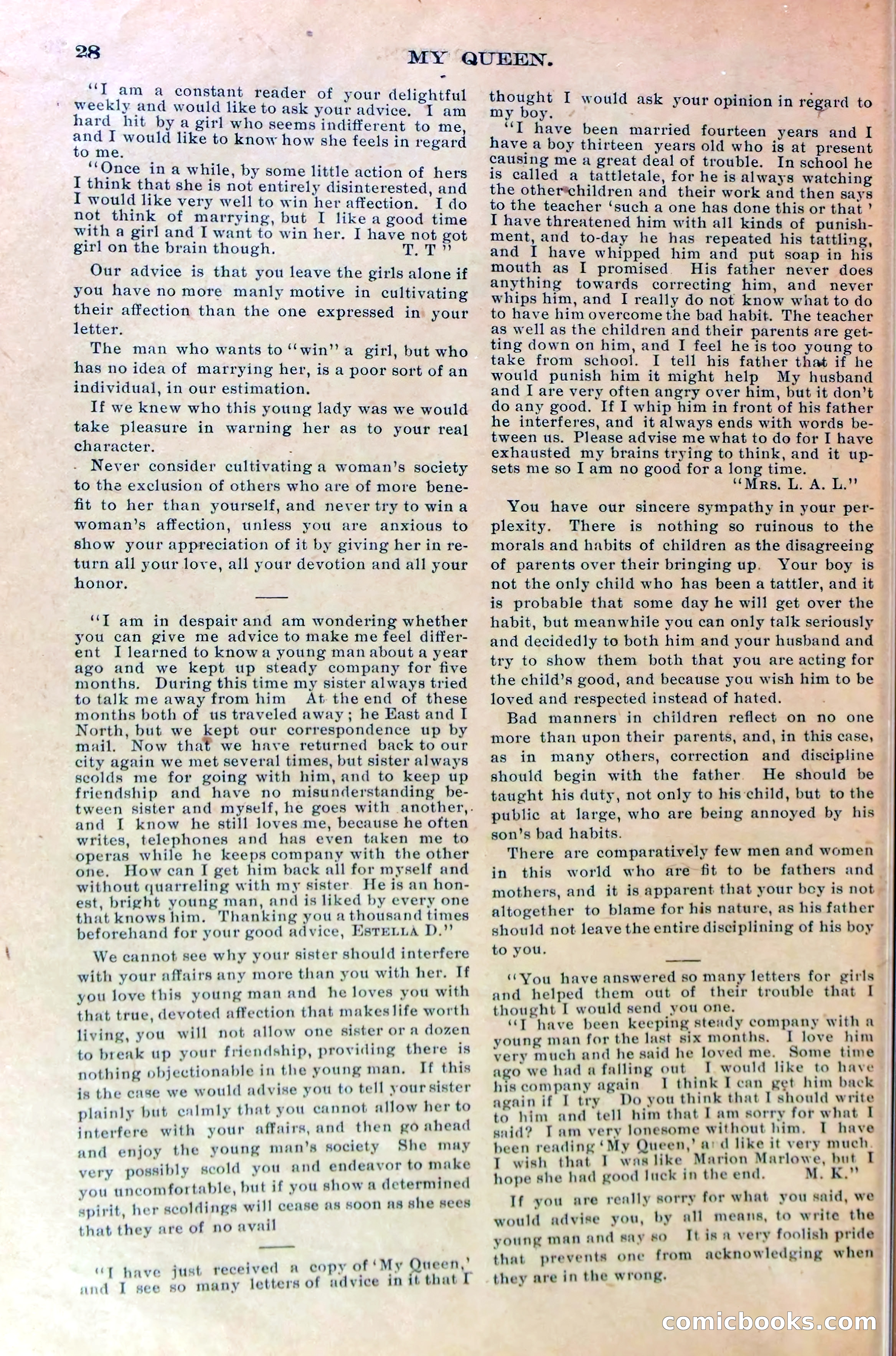
A restored page from Penny Dreadfuls, 1901. Page through the whole issue in the reader above.
📄 Transcribed text from this page (OCR, searchable)
Machine-transcribed from the original scan — historical spelling and the odd misread are preserved.
28 “T am a constant reader of your delightful weekly and would like to ask your advice, I am hard hit by a girl who seems indifferent to me, and I would like to know how she feels in regard to me. ‘‘Once in a while, by some little action of hers I think that she is not entirely disinterested, and I would like very well to win her affection. I do not think of marrying, but I like a good time with a girl and I want to win her. I have not got girl on the brain though. dBRL A Our advice is that you leave the girls alone if you have no more manly motive in cultivating their affection than the one expressed in your letter. The man who wants to ‘win’ a girl, but who has no idea of marrying her, is a poor sort of an individual, in our estimation. If we knew who this young lady was we would take pleasure in warning her as to your real character. Never consider cultivating a woman’s society to the exclusion of others who are of more bene- fit to her than yourself, and never try to wina woman’s affection, unless you are anxious to show your appreciation of it by giving her in re- turn all your love, all your devotion and all your honor. “T am in despair and am wondering whether you can give me advice to make me feel differ- ent I learned to knowa young man about a year ago and we kept up steady company for five months. During this time my sister always tried to talk me away from him At the end of these months both of us traveled away; he East and I North, but we kept our correspondence up by mail. Now that we have returned back to our city again we met several times, but sister always scolds me for going with him, and to keep up friendship and have no misunderstanding be- tween sister and myself, he goes with another,. and I know he still loves me, because he often writes, telephones and has even taken me to operas while he keeps company with the other one. How can I get him back all for myself and without quarreling with my sister. He is an hon- est, bright young man, and is liked by every one that knows him. Thanking you a thousand times beforehand for your good advice, Estetia D.” We cannot see why your sister should interfere with your affairs any more than you with her. If you love this young man and he loves you with that true, devoted affection that makeslife worth living, you will not allow one sister ora dozen to break up your friendship, providing there is nothing objectionable in the young man, If this ig the ense we would advise you to tell your sister plainly but calmly that you cannot allow her to interfere with your affairs, and then go ahead and enjoy the young man’s society She may very possibly scold you and endeavor to make you uncomfortable, but if you showa determined spirit, her scoldings will cease as soon as she sees that they are of no avail ’ just received a copy of ‘My Queen, ‘T have ) fe so many letters of advice init that I and I see MY QUEEN. thought I would ask your opinion in regard to my boy. . ‘I have been married fourteen years and I have a boy thirteen years old who is at present causing mea great deal of trouble. In school he is called a tattletale, for he is always watching the other*children and their work and then says to the teacher ‘such a one has done this or that ” I have threatened him with all kinds of punish- ment, and to-day he has repeated his tattling, and I have whipped him and put soap in his mouth as I promised. His father never does anything towards correcting him, and never whips him, and I really do not know what to do to have him overcome the bad habit. The teacher as well as the children and their parents are get- ting down on him, and I feel he is too young to take from school. I tell his father that if he would punish him it might help My husband and I are very often angry over him, but it don’t do any good. If I whip him in front of his father he interferes, and it always ends with words be- tween us. Please advise me what to do for I have © exhausted my brains trying to think, and it up- sets me so [am no good for a long time. ; ‘Mrs, L. A. Ll.” You have our sincere sympathy in your per- plexity. There is nothing so ruinous to the morals and habits of children as the disagreeing of parents over their bringing up. Your boy is not the only child who has been a tattler, and it is probable that some day he will get over the habit, but meanwhile you can only talk seriously and decidedly to both him and your husband and try to show them both that you are acting for the child’s good, and because you wish him to be loved and respected instead of hated. Bad manners in children reflect on no one more than upon their parents, and, in this case, as in many others, correction and discipline should begin with the father He should be taught his duty, not only to his child, but to the public at large, who are being annoyed by his son’s bad habits. : There are comparatively few men and women in this world who are fit to be fathers and mothers, and it is apparent that your bey is not — altogether to blame for his nature, as his father should not leave the entire disciplining of his boy to you. a “You have answered so many letters for girls and helped them out of their trouble that I thought I would send you one, My “T have been keeping steady company with a young man for the last six months. I love him very much and he said he loved me. Some time ago we had a falling out I would like to have his company again I think I can get him back again if I try Do you think that I should write to him and tell him that lam sorry for what I snid? Tam very lonesome without him, I have been reading ‘My Queen,’ ard like it very much. I wish that I was like Marion Marlowe, but I hope she had good luck in the end. If you are really sorry for what you said, we would advise you, by all means, to write the young man and say so It is a very foolish pride that prevents one from acknowledging when they are in the wrong. GEomichooks.com q