
Penny Dreadfuls, 1901 · page 32 of 37
Marion Marlowe in Indianapolis — page 32: what you’re looking at
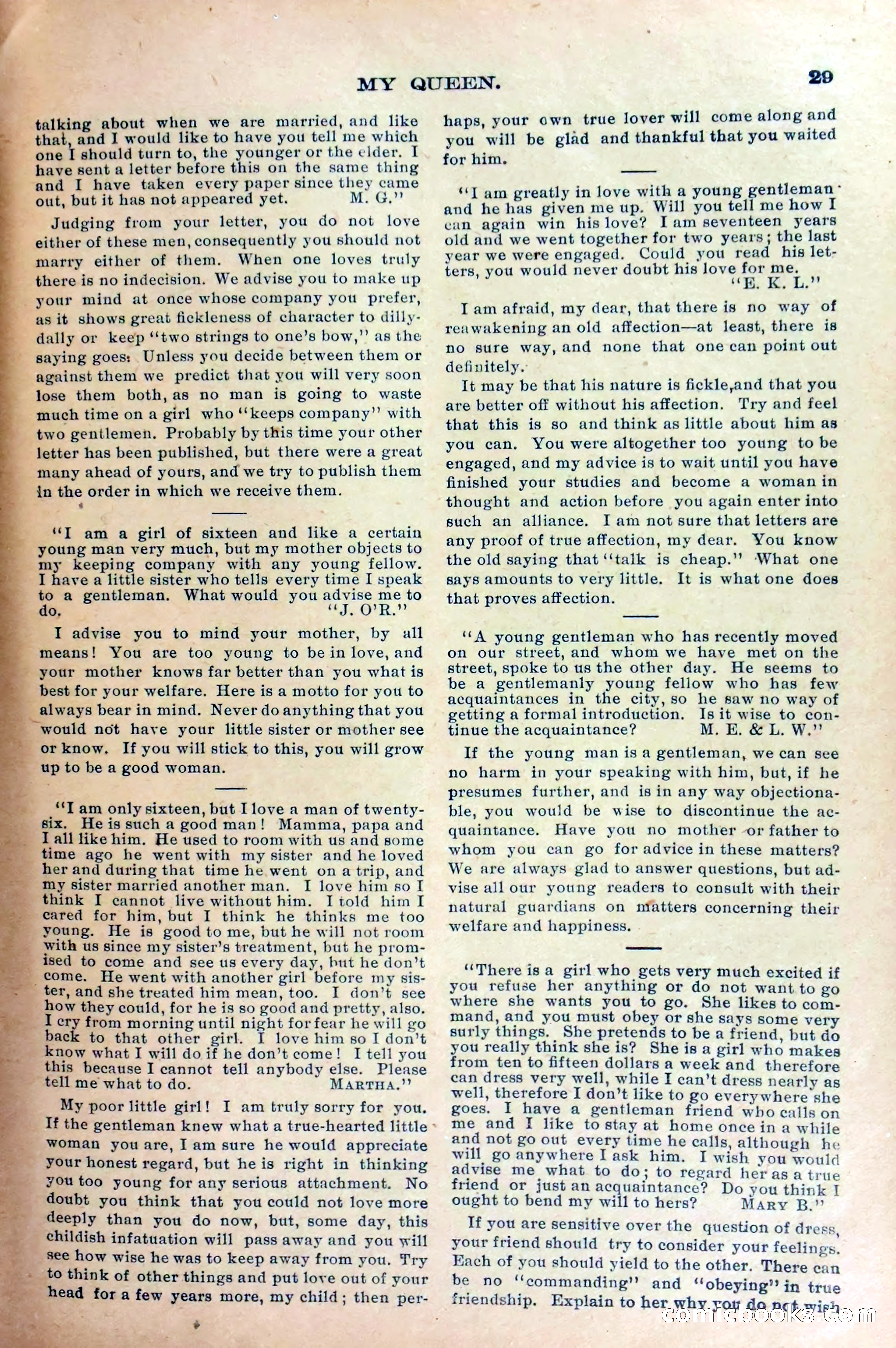
A restored page from Penny Dreadfuls, 1901. Page through the whole issue in the reader above.
📄 Transcribed text from this page (OCR, searchable)
Machine-transcribed from the original scan — historical spelling and the odd misread are preserved.
4 talking about when we are married, and like that, and I would like to have you tell me which ~ one I should turn to, the younger or the elder. I have sent a letter before this on the same thing and I have taken every paper since they came out, but it has not appeared yet. M. G,”” Judging from your letter, you do not love either of these men, consequently you should not marry either of them. When one loves truly there is no indecision. We advise you to make up your mind at once whose company you prefer, as it shows great fickleness of character to dilly- dally or keep ‘‘two strings to one’s bow,”’ as the saying goes: Unless you decide between them or against them we predict that you will very soon lose them both, as no man is going to waste - much time on a girl who ‘keeps company”’ with two gentlemen. Probably by this time your other letter has been published, but there were a great _ many ahead of yours, and we try to publish them in the order in which we receive them. = “ * “T am a girl of sixteen and like a certain young man very much, but my mother objects to my keeping company with any young fellow. J have a little sister who tells every time I speak to a gentleman. What would you advise me to “a “TOR,” _ I advise you to mind your mother, by all means! You are too young to bein love, and your mother knows far better than you what is best for your welfare. Here is a motto for you to always bear in mind. Never do anything that you would not have your little sister or mother see orknow. If you will stick to this, you will grow up to be a good woman. * -_-_-_oOoe Tam only sixteen, but I love a man of twenty- six. Heissuch a good man! Mamma, papa and lTalllike him. He used to room with us and some time ago he went with my sister and he loved her and during that time he went on a trip, and My sister married another man. I love him so I think I cannot live without him. I told him I cared for him, but I think he thinks me too young. He is good to me, but he will not room with us since my sister’s treatment, but he prom- ised to come and see us every day, but he don’t come. He went with another girl before my sis- ter, and she treated him mean, too. I don’t see _how they could, for he is so good and pretty, also. _icry from morning until night forfear he will go back to that other girl. I love him so I don’t _ know what I will do if he don’t come! I tell you this because I cannot tell anybody else. Please tell me what to do. MARTHA.”’ My poor little girl! I am truly sorry for you. woman you are, Iam sure he would appreciate . your honest regard, but heis right in thinking _ yOutoo young for any serious attachment. No _ doubt you think that you could not love more _ deeply than you do now, but, some day, this i childish infatuation will pass away and you will _ see how wise he was to keep away from you, Try _to think of other things and put love out of your head for a few years more, my child; then per- Aj . i * = | , MY QUEEN. 3 If the gentleman knew what a true-hearted little» haps, your own true lover will come along and you will be glad and thankful that you waited for him. ‘Tl am greatly in love with a young gentleman’ and he has given me up. Will you tell me how I can again win hislove? Iam seventeen years old and we went together for two years; the last year we were engaged. Could you read his let- ters, you would never doubt his love for me. ce, Bh,” Iam afraid, my dear, that there is no way of reawakening an old affection—at least, there is no sure way, and none that one can point out definitely. It may be that his nature is fickle,and that you are better off without his affection. Try and feel that this is so and think as little about him as you can. You were altogether too young to be engaged, and my advice is to wait until you have finished your studies and become a woman in thought and action before you again enter into such an alliance. I am not sure that letters are any proof of true affection, my dear. You know the old saying that ‘‘talk is cheap.’’ What one says amounts to very little. It is what one does that proves affection. ‘A young gentleman who has recently moved on our street,and whom we have met on the street, spoke to us the other duy. He seems to be a gentlemanly young fellow who has few acquaintances in the city, so he saw no way of getting a formal introduction. Is it wise to con- tinue the acquaintance? M. BE. & L. W.”’ If the young man isa gentleman, we can see no harm in your speaking with him, but, if he presumes further, and isin any way objectiona- ble, you would be wise to discontinue the ac- quaintance. Have you no mother or father to whom you can go for advice in these matters? We are always glad to answer questions, but ad- vise all our young readers to consult with their natural guardians on nYatters concerning their welfare and happiness. “There isa girl who gets very much excited if you refuse her anything or do not want to go where she wants you to go. She likes to com- mand, and you must obey or she says some very surly things. She pretends to be a friend, but do you really think she is? She isa girl who makes from ten to fifteen dollars a week and therefore can dress very well, while I can’t dress nearly as well, therefore I don’t like to go everywhere she goes. I have a gentleman friend who calls on me and [I like to stay at home once in a while and not go out every time he calls, although he will go anywhere Lask him. I wish you would advise me what to do; to regard herasa true friend or just an acquaintance? Do you think I ought to bend my will to hers? Mary B.” If you are sensitive over the question of dress, your friend should try to consider your feelings. Each of you should yield to the other. There ean be no ‘“‘commanding’’? and “obeying” in true friendship. Explain toh h i Pe OG DO OSGeo joie