
Penny Dreadfuls, 1901 · page 17 of 37
Marion Marlowe in Denver, or, The Tragedy of Pike's Peak — page 17: what you’re looking at
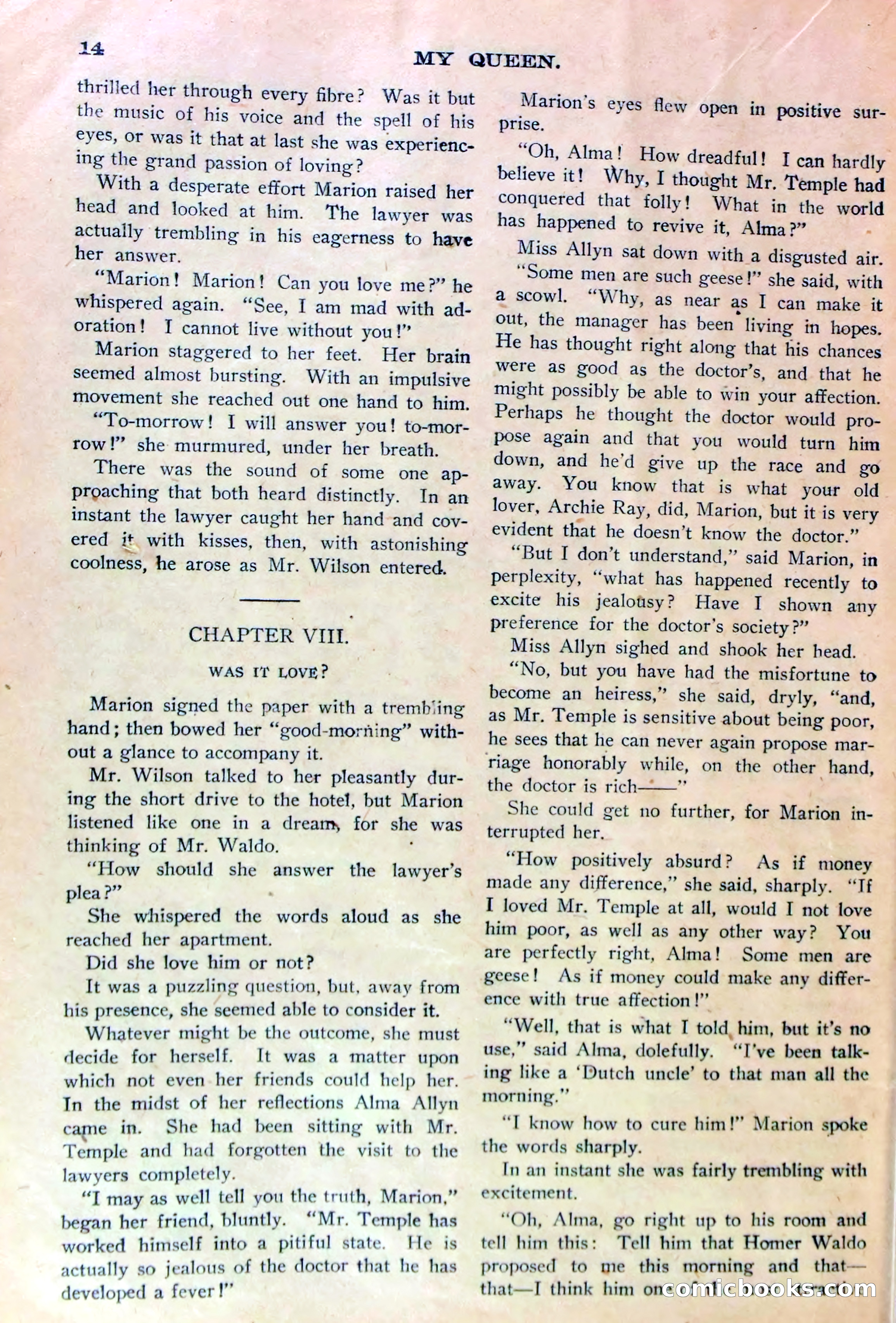
A restored page from Penny Dreadfuls, 1901. Page through the whole issue in the reader above.
📄 Transcribed text from this page (OCR, searchable)
Machine-transcribed from the original scan — historical spelling and the odd misread are preserved.
14 thrilled her through every fibre? Was it but the music of his voice and the spell of his ©yes, Or was it that at last she was experienc- ing the grand passion of loving? With a desperate effort Marion raised her head and looked at him. The lawyer was actually trembling in his eagerness to have her answer. “Marion! Marion! Can you love me?” he whispered again. “See, I am mad with ad- oration! [I cannot live without you!” Marion staggered to her feet. Her brain seemed almost bursting. With an impulsive movement she reached out one hand to him. “To-morrow! I will answer you! to-mor- row!” she murmured, under her breath. There was the sound of some one ap- proaching that both heard distinctly. In an instant the lawyer caught her hand and cov- ered it with kisses, then, with astonishing coolness, he arose as Mr. Wilson entered. CHAPTER VIIL. WAS IT LOVE? Marion signed the paper with a trembiing hand; then bowed her “good-morning” with- out a glance to accompany it. Mr. Wilson talked to her pleasantly dur- ing the short drive to the hotel, but Marion listened like one in a dream, for she was thinking of Mr. Waldo. “How should she answer the lawyer’s plea?” She whispered the words aloud as she reached her apartment. Did she love him or not? It was a puzzling question, but, away from his presence, she seemed able to consider it. Whatever might be the outcome, she must decide for herself. It was a matter upon which not even her friends could help her. In the midst of her reflections Alma Allyn came in. She had been sitting with Mr. Temple and had forgotten the visit to the lawyers completely. “I may as well tell you the truth, Marion,” began her friend, bluntly. “Mr. Temple has worked himself into a pitiful state. He is actually so jealous of the doctor that he has + developed a fever! MY QUEEN. Marion’s eyes flew open in positive sur- prise, “Oh, Alma! How dreadful! I can hardly believe it! Why, I thought Mr. Temple had conquered that folly! What in the world has happened to revive it, Alma?” . Miss Allyn sat down with a disgusted air. “Some men are such geese!” she said, with a scowl. “Why, as near as I can make it out, the manager has been living in hopes. He has thought right along that his chances were as good as the doctor’s, and that he might possibly be able to win your affection. Perhaps he thought the doctor would pro- pose again and that you would turn him down, and he’d give up the race and go away. You know that is what your old- lover, Archie Ray, did, Marion, but it is very evident that he doesn’t know the doctor.” “But I don’t understand,” said Marion, in perplexity, “what has happened recently to excite his jealotsy? Have I shown any preference for the doctor’s society?” Miss Allyn sighed and shook her head. “No, but you have had the misfortune to become an heiress,” she said, dryly, “and, as Mr. Temple is sensitive about being poor, he sees that he can never again propose mar- riage honorably while, on the other hand, o %* the doctor is rich | She could get no further, for Marion in- terrupted her, “How positively absurd? As if money made any difference,” she said, sharply. “Tf [ loved Mr. Temple at all, would I not love him poor, as well as any other way? You are perfectly right, Alma! Some men are geese! As if money could make any differ- ence with true affection!” “Well, that is what I told, him, but it’s no use,”’ said Alma, dolefully. “I’ve been talk- ing like a ‘Dutch uncle’ to that man all the morning.” “IT know how to cure him!” Marion spoke the words sharply. In an instant she was fairly trembling with excitement, “Oh, Alma, go right up to his room and tell him this: Tell him that Homer Waldo proposed to me this morning and that— that—I think him omeCfi al sx0xe) eerxetoy oi)