
Penny Dreadfuls, 1901 · page 9 of 37
Marion Marlowe in Cleveland, or, The Mystery of the Red Rose — page 9: what you’re looking at
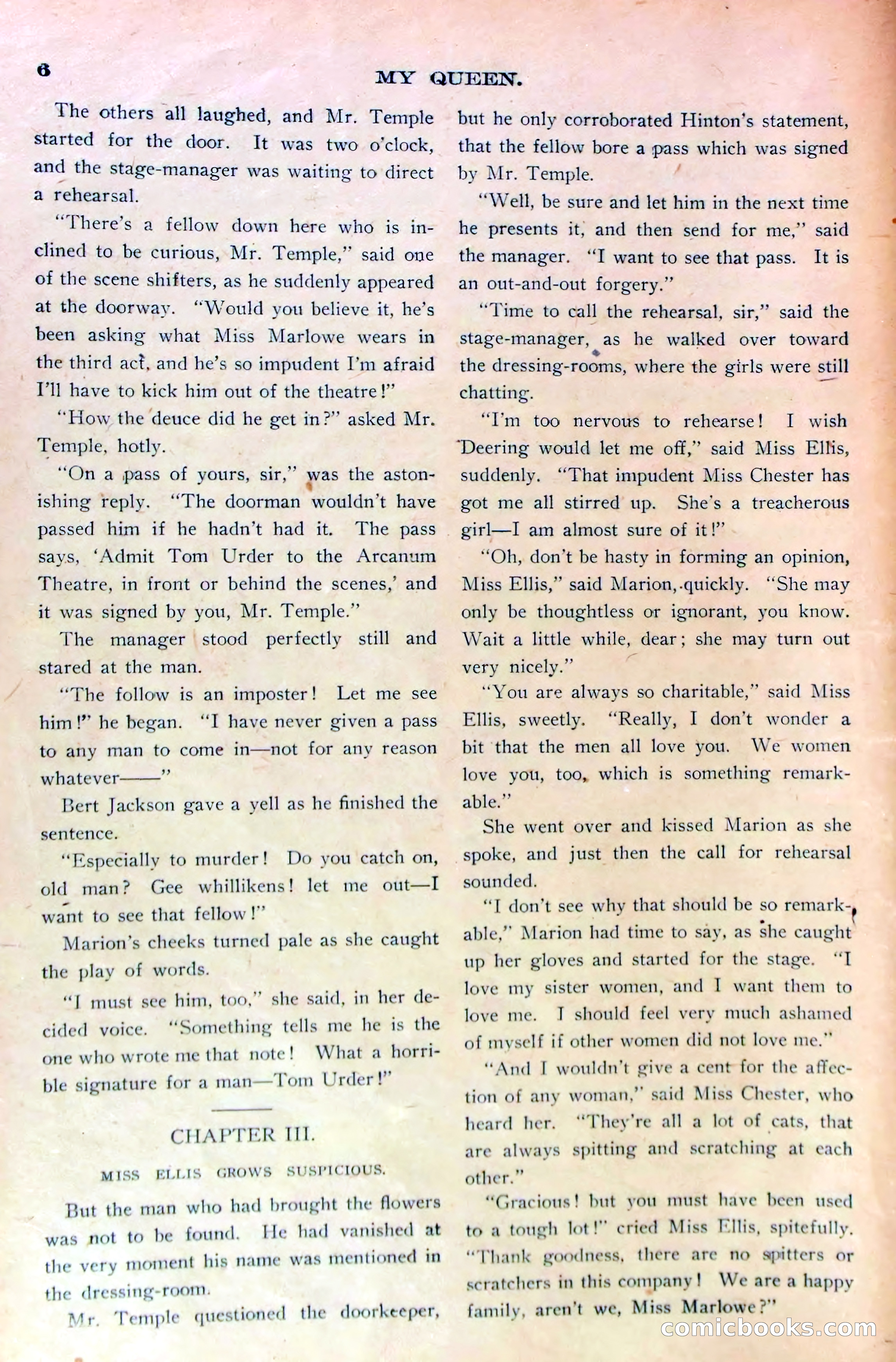
A restored page from Penny Dreadfuls, 1901. Page through the whole issue in the reader above.
📄 Transcribed text from this page (OCR, searchable)
Machine-transcribed from the original scan — historical spelling and the odd misread are preserved.
6 MY QUEEN. The others all laughed, and Mr. Temple Started for the door. It was two o'clock, and the stage-manager was waiting to direct a rehearsal. “There’s a fellow down here who is in- clined to be curious, Mr. Temple,” said one of the scene shifters, as he suddenly appeared at the doorway. “Would you believe it, he’s been asking what Miss Marlowe wears in the third act, and he’s so impudent I’m afraid I'll have to kick him out of the theatre!” “How the deuce did he get in?” asked Mr. Temple, hotly. ) “On a pass of yours, sir,’ was the aston- “The doorman wouldn’t have passed him if he hadn’t had it. ‘Admit Tom Urder to the Arcanum Theatre, in front or behind the scenes,’ and ishing reply. says, it was signed by you, Mr. Temple.” The manager stood perfectly still and stared at the man. “The follow is an imposter! Let me see him!” he began. “I have never given a pass to any man to come in—not for any reason 9) whatever Bert Jackson gave a yell as he finished the sentence. “Especially to murder! Do you catch on, Gee whillikens! let me out—I want to see that fellow!” old man? Marion’s cheeks turned pale as she caught the play of words. “IT must see him, too,” she said, in her de- “Something tells me he is the What a horri- cided voice. one who wrote me that note! ry* $s? ble signature for a man—Tom Urder! CHAPTER III. MISS ELLIS GROWS SUSPICIOUS, But the man who had brought the flowers was not to be found. He had vanished at the very moment his name was mentioned in the dressing-room. Mr. Temple questioned the doorkeeper, The pass | but he only corroborated Hinton’s statement, that the fellow bore a pass which was signed by Mr. Temple. “Well, be sure and let him in the next time he presents it, and then send for me,” said the manager. “I want to see that pass. It is an out-and-out forgery.” “Time to call the rehearsal, sir,” said the stage-manager, as he walked over toward the dressing-rooms, where the girls were still chatting. vo “I’m too nervous to rehearse! I wish ‘Deering would let me off,’ said Miss Ellis, suddenly. “‘Yhat impudent Miss Chester has got me all stirred up. She’s a treacherous girl—I am almost sure of it!” “Oh, don’t be hasty in forming an opinion, Miss Ellis,” said Marion,.quickly. “She may only be thoughtless or ignorant, you know. Wait a little while, dear; she may turn out very nicely.” > “You are always so charitable,’ ’ said Miss Ellis, sweetly. “Really, I don’t wonder a bit that the men all love you. We women love you, too, which is something remark- able.” She went over and kissed Marion as she spoke, and just then the call for rehearsal sounded. “T don’t see why that should be so remark- able,” Marion had time to say, as she caught up her gloves and started for the stage. “T love my sister women, and I want them to love me. J should feel very much ashamed of myself if other women did not love me.”’ “And I wouldn't give a cent for the affec- tion of any woman,” said Miss Chester, who heard her. “They're all a lot of cats, that are always spitting and scratching at each other.” “Gracious! but you must have been used to a tough lot!” cried Miss [Ilis, spitefully. “Thank goodness, there are no spitters or scratchers in this company! We are a happy family, aren't we, Miss Marlowe ?”’ Eomicboo <SriG@ | f = es ee