
Penny Dreadfuls, 1854 · page 89 of 399
Joseph Wilmot, or, The Memoirs of a Man-Servant — page 89: what you’re looking at
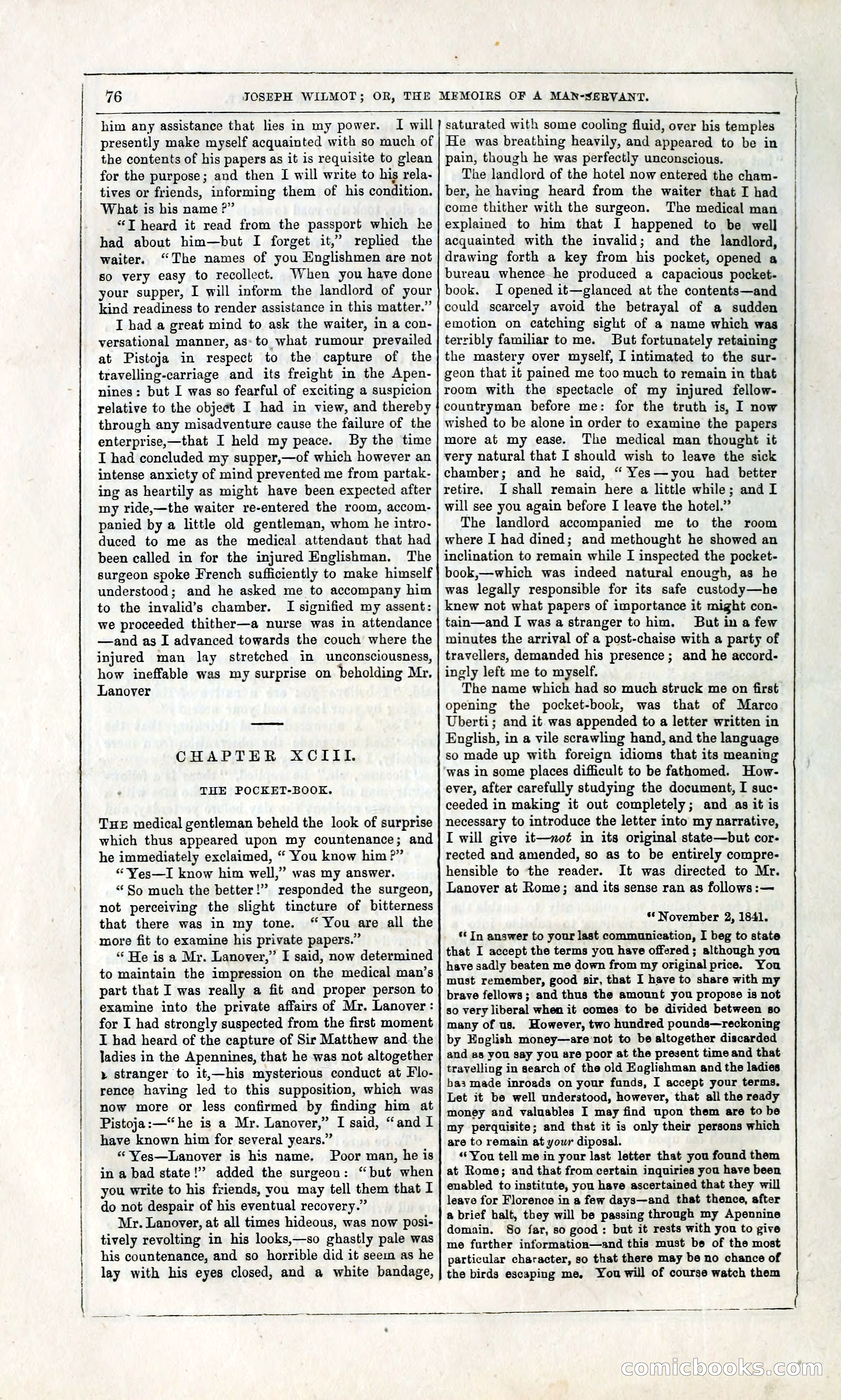
A restored page from Penny Dreadfuls, 1854. Page through the whole issue in the reader above.
📄 Transcribed text from this page (OCR, searchable)
Machine-transcribed from the original scan — historical spelling and the odd misread are preserved.
| 76 him any assistance that lies in my power. I will presently make myself acquainted with so much of the contents of his papers as it is requisite to glean for the purpose; and then I will write to his rela- tives or friends, informing them of his condition. What is his name ?” ‘T heard it read from the passport which he had about him—but I forget it,’ replied the waiter. “The names of you Englishmen are not so very easy to recollect. When you have done your supper, I will inform the landlord of your kind readiness to render assistance in this matter.” I had a great mind to ask the waiter, in a con- versational manner, as: to what rumour prevailed at Pistoja in respect to the capture of the travelling-carriage and its freight in the Apen- nines: but I was so fearful of exciting a suspicion relative to the object I had in view, and thereby through any misadventure cause the failure of the enterprise,—that I held my peace. By the time I had concluded my supper,—of which however an intense anxiety of mind prevented me from partak- ing as heartily as might have been expected after my ride,—the waiter re-entered the room, accom- panied by a little old gentleman, whom he intro- duced to me as the medical. attendant that had been called in for the injured Englishman. The surgeon spoke French sufficiently to make himself understood; and he asked me to accompany him to the invalid’s chamber. I signified my assent: we proceeded thither—a nurse was in attendance —and as I advanced towards the couch where the injured man lay stretched in unconsciousness, how ineffable was my surprise on beholding Mr, Lanover CHAPTER XCIII. THE POCKET-BOOK. THE medical gentleman beheld the look of surprise which thus appeared upon my countenance; and he immediately exclaimed, “ You know him ?” “Yes—I know him well,” was my answer. “So much the better!” responded the surgeon, not perceiving the slight tincture of bitterness that there was in my tone. “ You are all the more fit to examine his private papers.” ‘“ He is a Mr. Lanover,” I said, now determined to maintain the impression on the medical man’s part that I was really a fit and proper person to examine into the private affairs of Mr. Lanover: for I had strongly suspected from the first moment I had heard of the capture of Sir Matthew and the Jadies in the Apennines, that he was not altogether » stranger to it,—his mysterious conduct at Flo- rence haying led to this supposition, which was now more or less confirmed by finding him at Pistoja:—“ he is a Mr. Lanover,” I said, “and I have known him for several years.” ‘‘ Yes—Lanover is his name. Poor man, he is in a bad state!” added the surgeon: “but when you write to his friends, you may tell them that I do not despair of his eventual recovery.” Mr. Lanover, at all times hideous, was now posi- tively revolting in his looks,—so ghastly pale was his countenance, and so horrible did it seem as he lay with his eyes closed, and a white bandage, SS + - JOSEPH WILMOT; OR, THE MEMOIRS OF A MAN-SERVANT. saturated with some cooling fluid, over his temples He was breathing heavily, and appeared to be in pain, though he was perfectly unconscious. The landlord of the hotel now entered the cham- ber, he having heard from the waiter that I had come thither with the surgeon. The medical man explained to him that I happened to be well acquainted with the invalid; and the landlord, drawing forth a key from his pocket, opened a bureau whence he produced a capacious pocket- book. I opened it—glanced at the contents—and could scarcely avoid the betrayal of a sudden emotion on catching sight of a name which was terribly familiar to me. But fortunately retaining the mastery over myself, I intimated to the sur- geon that it pained me too much to remain in that room with the spectacle of my injured fellow- countryman before me: for the truth is, I now wished to be alone in order to examine the papers more at my ease. The medical man thought it very natural that I should wish to leave the sick chamber; and he said, “ Yes—you had better retire. I shall remain here a little while; and I will see you again before I leave the hotel.” The landlord accompanied me to the room where I had dined; and methought he showed an inclination to remain while I inspected the pocket- book,—which was indeed natural enough, as he was legally responsible for its safe custody—he knew not what papers of importance it might con- tain—and I wasa stranger to him. But in a few minutes the arrival of a post-chaise with a party of travellers, demanded his presence; and he accord- ingly left me to myself. The name which had so much struck me on first opening the pocket-book, was that of Marco Uberti; and it was appended to a letter written in English, in a vile scrawling hand, and the language so made up with foreign idioms that its meaning was in some places difficult to be fathomed. How- ever, after carefully studying the document, I suc- ceeded in making it out completely; and as it is necessary to introduce the letter into my narrative, I will give it—noé¢ in its original state—but cor- rected and amended, so as to be entirely compre- hensible to the reader. It was directed to Mr. Lanover at Rome; and its sense ran as follows :— ** November 2, 1841. ‘¢ In answer to your last communication, I beg to state that I accept the terms you have offered; although you have sadly beaten me down from my original price. You must remember, good sir, that I have to share with my brave fellows; and thus the amount you propose is not so very liberal when it comes to be divided between so many of us. However, two hundred pounds—reckoning by English money—are‘not to be altogether discarded and as you say you are poor at the present time and that travelling in search of the old Eaglishman and the ladies ba3 made inroeds on your funds, I accept your terms, Let it be well understood, however, that all the ready money and valuables I may find upon them are to be my perquisite; and that it is only their persons which are to remain at your diposal. ‘“You tell me in your last letter that you found them at Rome; and that from certain inquiries you have been enabled to institute, you have ascertained that they will leave for Florence in a few days—and that thence, after a brief halt, they will be passing through my Apennine domain. §8o far, so good: but it rests with yon to give me further informatios—and this must be of the most particular character, so that there may be no chance of the birds escaping me, You will of course watch them ee Lee OOO) (E Ss (CO) im