
Penny Dreadfuls, 1854 · page 82 of 399
Joseph Wilmot, or, The Memoirs of a Man-Servant — page 82: what you’re looking at
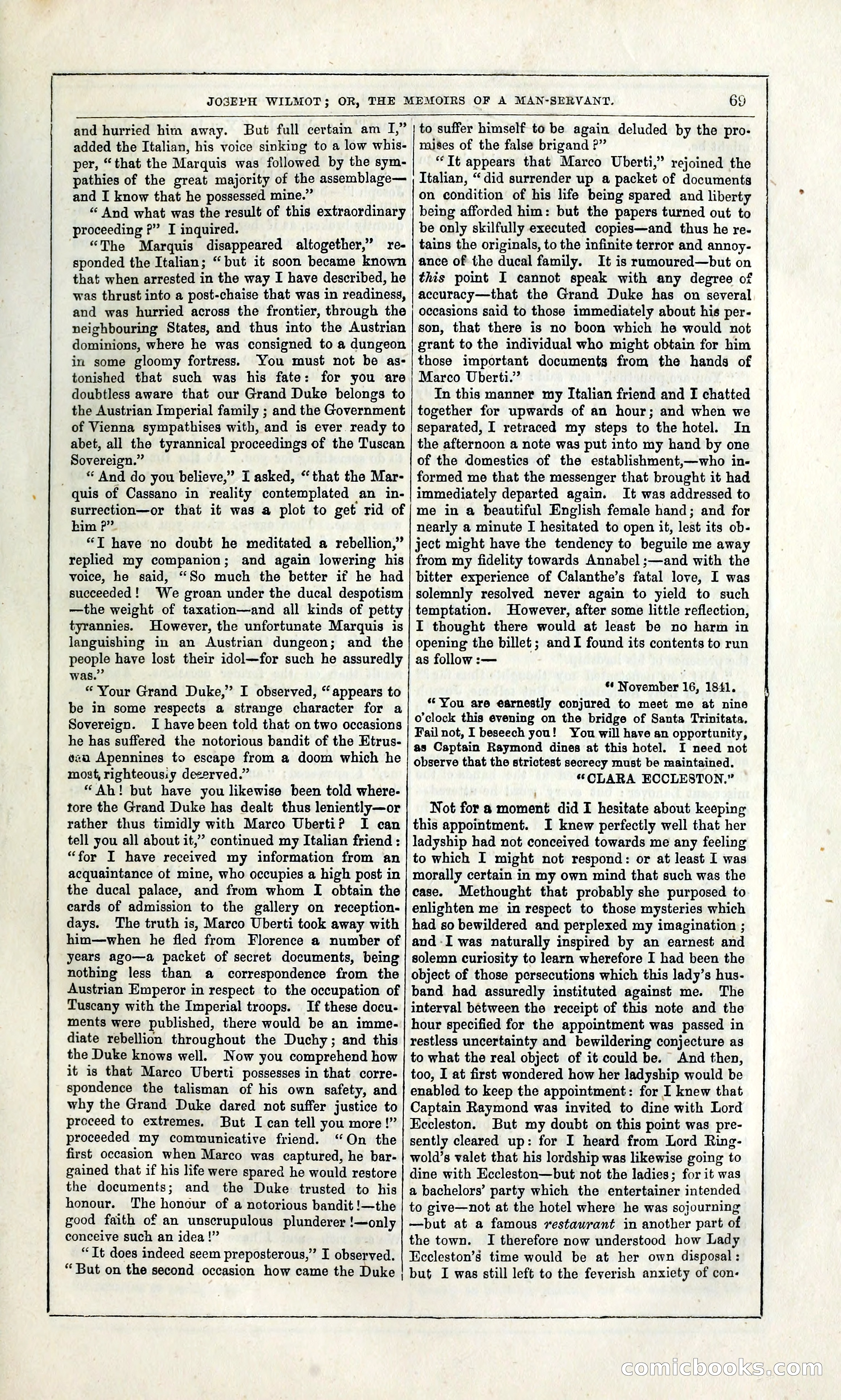
A restored page from Penny Dreadfuls, 1854. Page through the whole issue in the reader above.
📄 Transcribed text from this page (OCR, searchable)
Machine-transcribed from the original scan — historical spelling and the odd misread are preserved.
JOSEPH WILMOT; OR, THE MEMOIRS OF A MAN-SERVANT. 69 and hurried him away. But full certain am I,” | to suffer himself to be again deluded by the pro- added the Italian, his voice sinking to a low whis- per, “that the Marquis was followed by the sym- majses of the false brigand P” “It appears that Marco Uberti,” rejoined the pathies of the great majority of the assemblage— , Italian, “did surrender up a packet of documents and I know that he possessed mine.” “‘ And what was the result of this extraordinary proceeding P” I inquired. “The Marquis disappeared altogether,” re- sponded the Italian; “but it soon became known that when arrested in the way I have described, he was thrust into a post-chaise that was in readiness, and was hurried across the frontier, through the neighbouring States, and thus into the Austrian dominions, where he was consigned to a dungeon in some gloomy fortress. You must not be as- tonished that such was his fate: for you are doubtless aware that our Grand Duke belongs to the Austrian Imperial family ; and the Government of Vienna sympathises with, and is ever ready to abet, all the tyrannical proceedings of the Tuscan Sovereign.” _ And do you believe,” I asked, “that the Mar- quis of Cassano in reality contemplated an in- surrection—or that it was a plot to get rid of bim P”. “T have no doubt he meditated a rebellion,” replied my companion; and again lowering his voice, he said, “So much the better if he had succeeded! ‘We groan under the ducal despotism —the weight of taxation—and all kinds of petty tyrannies. However, the unfortunate Marquis is languishing in an Austrian dungeon; and the people have lost their idol—for such he assuredly was.” “Your Grand Duke,” I observed, “appears to be in some respects a strange character for a Sovereign. I have been told that on two occasions he has suffered the notorious bandit of the Etrus- gaa Apennines to escape from a doom which he most, righteousiy dezerved.” “Ah! but have you likewise been told where- tore the Grand Duke has dealt thus leniently—or rather thus timidly with Marco Uberti? I can tell you all about it,” continued my Italian friend : “for I have received my information from an acquaintance ot mine, who occupies a high post in the ducal palace, and from whom I obtain the cards of admission to the gallery on reception- days. The truth is, Marco Uberti took away with him—when he fled from Florence a number of years ago—a packet of secret documents, being nothing less than a correspondence from the Austrian Emperor in respect to the occupation of Tuscany with the Imperial troops. If these docu- ments were published, there would be an imme- diate rebellion throughout the Duchy; and this the Duke knows well. Now you comprehend how it is that Marco Uberti possesses in that corre- spondence the talisman of his own safety, and why the Grand Duke dared not suffer justice to preceed to extremes. But I can tell you more!” proceeded my communicative friend. “On the first occasion when Marco was captured, he bar- gained that if his life were spared he would restore the documents; and the Duke trusted to his honour. ‘The honour of a notorious bandit !—the good faith of an unscrupulous plunderer !—only conceive such an idea !” “Jt does indeed seem preposterous,” I observed. “But on the second occasion how came the Duke | ' the town. on condition of his life being spared and liberty being afforded him: but the papers turned out to be only skilfully executed copies—and thus he re. tains the originals, to the infinite terror and annoy- ance of the ducal family. It is ramoured—but on this point I cannot speak with any depree of accuracy—that the Grand Duke has on several occasions said to those immediately about his per- son, that there is no boon which he would not grant to the individual who might obtain for him those important documents from the hands of Marco Uberti.” In this manner my Italian friend and I chatted together for upwards of an hour; and when we separated, I retraced my steps to the hotel. In the afternoon a note was put into my hand by one of the domestics of the establishment,—who in- formed me that the messenger that brought it had immediately departed again. It was addressed to me in @ beautiful English female hand; and for nearly a minute I hesitated to open it, lest its ob- ject might have the tendency to beguile me away from my fidelity towards Annabel ;—and with the bitter experience of Calanthe’s fatal love, I was solemnly resolved never again to yield to such temptation. However, after some little reflection, I thought there would at least be no harm in opening the billet; and I found its contents to run as follow :— *¢ November 16, 1841. “You are earnestly conjured to meet me at nine o’clock this evening on the bridge of Santa Trinitata, Fail not, I beseech you! You will have an opportunity, as Captain Raymond dines at this hotel. I need not observe that the strictest secrecy must be maintained. *CLARA ECCLESTON.” Not for a moment did I hesitate about keeping this appointment. I knew perfectly well that her ladyship had not conceived towards me any feeling to which I might not respond: or at least I was morally certain in my own mind that such was the case. Methought that probably she purposed to enlighten me in respect to those mysteries which had so bewildered and perplexed my imagination ; and -I was naturally inspired by an earnest and solemn curiosity to learn wherefore I had been the object of those persecutions which this lady’s hus- band had assuredly instituted against me. The interval between the receipt of this note and the hour specified for the appointment was passed in restless uncertainty and bewildering conjecture as to what the real object of it could be. And then, too, I at first wondered how her ladyship would be enabled to keep the appointment: for I knew that Captain Raymond was invited to dine with Lord Eccleston. But my doubt on this point was pre- sently cleared up: for I heard from Lord Ring- wold’s valet that his lordship was likewise going to dine with Eccleston—but not the ladies; for it was a bachelors’ party which the entertainer intended to give—not at the hotel where he was sojourning —but at a famous restawrant in another part of I therefore now understood how Lady Eccleston’s time would be at her own disposal : but I was still left to the feverish anxiety of con- CORNICLO® S (C@)