
Penny Dreadfuls, 1854 · page 77 of 399
Joseph Wilmot, or, The Memoirs of a Man-Servant — page 77: what you’re looking at
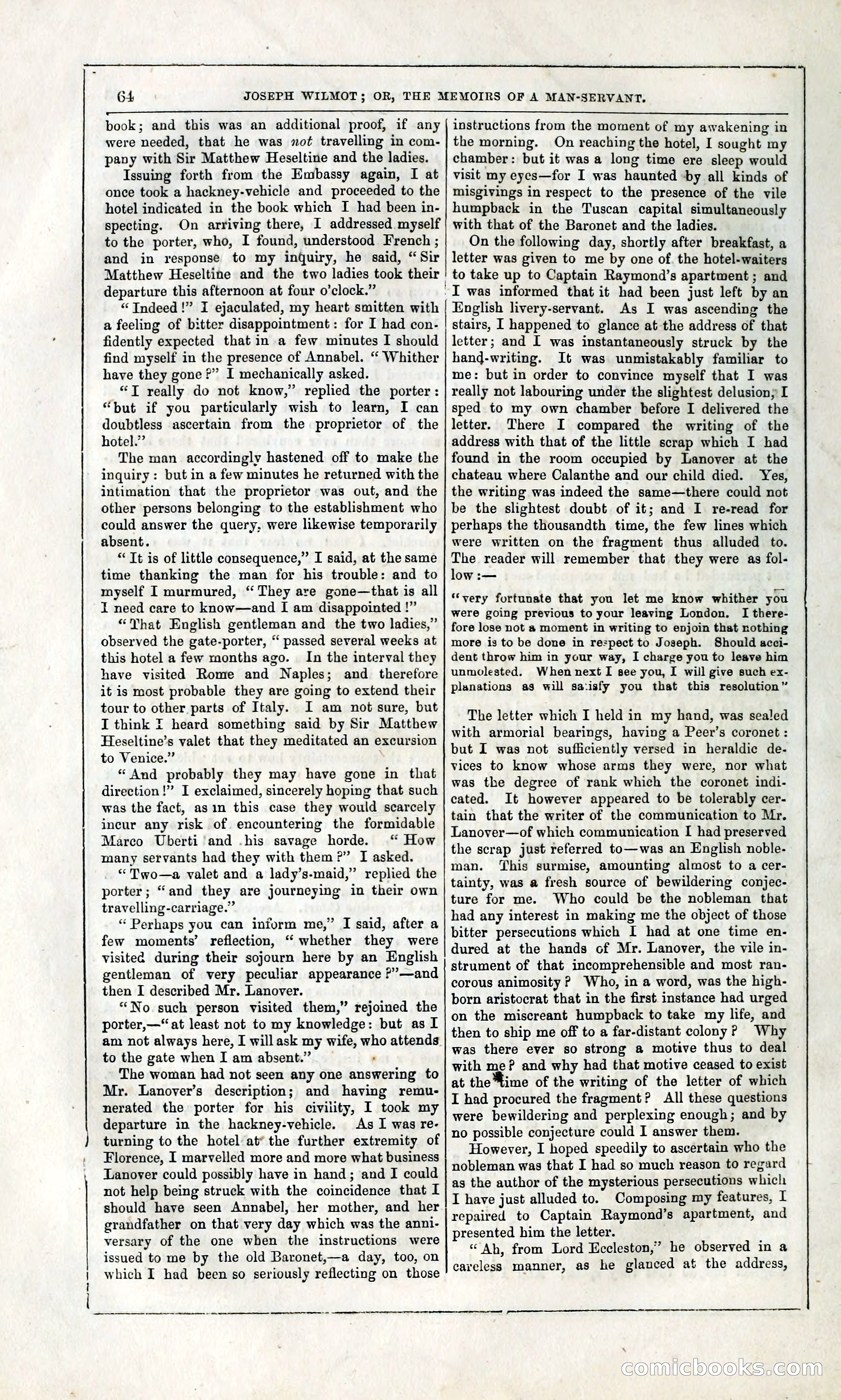
A restored page from Penny Dreadfuls, 1854. Page through the whole issue in the reader above.
📄 Transcribed text from this page (OCR, searchable)
Machine-transcribed from the original scan — historical spelling and the odd misread are preserved.
64 book; and this was an additional proof, if any were needed, that he was not travelling in com- pany with Sir Matthew Heseltine and the ladies. Issuing forth from the Embassy again, I at once took a hackney-vehicle and proceeded to the hotel indicated in the book which I had been in- specting. On arriving there, I addressed myself to the porter, who, I found, understood French ; and in response to my inquiry, he said, “Sir Matthew Heseltine and the two ladies took their departure this afternoon at four o’clock.” “ Indeed !” I ejaculated, my heart smitten with a feeling of bitter disappointment: for I had con- fidently expected that in a few minutes I should find myself in the presence of Annabel. “ Whither have they gone ?” I mechanically asked. “T really do not know,” replied the porter: “but if you particularly wish to learn, I can doubtless ascertain from the proprietor of the hotel.” The man accordingly hastened off to make the inquiry: but in a few minutes he returned with the intimation that the proprietor was out, and the other persons belonging to the establishment who could answer the query, were likewise temporarily absent. “ Tt is of little consequence,” I said, at the same time thanking the man for his trouble: and to myself I murmured, “‘ They are gone—that is all I need care to know—and I am disappointed !” “Yhat English gentleman and the two ladies,” observed the gate-porter, “ passed several weeks at this hotel a few months ago. In the interval they have visited Rome and Naples; and therefore it is most probable they are going to extend their tour to other parts of Italy. I am not sure, but I think I heard something said by Sir Matthew Heseltine’s valet that they meditated an excursion to Venice.” | * And probably they may have gone in that direction !”’ I exclaimed, sincerely hoping that such was the fact, asin this case they would scarcely incur any risk of encountering the formidable Marco Uberti and .his savage horde. “ How many servants had they with them?” I asked. “Two—a valet and a lady’s-maid,” replied the porter; “and they are journeying in their own travelling-carriage.” “ Perhaps you can inform me,” I said, after a few moments’ reflection, “ whether they were visited during their sojourn here by an English gentleman of very peculiar appearance ?’—and then I described Mr. Lanover. “No such person visited them,” rejoined the porter,—“ at least not to my knowledge: but as I am not always here, I will ask my wife, who attends to the gate when I am absent.” , The woman had not seen any one answering to Mr. Lanover’s description; and having remu- nerated the porter for his civility, I took my departure in the hackney-vehicle. As I was re- turning to the hotel at’ the further extremity of Florence, I marvelled more and more what business Lanover could possibly have in hand; and I could not help being struck with the coincidence that I should have seen Annabel, her mother, and her grandfather on that very day which was the anni- versary of the one when the instructions were issued to me by the old Baronet,—a day, too, on which I had been so seriously reflecting on those JOSEPH WILMOT; OR, THE MEMOIRS OF A MAN-SERVANT. instructions from the moment of my awakening in the morning. On reaching the hotel, I sought my chamber: but it was a long time ere sleep would visit my eyes—for I was haunted -by all kinds of misgivings in respect to the presence of the vile humpback in the Tuscan capital simultaneously with that of the Baronet and the ladies. On the following day, shortly after breakfast, a letter was given to me by one of. the hotel-waiters to take up to Captain Raymond’s apartment ; and I was informed that it had been just left by an English livery-servant. As I was ascending the stairs, I happened to glance at the address of that letter; and I was instantaneously struck by the hand-writing. It was unmistakably familiar to me: but in order to convince myself that I was really not labouring under the slightest delusion; I sped to my own chamber before I delivered the letter. There I compared the writing of the address with that of the little scrap which I had found in the room occupied by Lanover at the chateau where Calanthe and our child died. Yes, the writing was indeed the same—there could not be the slightest doubt of it; and I re-read for perhaps the thousandth time, the few lines which were written on the fragment thus alluded to. The reader will remember that they were as fol- low :— ‘very fortunate that you let me know whither you were going previous to your leaving London. I there- fore lose not a moment in writing to enjoin that nothing more is to be done in respect to Joseph. Should acci- dent throw him in your way, I charge you to leave him unmolested. When next I see you, I will give such ex- planations as will sa:isfy you that this resolution” The letter which I held in my hand, was sealed with armorial bearings, having a Peer’s coronet : but I was not sufficiently versed in heraldic de- vices to know whose arms they were, nor what was the degree of rank which the coronet indi- cated. It however appeared to be tolerably cer- tain that the writer of the communication to Mr. Lanover—of which communication I had preserved the scrap just referred to—was an English noble- man. This surmise, amounting almost to a cer- tainty, was a fresh source of bewildering conjec- ture for me. Who could be the nobleman that had any interest in making me the object of those bitter persecutions which I had at one time en- dured at the hands of Mr. Lanover, the vile in- strument of that incomprehensible and most ran- corous animosity ? Who, in a word, was the high- born aristocrat that in the first instance had urged on the miscreant humpback to take my life, and then to ship me off to a far-distant colony? Why was there ever so strong a motive thus to deal with me? and why had that motive ceased to exist at the time of the writing of the letter of which I had procured the fragment? All these questions were bewildering and perplexing enough; and by no possible conjecture could I answer them. However, I hoped speedily to ascertain who the nobleman was that I had so much reason to regard as the author of the mysterious persecutions which I have just alluded to. Composing my features, I repaired to Captain Raymond’s apartment, and presented him the letter. “Ah, from Lord Eccleston,’ he observed in a careless manner, as he glanced at the address, <S) ELN@QO) (c@)