
Penny Dreadfuls, 1854 · page 72 of 399
Joseph Wilmot, or, The Memoirs of a Man-Servant — page 72: what you’re looking at
A restored page from Penny Dreadfuls, 1854. Page through the whole issue in the reader above.
📄 Transcribed text from this page (OCR, searchable)
Machine-transcribed from the original scan — historical spelling and the odd misread are preserved.
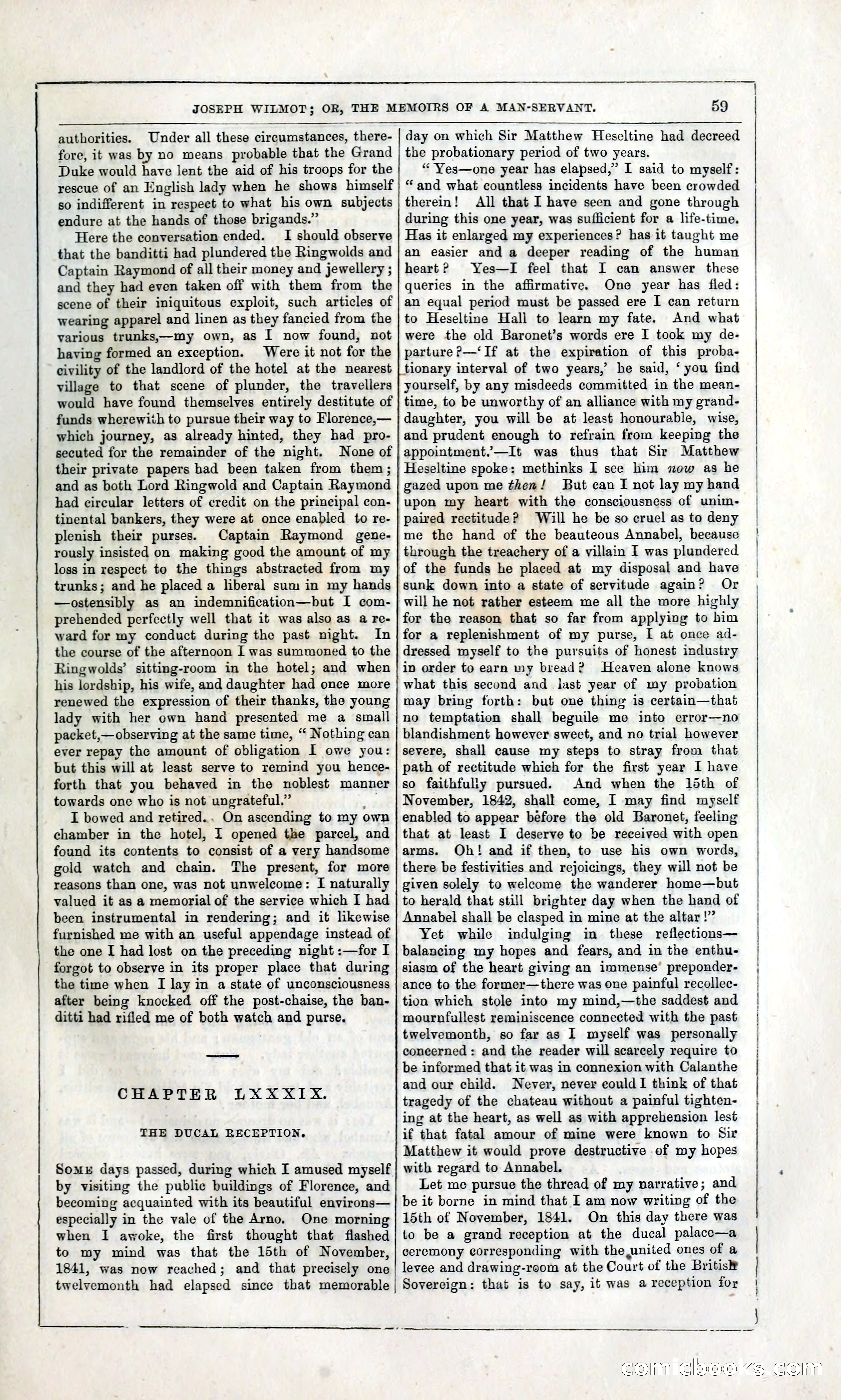
JOSEPH WILMOT; OR, THE MEMOIRS OF A MAN-SERVANT. 59 authorities. Under all these circumstances, there- fore, it was by no means probable that the Grand Duke would have lent the aid of his troops for the rescue of an English lady when he shows himself so indifferent in respect to what his own subjects endure at the hands of those brigands.” Here the conversation ended. I should observe that the banditti had plundered the Ringwolds and Captain Raymond of all their money and jewellery ; and they had even taken off with them from the scene of their iniquitous exploit, such articles of wearing apparel and linen as they fancied from the various trunks,—my own, as I now found, not having formed an exception. Were it not for the civility of the landlord of the hotel at the nearest village to that scene of plunder, the travellers would have found themselves entirely destitute of funds wherewith to pursue their way to Florence,— which journey, as already hinted, they had pro- secuted for the remainder of the night. None of their private papers had been taken from them; and as both Lord Ringwold and Captain Raymond had circular letters of credit on the principal con- tinental bankers, they were at once enabled to re- plenish their purses. Captain Raymond gene- rously insisted on making good the amount of my loss in respect to the things abstracted from my trunks; and he placed a liberal sum in my hands —ostensibly as an indemnification—but I com- prehended perfectly well that it was also as a re- ward for my conduct during the past mght. In the course of the afternoon I was summoned to the Ringwolds’ sitting-room in the hotel; and when his lordship, his wife, and daughter had once more renewed the expression of their thanks, the young lady with her own hand presented me a small packet,— observing at the same time, “ Nothing can ever repay the amount of obligation 1 owe you: but this will at least serve to remind you hence- forth that you behaved in the noblest manner towards one who is not ungrateful.” ie I bowed and retired... On ascending to my own chamber in the hotel, I opened the parcel, and found its contents to consist of a very handsome gold watch and chain. The present, for more reasons than one, was not unwelcome: [I naturally valued it as a memorial of the service which I had been instrumental in rendering; and it likewise furnished me with an useful appendage instead of the one I had lost on the preceding night :—for I forgot to observe in its proper place that during the time when I lay in a state of unconsciousness after being knocked off the post-chaise, the ban- ditti had rifled me of both watch and purse. CHAPTER LXXXIx. THE DUCAL RECEPTION. Some days passed, during which I amused myself by visiting the public buildings of Florence, and becoming acquainted with its beautiful environs— especially in the vale of the Arno. One morning when I awoke, the first thought that flashed to my mind was that the 15th of November, 1841, was now reached; and that precisely one twelyemonth had elapsed since that memorable day on which Sir Matthew Heseltine had decreed the probationary period of two years. ““'Yes—one year has elapsed,” I said to myself: “and what countless incidents have been crowded therein! All that I have seen and gone through during this one year, was sufficient for a life-time. Has it enlarged my experiences? has it taught me an easier and a deeper reading of the human heart? Yes—I feel that I can answer these queries in the affirmative. One year has fled: an equal period must be passed ere I can return to Heseltine Hall to learn my fate. And what were the old Baronet’s words ere I took my de- parture P—‘If at the expiration of this proba- tionary interval of two years,’ he said, ‘ you find yourself, by any misdeeds committed in the mean- time, to be unworthy of an alliance with my grand- daughter, you will be at least honourable, wise, and prudent enough to refrain from keeping the appointment.’—It was thus that Sir Matthew Heseltine spoke: methinks I see him now as he gazed upon me then! But can I not lay my hand upon my heart with the consciousness cf unim- paired rectitude? Will he be so cruel as to deny me the hand of the beauteous Annabel, because through the treachery of a villain I was plundered of the funds he placed at my disposal and have sunk down into a state of servitude again? Or will he not rather esteem me all the more highly for the reason that so far from applying to him for a replenishment of my purse, I at once ad- dressed myself to the pursuits of honest industry in order to earn my bread? Heaven alone knows what this second and last year of my probation may bring forth: but one thing is certain—that no temptation shall beguile me into error—no blandishment however sweet, and no trial however severe, shall cause my steps to stray from that path of rectitude which for the first year I have so faithfuliy pursued. And when the lath of November, 1842, shall come, I may find myself enabled to appear before the old Baronet, feeling that at least I deserve to be received with open arms. Oh! and if then, to use his own words, there be festivities and rejoicings, they will not be given solely to welcome the wanderer home—but to herald that still brighter day when the hand of Annabel shall be clasped in mine at the altar!” Yet while indulging im these reflections— balancing my hopes and fears, and in the enthu- siasm of the heart giving an immense’ preponder- ance to the former—there was one painful recollec- tion which stole into my mind,—the saddest and mournfullest reminiscence connected with the past twelvemonth, so far as 1 myself was personally concerned : and the reader will scarcely require to be informed that it was in connexion with Calanthe and our child. Never, never could I think of that tragedy of the chateau without a painful tighten- ing at the heart, as well as with apprehension lest if that fatal amour of mine were known to Sir Matthew it would prove destructive of my hopes with regard to Annabel. Let me pursue the thread of my narrative; and be it borne in mind that I am now writing of the 15th of November, 1841. On this day there was to be a grand reception at the ducal palace—a ceremony corresponding with the united ones of a levee and drawing-room at the Court of the Britis Sovereign: that is to say, it was a reception for — -- Glyoo S (CO im