
Penny Dreadfuls, 1854 · page 66 of 399
Joseph Wilmot, or, The Memoirs of a Man-Servant — page 66: what you’re looking at
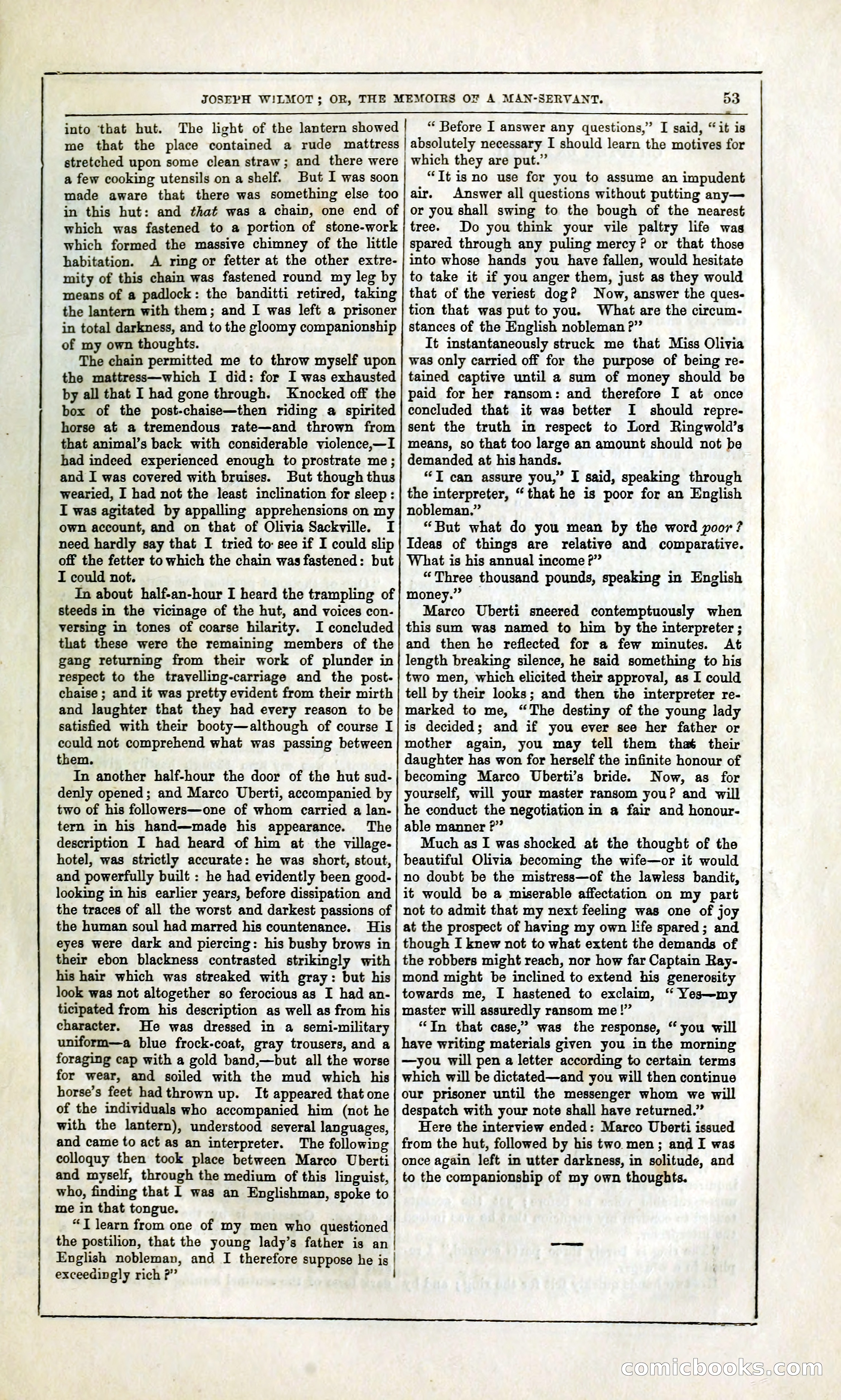
A restored page from Penny Dreadfuls, 1854. Page through the whole issue in the reader above.
📄 Transcribed text from this page (OCR, searchable)
Machine-transcribed from the original scan — historical spelling and the odd misread are preserved.
JOSEPH WI!ILMOTs; OR, THE MEMOIRS OF A MAN-SERVANT. od into that hut. The light of the lantern showed “‘ Before I answer any questions,” I said, “it is me that the place contained a rude mattress | absolutely necessary I should learn the motives for stretched upon some clean straw; and there were a few cooking utensils on a shelf. But I was soon made aware that there was something else too in this hut: and that was a chain, one end of which was fastened to a portion of stone-work which formed the massive chimney of the little habitation. A ring or fetter at the other extre- mity of this chain was fastened round my leg by means of a padlock: the banditti retired, taking the lantern with them; and I was left a prisoner in total darkness, and to the gloomy companionship of my own thoughts. The chain permitted me to throw myself upon the mattress—which I did: for I was exhausted by all that I had gone through. Knocked off the box of the post-chaise—then riding a spirited horse at a tremendous rate—and thrown from that animal’s back with considerable violence,—I had indeed experienced enough to prostrate me; and I was covered with bruises. But though thus wearied, I had not the least inclination for sleep: I was agitated by appalling apprehensions on my own account, and on that of Olivia Sackville. I need hardly say that I tried to: see if I could slip off the fetter to which the chain was fastened: but I could not. In about half-an-hour I heard the trampling of steeds in the vicinage of the hut, and voices con- versing in tones of coarse hilarity. I concluded that these were the remaining members of the gang returning from their work of plunder in respect to the travelling-carriage and the post- chaise ; and it was pretty evident from their mirth and laughter that they had every reason to be satisfied with their booty—although of course I eculd not comprehend what was passing between them. In another half-hour the door of the hut sud- denly opened; and Marco Uberti, accompanied by two of his followers—one of whom carried a lan- tern in his hand—made his appearance. The description I had heard of him at the village- hotel, was strictly accurate: he was short, stout, and powerfully built : he had evidently been good- looking in his earlier years, before dissipation and the traces of all the worst and darkest passions of the human soul had marred his countenance. His eyes were dark and piercing: his bushy brows in their ebon blackness contrasted strikingly with his hair which was streaked with gray: but his look was not altogether so ferocious as I had an- ticipated from his description as well as from his character. He was dressed in a semi-military uniform—a blue frock-coat, gray trousers, and a foraging cap with a gold band,—but all the worse for wear, and soiled with the mud which his horse’s feet hadthrown up. It appeared that one of the individuals who accompanied him (not he with the lantern), understood several languages, and came to act as an interpreter. The following colloquy then took place between Marco Uberti and myself, through the medium of this linguist, who, finding that 1 was an Englishman, spoke to me in that tongue. “T learn from one of my men who questioned the postilion, that the young lady’s father is an English nobleman, and I therefore suppose he is exceedingly rich ?” which they are put.” “Tt isno use for you to assume an impudent air. Answer all questions without putting any— or you shall swing to the bough of the nearest tree. Do you think your vile paltry life was spared through any puling mercy? or that those into whose hands you have fallen, would hesitate to take it if you anger them, just as they would that of the veriest dog? Now, answer the ques- tion that was put to you. What are the circum- stances of the English nobleman ?” It instantaneously struck me that Miss Olivia was only carried off for the purpose of being re- tained captive until a sum of money should be paid for her ransom: and therefore I at once concluded that it was better I should repre- sent the truth in respect to Lord Ringwold’s means, so that too large an amount should not be demanded at his hands. “TI can assure you,” I said, speaking through the interpreter, “that he is poor for an English nobleman.” “But what do you mean by the word poor? Ideas of things are relative and comparative. What is his annual income ?” “Three thousand pounds, speaking in English money.” Marco Uberti sneered contemptuously when this sum was named to him by the interpreter ; and then he reflected for a few minutes. At length breaking silence, he said something to his two men, which elicited their approval, as I could tell by their looks; and then the interpreter re- marked to me, “The destiny of the young lady is decided; and if you ever see her father or mother again, you may tell them that their daughter has won for herself the infinite honour of becoming Marco Uberti’s bride. Now, as for yourself, will your master ransom you? and will he conduct the negotiation in a fair and honour- able manner ?” Much as I was shocked at the thought of the beautiful Olivia becoming the wife—or it would no doubt be the mistress—of the lawless bandit, it would be a miserable affectation on my part not to admit that my next feeling was one of joy at the prospect of having my own life spared; and though I knew not to what extent the demands of the robbers might reach, nor how far Captain Ray- mond might be inclined to extend his generosity towards me, I hastened to exclaim, “ Yes~—my master will assuredly ransom me!” “In that case,” was the response, “you will have writing materials given you in the morning —you will pen a letter according to certain terms which will be dictated—and you will then continue our prisoner until the messenger whom we will despatch with your note shall have returned.” Here the interview ended: Marco Uberti issued from the hut, followed by his two men; and I was once again left in utter darkness, in solitude, and to the companionship of my own thoughts. ee eee eee ECORNICLO@ S (CO) AA