
Penny Dreadfuls, 1854 · page 60 of 399
Joseph Wilmot, or, The Memoirs of a Man-Servant — page 60: what you’re looking at
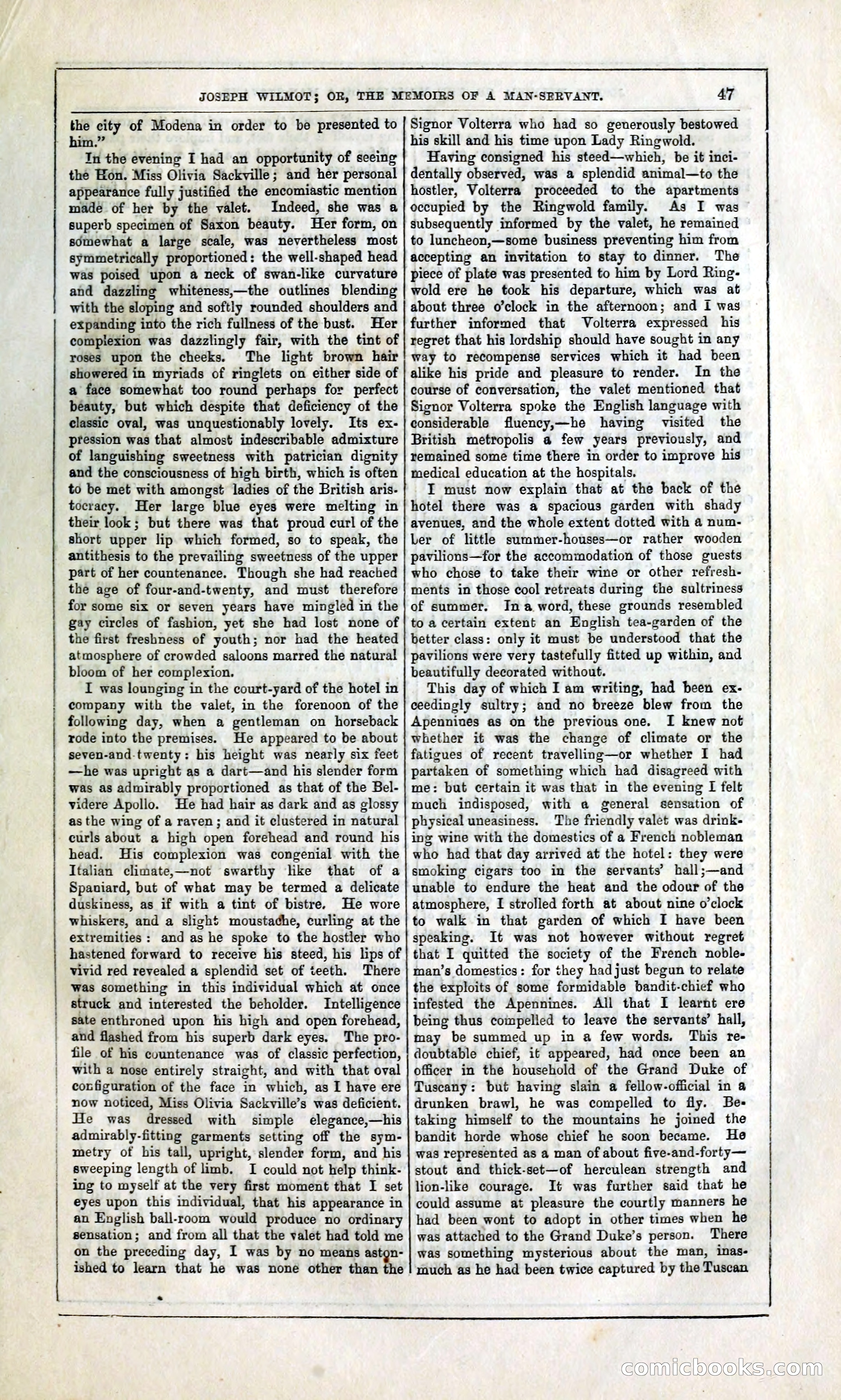
A restored page from Penny Dreadfuls, 1854. Page through the whole issue in the reader above.
📄 Transcribed text from this page (OCR, searchable)
Machine-transcribed from the original scan — historical spelling and the odd misread are preserved.
JOSEPH WILMOT; OR, THE MEMOIRS OF A MAN-SERVANT. 47 the city of Modena in order to be presented to him.” Tn the evening I had an opportunity of seeing the Hon. Miss Olivia Sackville; and her personal appearance fully justified the encomiastic mention made of her by the valet. Indeed, she was a superb specimen of Saxon beauty. Her form, on sdmewhat a large scale, was nevertheless most symmetrically proportioned: the well-shaped head was poised upon a neck of swan-like curvature and dazzling whiteness,—the outlines blending with the sloping and softly rounded shoulders and expanding into the rich fullness of the bust. Her complexion was dazzlingly fair, with the tint of roses upon the cheeks. The light brown hair showered in myriads of ringlets on either side of a face somewhat too round perhaps for perfect beauty, but which despite that deficiency of the classic oval, was unquestionably lovely. Its ex- pression was that almost indescribable admixture of languishing sweetness with patrician dignity and the consciousness of high birth, which is often to be met with amongst ladies of the British aris- tocracy. Her large blue eyes were melting in their look; but there was that proud curl of the short upper lip which formed, so to speak, the antithesis to the prevailing sweetness of the upper part of her countenance. Though she had reached the age of four-and-twenty, and must therefore for some six or seven years have mingled in the gay circles of fashion, yet she had lost none of the first freshness of youth; nor had the heated atmosphere of crowded saloons marred the natural bloom of her complexion. I was lounging in the court-yard of the hotel in company with the valet, in the forenoon of the following day, when a gentleman on horseback rode into the premises. He appeared to be about seven-and-twenty: his height was nearly six feet —he was upright as a dart—and his slender form was as admirably proportioned as that of the Bel- videre Apollo. He had hair as dark and as glossy as the wing of a raven; and it clustered in natural curls about a high open forehead and round his head. His complexion was congenial with the Italian climate,—not swarthy like that of a Spaniard, but of what may be termed a delicate duskiness, as if with a tint of bistre. He wore whiskers, and a slight moustache, curling at the extremities: and as he spoke to the hostler who hastened forward to receive his steed, his lips of vivid red revealed a splendid set of teeth. There was something in this individual which at once struck and interested the beholder. Intelligence sate enthroned upon his high and open forehead, and flashed from his superb dark eyes. The pro- file of his countenance was of classic perfection, with a nose entirely straight, and with that oval configuration of the face in which, as I have ere now noticed, Miss Olivia Sackville’s was deficient. He was dressed with simple elegance,—his admirably-fitting garments setting off the sym- metry of his tall, upright, slender form, and his sweeping length of limb. I could not help think- ing to myself at the very first moment that I set eyes upon this individual, that his appearance in an English ball-room would produce no ordinary sensation; and from all that the valet had told me on the preceding day, I was by no means aston- ished to learn that he was none other than the Signor Volterra who had so generously bestowed his skill and his time upon Lady Ringwold. Having consigned his steed—which, be it inci- dentally observed, was a splendid animal—to the hostler, Volterra proceeded to the apartments occupied by the Ringwold family. As I was subsequently informed by the valet, he remained to luncheon,—some business preventing him from accepting an invitation to stay to dinner. The piece of plate was presented to him by Lord Ring- wold ere he took his departure, which was at about three o’clock in the afternoon; and I was further informed that Volterra expressed his regret that his lordship should have sought in any way to recompense services which it had been alike his pride and pleasure to render. In the course of conversation, the valet mentioned that Signor Volterra spoke the English language with considerable fluency,—he having visited the British metropolis a few years previously, and remained some time there in order to improve his medical education at the hospitals. I must now explain that at the back of the hotel there was a spacious garden with shady avenues, and the whole extent dotted with 4 num- Ler of little summer-houses—or rather wooden pavilions—for the accommodation of those guests who chose to take their wine or other refresh- ments in those cool retreats during the sultriness of summer. Ina word, these grounds resembled to a certain extent an English tea-garden of the better class: only it must be understood that the pavilions were very tastefully fitted up within, and beautifully decorated without. This day of which I am writing, had been ex- ceedingly sultry; and no breeze blew from the Apennines as on the previous one. I knew not whether it was the change of climate or the fatigues of recent travelling—or whether I had partaken of something which had disagreed with me: but certain it was that in the evening I felt much indisposed, with a general sensation of physical uneasiness. The friendly valet was drink- ing wine with the domestics of a French nobleman who had that day arrived at the hotel: they were smoking cigars too in the servants’ hall;—and unable to endure the heat and the odour of the atmosphere, [I strolled forth at about nine o’clock to walk in that garden of which I have been speaking. It was not however without regret that I quitted the society of the French noble- man’s domestics: for they had just begun to relate the exploits of some formidable bandit-chief who infested the Apennines. All that I learnt ere being thus compelled to leave the servants’ hall, may be summed up in a few words. This re- doubtable chief, it appeared, had once been an officer in the household of the Grand Duke of Tuscany: but having slain a fellow-official in 4 drunken brawl, he was compelled to fly. Bes taking himself to the mountains he joined the bandit horde whose chief he soon became. He was represented as a man of about five-and-forty— stout and thick-set—of herculean strength and lion-like courage. It was further said that he could assume at pleasure the courtly manners he had been wont to adopt in other times when he was attached to the Grand Duke’s person. There was something mysterious about the man, inas- much as he had been twice captured by the Tuscan ee <S (Cc) ElO@QO)