
Penny Dreadfuls, 1854 · page 44 of 399
Joseph Wilmot, or, The Memoirs of a Man-Servant — page 44: what you’re looking at
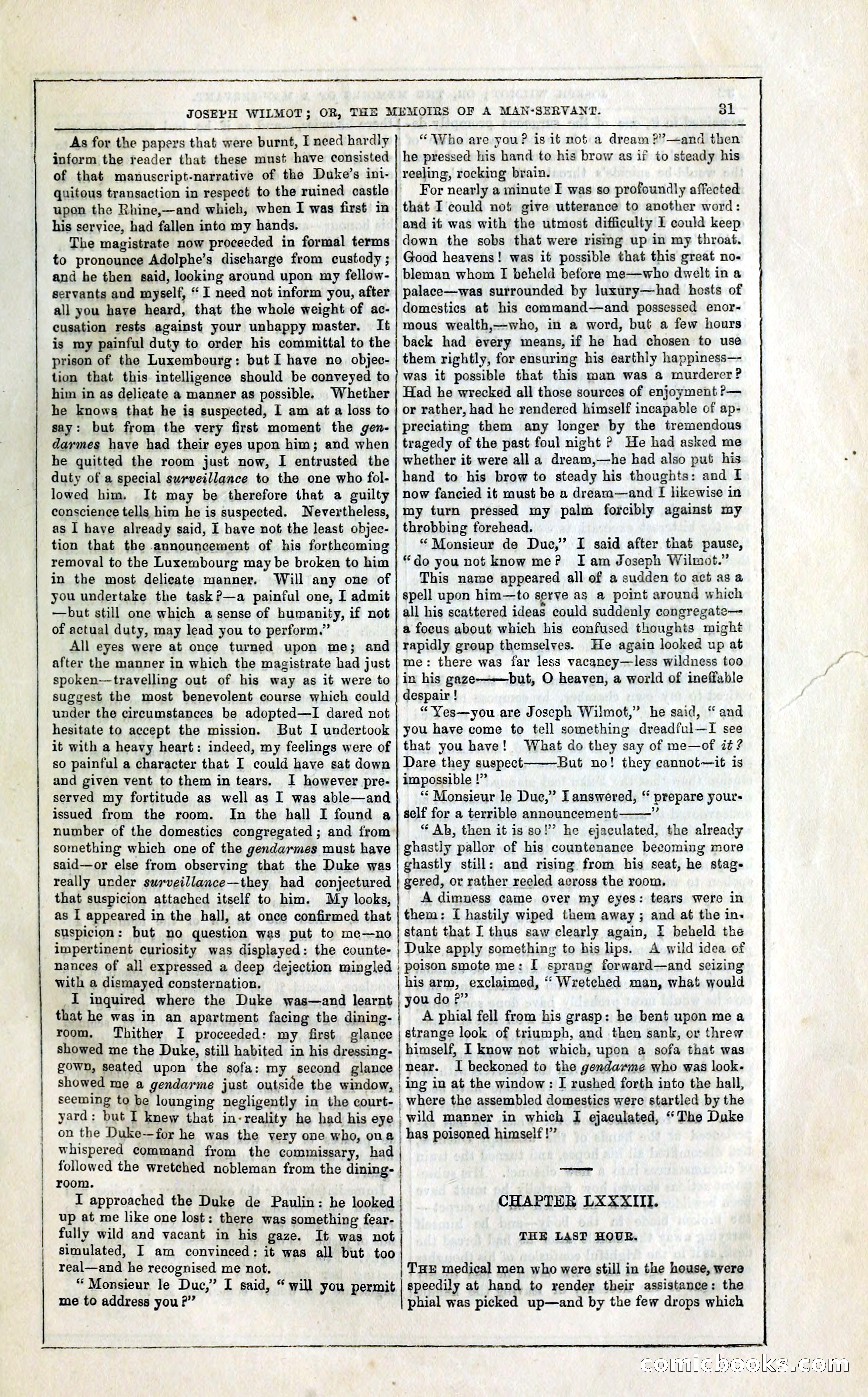
A restored page from Penny Dreadfuls, 1854. Page through the whole issue in the reader above.
📄 Transcribed text from this page (OCR, searchable)
Machine-transcribed from the original scan — historical spelling and the odd misread are preserved.
As for the paper's that were burnt, I need hardly inform the reader that these must have consisted of that manuscript-narrative of the Duke’s ini- quitous transaction in respect to the ruined castle upon the Rhine,—and which, when I was first in his service, had fallen into my hands. The magistrate now proceeded in formal terms to pronounce Adolphe’s discharge from custody ; and he then said, looking around upon my fellow- servants and myself, “I need not inform you, after all you have heard, that the whole weight of ac- cusation rests against your unhappy master. It is my painful duty to order his committal to the prison of the Luxembourg: but I have no objec- tion that this intelligence should be conveyed to him in as delicate a manner as possible. Whether he knows that he is suspected, I am at a loss to say: but from the very first moment the gen- darmes have had their eyes upon him; and when he quitted the room just now, I entrusted the duty of a special surveillance to the one who fol- lowed him. It may be therefore that a guilty conscience tells him he is suspected. Nevertheless, as I have already said, I have not the least objec- tion that the announcement of his forthcoming removal to the Luxembourg may be broken to him in the most delicate manner. Will any one of you undertake the task?—a painful one, I admit —but still one which a sense of humanity, if not of actual duty, may lead you to perform.” All eyes were at once turned upon me; and after the manner in which the magistrate had just spoken—travelling out of his way as it were to suggest the most benevolent course which could under the circumstances be adopted—I dared not hesitate to accept the mission. But I undertook it with a heavy heart: indeed, my feelings were of so painful a character that I could have sat down and given vent to them in tears. I however pre- served my fortitude as well as I was able—and issued from the room. In the hall I found a number of the domestics congregated ; and from something which one of the gendarmes must have said—or else from observing that the Duke was really under swuveillance—they had conjectured that suspicion attached itself to him. My looks, as I appeared in the hall, at once confirmed that suspicion: but no question was put to me—no impertinent curiosity was displayed: the counte- mm ee me JOSEPH WILMOT; OR, THE MEMOIRS OF A MAN-SERVANT. SL * Who are you? is it not a dream ?”—~and then he pressed his hand to his brow as if to steady his reeling, rocking brain. For nearly a minute I was so profoundly affected that I could not give utterance to another word: and it was with the utmost difficulty I could keep down the sobs that were rising up in my throat. Good heavens! was it possible that this great no- bleman whom I beheld before me—who dwelt in a palace—was surrounded by luxury—had hosts of domestics at his command—and possessed enor- mous wealth,—who, in a word, but a few hours back had every means, if he had chosen to use them rightly, for ensuring his earthly happiness— was it possible that this man was a murderer? Had he wrecked all those sources of enjoyment ?— or rather, had he rendered himself incapable of ap- preciating them any longer by the tremendous tragedy of the past foul night ? He had asked me whether it were all a dream,—he had also put his hand to his brow to steady his thoughts: and [ now fancied it must be a dream—and If likewise in my turn pressed my palm forcibly against my throbbing forehead. * Monsieur de Due,” I said after that pause, “do you not know me? Iam Joseph Wilmot.” This name appeared all of a sudden to act asa spell upon him—to serve as a point around which all his scattered ideas could suddenly congregate— a focus about which his confused thoughts might rapidly group themselves. He again looked up at me: there was far less vacancy—less wildness too in his gaze——but, O heaven, a world of ineffable despair ! “Yes—you are Joseph Wilmot,” he said, “and you have come to tell something dreadful—I see that you have! What do they say of me—of it? Dare they suspect But no! they cannot—it is impossible !” ‘“* Monsieur le Duce,” I answered, “ prepare your- self for a terrible announcement @ “ Ab, then it is so!’ he ejaculated, the already ghastly pallor of his countenance becoming more ghastly still: and rising from his seat, he stag- gered, or rather reeled across the room. A dimness came over my eyes: tears were in them: I hastily wiped them away; and at the in. stant that I thus saw clearly again, I beheld the Duke apply something to his lips. A wild idea of nances of all expressed a deep dejection mingled ; poison smote me: I sprang forward—and seizing with a dismayed consternation. his arm, exclaimed, “ Wretched man, what would _I inquired where the Duke was—and learnt | you do ?” that he was in an apartment facing the dining- room, A phial fell from his grasp: he ben§ upon me a Thither I proceeded: my first glance | strange look of triumph, and then sank, or threw showed me the Duke, still habited in his dressing- | himself, I know not which, upon a sofa that was gown, seated upon the sofa: my second glance |near. I beckoned to the gendarme who was look- showed me a gendarme just outside the window, | ing in at the window: I rushed forth into the hall, seeming to be lounging negligently in the court- | where the assembled domestics were startled by the yard: but I knew that in-reality he had his eye |; wild manner in which | ejaculated, “The Duke | on the Duke—for he was the very one who, ona has poisoned himself!” whispered command from the commissary, had | followed the wretched nobleman from the dining- | | room. I approached the Duke de Paulin: he looked up at me like one lost: there was something fear- fully wild and vacant in his gaze. It was not simulated, I am convinced: it was all but too real—and he recognised me not. THE medical men who were still in the house, were “Monsieur le Duc,’ I said, “ will you permit | speedily at hand to render their assistance: the me to address you ?” phial was picked up—and by the few drops which —Terea CHAPTER LXXXIII. THE LAST HOUR. ae O88 ECORNIECLOO SHalEO