
Penny Dreadfuls, 1854 · page 42 of 399
Joseph Wilmot, or, The Memoirs of a Man-Servant — page 42: what you’re looking at
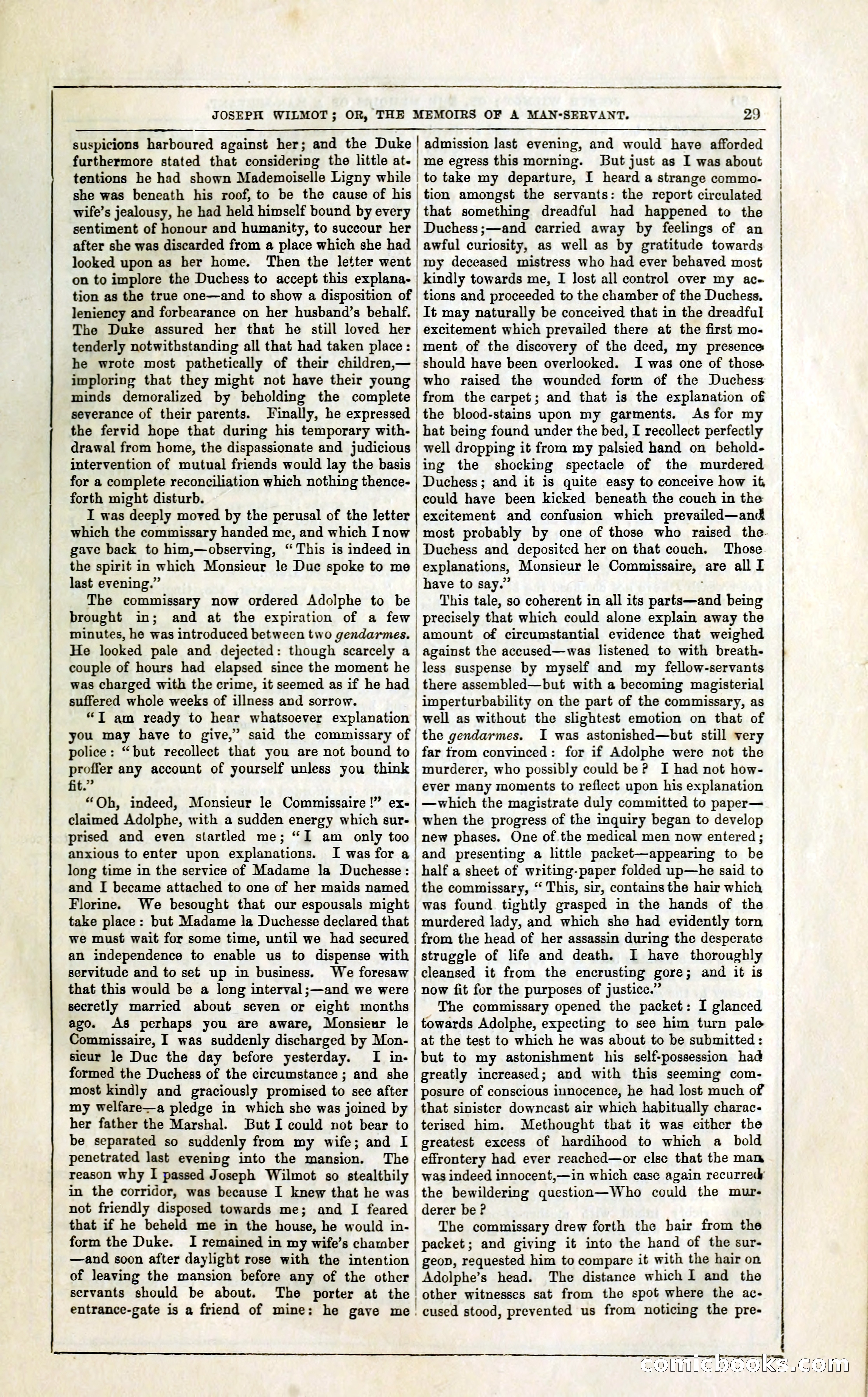
A restored page from Penny Dreadfuls, 1854. Page through the whole issue in the reader above.
📄 Transcribed text from this page (OCR, searchable)
Machine-transcribed from the original scan — historical spelling and the odd misread are preserved.
JOSEPH WILMOT; OR, THE MEMOIRS OF A MAN-SERVANT. 29 suspicions harboured against her; and the Duke | admission last evening, and would have afforded furthermore stated that considering the little at- | me egress this morning. But just as I was about tentions he had shown Mademoiselle Ligny while | to take my departure, I heard a strange commo- she was beneath his roof, to be the cause of his wife’s jealousy, he had held himself bound by every sentiment of honour and humanity, to succour her after she was discarded from a place which she had looked upon as her home. Then the letter went on to implore the Duchess to accept this explana- tion as the true one—and to show a disposition of leniency and forbearance on her husband’s behalf. The Duke assured her that he still loved her tenderly notwithstanding all that had taken place: he wrote most pathetically of their children,— imploring that they might not have their young minds demoralized by beholding the complete severance of their parents. Finally, he expressed the fervid hope that during his temporary with- drawal from home, the dispassionate and judicious intervention of mutual friends would lay the basis for a complete reconciliation which nothing thence- forth might disturb. I was deeply moved by the perusal of the letter which the commissary handed me, and which I now gave back to him,—observing, “This is indeed in the spirit in which Monsieur le Duc spoke to me last evening.” The commissary now ordered Adolphe to be brought in; and at the expiration of a few minutes, he was introduced between two gendarmes. He looked pale and dejected: though scarcely a couple of hours had elapsed since the moment he was charged with the crime, it seemed as if he had suffered whole weeks of illness and sorrow. “I am ready to hear whatsoever explanation you may have to give,” said the commissary of police: “but recollect that you are not bound to proffer any account of yourself unless you think fit.” “Oh, indeed, Monsieur le Commissaire!’ ex- claimed Adolphe, with a sudden energy which sur- prised and even startled me; “I am only too anxious to enter upon explanations. I was for a long time in the service of Madame la Duchesse: and I became attached to one of her maids named Florine. We besought that our espousals might take place: but Madame la Duchesse declared that we must wait for some time, until we had secured an independence to enable us to dispense with servitude and to set up in business. We foresaw that this would be a long interval;—and we were secretly married about seven or eight months ago. As perhaps you are aware, Monsieur le Commissaire, I was suddenly discharged by Mon- sieur le Duc the day before yesterday. I in- formed the Duchess of the circumstance ; and she should have been overlooked. Iwas one of those | { tion amongst the servants: the report circulated that something dreadful had happened to the Duchess ;—and carried away by feelings of an awful curiosity, as well as by gratitude towards my deceased mistress who had ever behaved most kindly towards me, I lost all control over my ac- tions and proceeded to the chamber of the Duchess, It may naturally be conceived that in the dreadful excitement which prevailed there at the first mo- ment of the discovery of the deed, my presence who raised the wounded form of the Duchess from the carpet; and that is the explanation of the blood-stains upon my garments. As for my hat being found under the bed, I recollect perfectly well dropping it from my palsied hand on behold- ing the shocking spectacle of the murdered Duchess; and it is quite easy to conceive how it could have been kicked beneath the couch in the excitement and confusion which prevailed—an& most probably by one of those who raised the- Duchess and deposited her on that couch. Those explanations, Monsieur le Commissaire, are all I have to say.” ; This tale, so coherent in all its parts—and being precisely that which could alone explain away the amount of circumstantial evidence that weighed against the accused—was listened to with breath- less suspense by myself and my fellow-servants there assembled—but with a becoming magisterial imperturbability on the part of the commissary, as well as without the slightest emotion on that of the gendarmes. I was astonished—but still very far from convinced: for if Adolphe were not the murderer, who possibly could be? I had not how- ever many moments to reflect upon his explanation —which the magistrate duly committed to paper— when the progress of the inquiry began to develop new phases. One of the medical men now entered ; and presenting a little packet—appearing to be half a sheet of writing-paper folded up—he said to the commissary, “ This, sir, contains the hair which was found tightly grasped in the hands of the murdered lady, and which she had evidently torn from the head of her assassin during the desperate struggle of life and death. I have thoroughly cleansed it from the encrusting gore; and it is now fit for the purposes of justice.” The commissary opened the packet: I glanced towards Adolphe, expecting to see him turn pale at the test to which he was about to be submitted : but to my astonishment his self-possession had greatly increased; and with this seeming com- most kindly and graciously promised to see after | posure of conscious innocence, he had lost much of my welfare—a pledge in which she was joined by | that sinister downcast air which habitually charac- her father the Marshal. But I could not bear to terised him. Methought that it was either the be separated so suddenly from my wife; and I | greatest excess of hardihood to which a bold penetrated last evening into the mansion. The | effrontery had ever reached—or else that the mam reason why I passed Joseph Wilmot so stealthily | was indeed innocent,—in which case again recurred in the corridor, was because I knew that he was | the bewildering question—Who could the mur- not friendly disposed towards me; and I feared derer be? that if he beheld me in the house, he would in- The commissary drew forth the hair from the form the Duke. 1 remained in my wife’s chamber | packet; and giving it into the hand of the sur- —and soon after daylight rose with the intention | geon, requested him to compare it with the hair on of leaving the mansion before any of the other | Adolphe’s head. The distance which I and the servants should be about. The porter at the other witnesses sat from the spot where the ac- entrance-gate is a friend of mine: he gave me: cused stood, prevented us from noticing the pre- a EE Gomicyooks (EO)