
Penny Dreadfuls, 1854 · page 397 of 399
Joseph Wilmot, or, The Memoirs of a Man-Servant — page 397: what you’re looking at
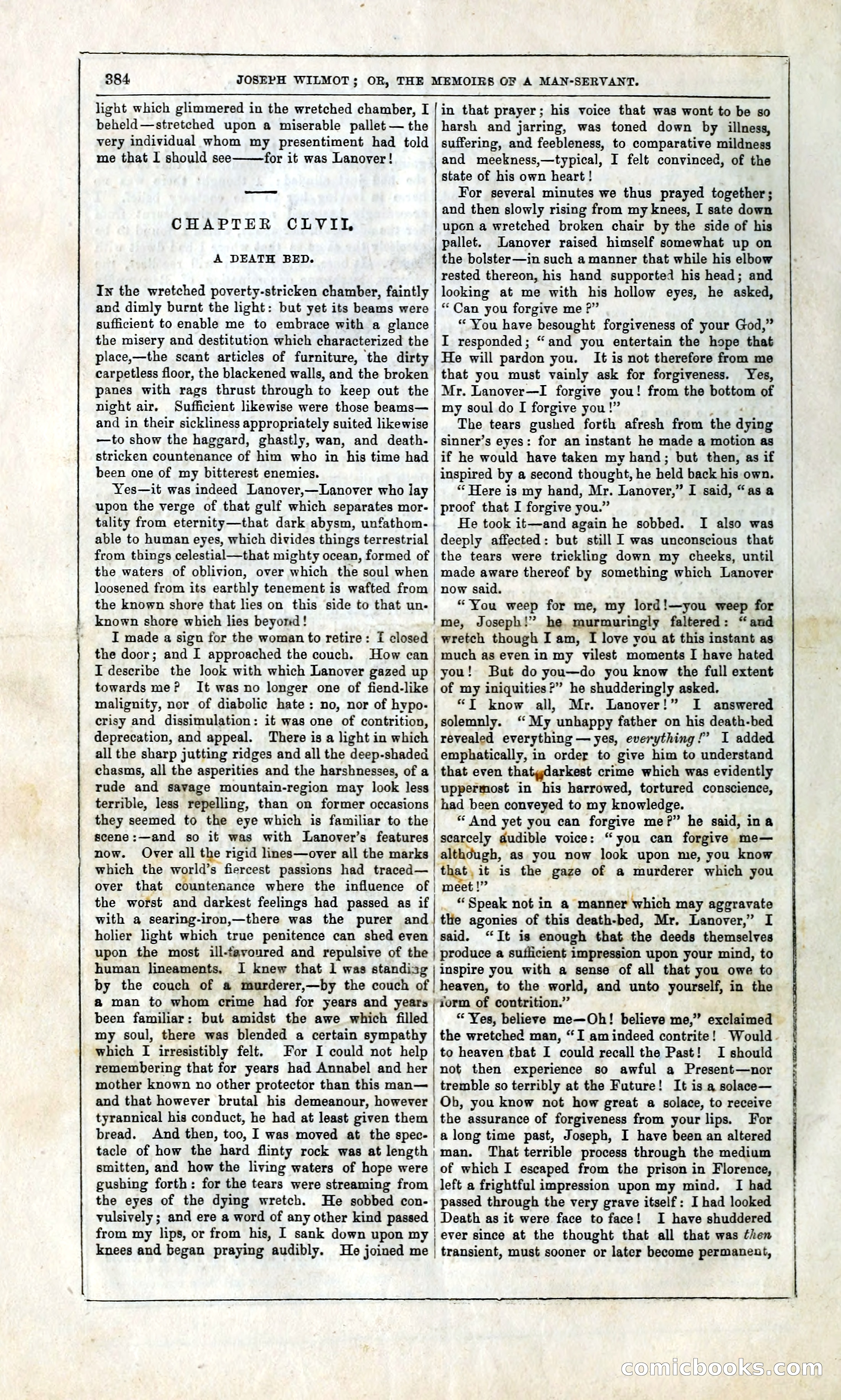
A restored page from Penny Dreadfuls, 1854. Page through the whole issue in the reader above.
📄 Transcribed text from this page (OCR, searchable)
Machine-transcribed from the original scan — historical spelling and the odd misread are preserved.
384 JOSEPH WILMOT; PRS, ORR ERED Ts ) OR ARE PRISE PY Oe eee a THE MEMOIRS OF A MAN-SERVANT. light which izbt which plimmered in Bhp wretched chamber, Li insthat apasts caida oreo BERD Ga in the wretched chamber, I beheld —stretched upon a miserable pallet — the very individual whom my presentiment had told me that 1 should see for it was Lanover ! in that prayer ; his voice that was wont to be so harsh and jarring, was toned down by illness, suffering, and feebleness, to comparative mildness and meekness,—typical, I felt convinced, of the state of his own heart! For several minutes we thus prayed together; and then slowly rising from my knees, I sate down upon a wretched broken chair by the side of his pallet. Lanover raised himself somewhat up on the bolster—in such a manner that while his elbow rested thereon, his hand supported his head; and In the wretched poverty-stricken chamber, faintly | looking at me with his hollow eyes, he asked, ana dimly burnt the light: but yet its beams were | “‘ Can you forgive me ?” CHAPTER CLVII, A DEATH BED. sufficient to enable me to embrace with a glance; ‘ You have besought forgiveness of your God,” the misery and destitution which characterized the | I responded; “and you entertain the hope that place,—the scant articles of furniture, the dirty | He will pardon you. It is not therefore from me carpetless floor, the blackened walls, and the broken | that you must vainly ask for forgiveness. Yes, panes with rags thrust through to keep out the | Mr. Lanover—I forgive you! from the bottom of night air, Sufficient likewise were those beams— | my soul do I forgive you!” and in their sickliness appropriately suited likewise| The tears gushed forth afresh from the dying —to show the haggard, ghastly, wan, and death- | sinner’s eyes: for an instant he made a motion as stricken countenance of him who in his time had | if he would have taken my hand; but then, as if been one of my bitterest enemies. inspired by a second thought, he held back his own. Yes—it was indeed Lanover,—Lanover who lay| “Here is my hand, Mr. Lanover,” I said, “as a upon the verge of that gulf which separates mor- | proof that I forgive you.” tality from eternity—that dark abysm, unfathom-| He took it—and again he sobbed. I also was able to human eyes, which divides things terrestrial | deeply affected: but still I was unconscious that from things celestial—that mighty ocean, formed of | the tears were trickling down my cheeks, until the waters of oblivion, over which the soul when | made aware thereof by something which Lanover loosened from its earthly tenement is wafted from | now said. the known shore that lies on this side to that un-| ‘“ You weep for me, my lord!—you weep for known shore which lies beyond! me, Joseph!” he murmuringly faltered: “and I made a sign for the woman to retire: f closed ; wretch though I am, T love you at this instant as the door; and I approached the couch. How can! much as even in my vilest moments I have hated I describe the look with which Lanover gazed up| you! But do you—do you know the full extent towards me? It was no longer one of fiend-like | of my iniquities?” he shudderingly asked. malignity, nor of diabolic hate: no, nor of hypo- “IT know all, Mr. Lanover!” I answered crisy and dissimulation: it was one of contrition, | solemnly. ‘My unhappy father on his death-bed deprecation, and appeal. There is a light in which | revealed everything — yes, everything!” I added all the sharp jutting ridges and all the deep-shaded | emphatically, in order to give him to understand chasms, all the asperities and the harshnesses, of a | that even thatwdarkest crime which was evidently rude and savage mountain-region may look less| uppermost in his harrowed, tortured conscience, terrible, less repelling, than on former occasions | had been conveyed to my knowledge. they seemed to the eye which is familiar to the| “And yet you can forgive me?” he said, ina scene:—and so it was with Lanover’s features | scarcely dudible voice: “you can forgive me— now. Over all the rigid lines—over all the marks althdugh, as you now look upon me, you know which the world’s fiercest passions had traced— | that, it is the gaze of a murderer which you over that countenance where the influence of | meet!” the worst and darkest feelings had passed as if| “ Speak not in a manner which may ah with a searing-iron,—there was the purer and| tle agonies of this death-bed, Mr. Lanover,”’ I holier light which true penitence can shed even! said. “It is enough that the deeds themselves upon the most ill-tavoured and repulsive of the | produce a suflicient impression upon your mind, to human lineaments, 1 knew that 1 was standisg inspire you with a sense of all that you owe to by the couch of a murderer,—by the couch of! heaven, to the world, and unto yourself, in the a man to whom crime had for years and years }iorm of contrition.” been familiar: but amidst the awe which filled| ‘“ Yes, believe me—Oh! believe me,” exclaimed my soul, there was blended a certain sympathy | the wretched man, “I amindeed contrite! Would. which I irresistibly felt. For I could not help | to heaven that I could recall the Past! I should remembering that for years had Annabel and her | not then experience so awful a Present—nor mother known no other protector than this man—| tremble so terribly at the Future! It is a solace— and that however brutal his demeanour, however Ob, you know not how great a solace, to receive tyrannical his conduct, he had at least given them the assurance of forgiveness from your lips. For bread. And then, too, I was moved at the spec-| along time past, Joseph, I have been an altered tacle of how the hard flinty rock was at length; man. That terrible process through the medium smitten, and how the living waters of hope were of which I escaped from the prison in Florence, gushing forth: for the tears were streaming from | left a frightful impression upon my mind. I had the eyes of the dying wretch. He sobbed con- | passed through the very grave itself: I had looked vulsively ; and ere a word of any other kind passed | Death as it were face to face! I have shuddered from my lips, or from his, I sank down upon my | ever since at the thought that all that was then knees and began praying audibly. He joined me | transient, must sooner or later become permanent, ee ee ee ee 2 ECORMICOOOKS.eO