
Penny Dreadfuls, 1854 · page 395 of 399
Joseph Wilmot, or, The Memoirs of a Man-Servant — page 395: what you’re looking at
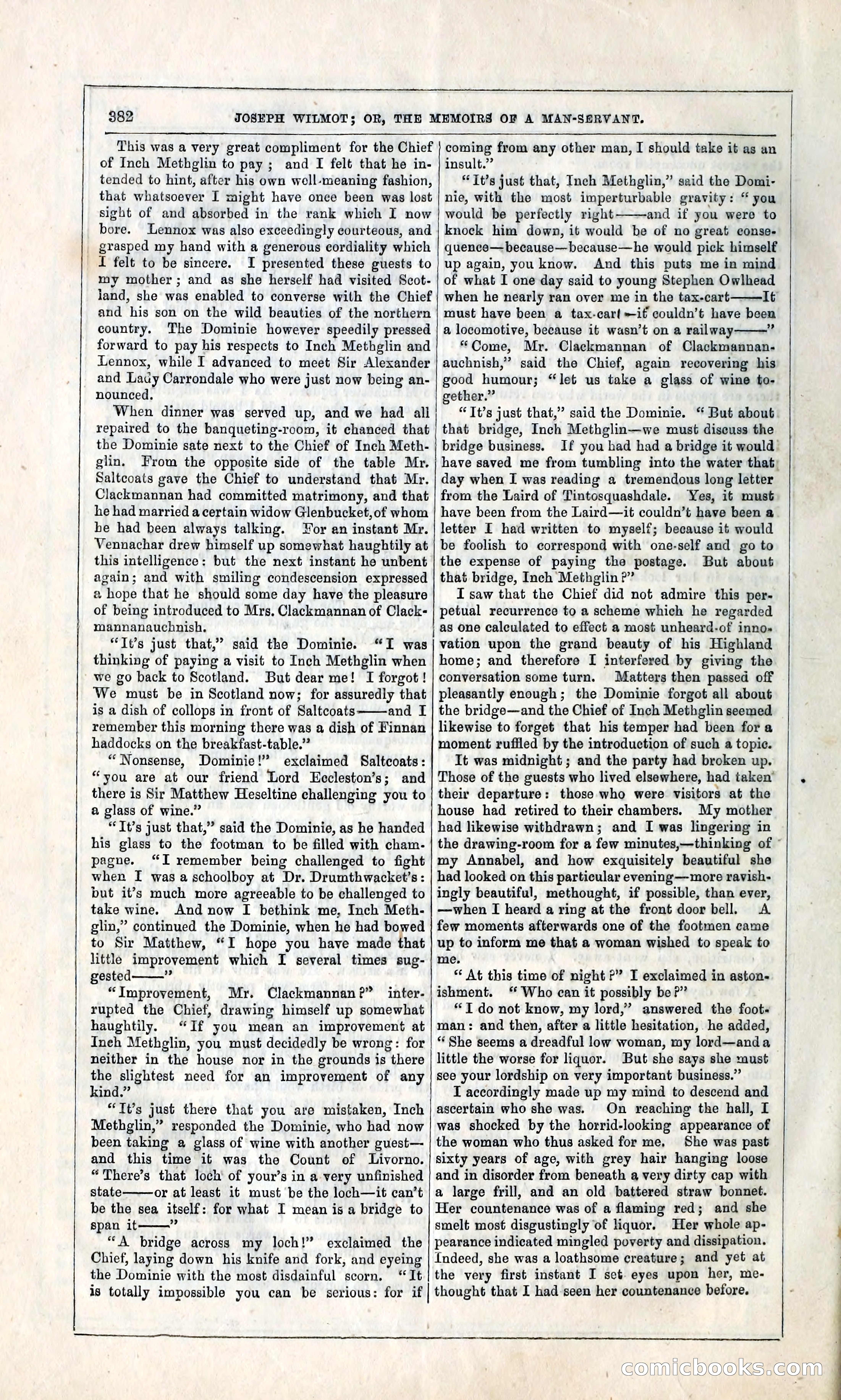
A restored page from Penny Dreadfuls, 1854. Page through the whole issue in the reader above.
📄 Transcribed text from this page (OCR, searchable)
Machine-transcribed from the original scan — historical spelling and the odd misread are preserved.
382 JOSEPH WILMOT; OR, THE MEMOIRS OF A MAN-SERVANT. This was a very great compliment for the Chief of Inch Methglin to pay ; and I felt that he in- tended to hint, after his own well-meaning fashion, that whatsoever I might have once been was lost sight of and absorbed in the rank which I now bore. Lennox was also exceedingly courteous, and grasped my hand with a generous eordiality which 1 felt to be sincere. I presented these guests to my mother; and as she herself had visited Scot- land, she was enabled to converse with the Chief and his son on the wild beauties of the northern country. The Dominie however speedily pressed forward to pay his respects to Inch Methglin and Lennox, while I advanced to meet Sir Alexander and Lady Carrondale who were just now being an- nounced, When dinner was served up, and we had all repaired to the banqueting-room, it chanced that the Dominie sate next to the Chief of Inch Meth- glin. From the opposite side of the table Mr. Saltcoats gave the Chief to understand that Mr. Clackmannan had committed matrimony, and that he had married a certain widow Glenbucket,of whom be had been always talking. Yor an instant Mr. Vennachar drew himself up somewhat haughtily at this intelligence: but the next instant he unbent again; and with smiling condescension expressed a hope that he should some day have the pleasure of being introduced to Mrs, Clackmannan of Clack- mannanauchnish., “It’s just that,” said the Dominie. “I was thinking of paying a visit to Inch Methglin when we go back to Scotland. But dear me! I forgot! We must be in Scotland now; for assuredly that is a dish of collops in front of Saltcoats and I remember this morning there was a dish of Finnan haddocks on the breakfast-table.” “Nonsense, Dominie!” exclaimed Saltcoats: “you are at our friend Lord Eecleston’s; and there is Sir Matthew Heseltine challenging you to a glass of wine.” ““Tt’s just that,” said the Dominie, as he handed his glass to the footman to be filled with cham- pagne. “I remember being challenged to fight when I was a schoolboy at Dr. Drumthwacket’s: but it’s much more agreeable to be challenged to take wine. And now I bethink me, Inch Meth- glin,” continued the Dominie, when he had bowed to Sir Matthew, “I hope you have made that little improvement which I several times sug- gested 9 “Improvement, Mr. Clackmannan?” inter- rupted the Chief, drawing himself up somewhat haughtily. “If you mean an improvement at Ineh Methglin, you must decidedly be wrong: for neither in the house nor in the grounds is there the slightest need for an improvement of any kind.” “Tt’s just there that you are mistaken, Inch Methglin,” responded the Dominie, who had now been taking a glass of wine with another guest— and this time it was the Count of Livorno. “There’s that loch of your’s in a very unfinished state or at least it must be the loch—it can’t be the sea itself: for what I mean is a bridge to span it “ “A bridge across my loch!” exclaimed the Chief, laying down his knife and fork, and eyeing the Dominie with the most disdainful scorn. “It coming from any other man, I should take it as an insult.” “Tt’s just that, Inch Methglin,” said the Domi- nie, with the most imperturbable gravity: “ you would be perfectly right and if you were to knock him down, it would be of no great conse. quence— because—because—he would pick himself up again, you know. And this puts me in mind of what I one day said to young Stephen Owlhead when he nearly ran over me in the tax-cart It must have been a tax-cart»if couldn’t have been a locomotive, because it wasn’t on a railway N “Come, Mr. Clackmannan of Clackmannan- auchnish,” said the Chief, again recovering his good humour; “let us take a glass of wine to- gether.” “It’s just that,” said the Dominie. “ But about that bridge, Inch Methglin—we must discuss the bridge business. day when I was reading a tremendous long letter from the Laird of Tintosquashdale. Yes, it must have been from the Laird—it couldn’t have been a letter I had written to myself; because if would be foolish to correspond with one-self and go to the expense of paying the postage. But about that bridge, Inch Methglin P” I saw that the Chief did not admire this per- petual recurrence to a scheme which he regarded as one calculated to effect a most unheard-of inno. vation upon the grand beauty of his Highland home; and therefore I interfered by giving the conversation some turn. Matters then passed off pleasantly enough; the Dominie forgot all about the bridge—and the Chief of Inch Methglin seemed likewise to forget that his temper had been for a moment ruffled by the introduction of such a topie. It was midnight; and the party had broken up. Those of the guests who lived elsewhere, had taken’ their departure: those who were visitors at the house had retired to their chambers. My mother had likewise withdrawn; and I was lingering in If you had had a bridge it would have saved me from tumbling into the water that, the drawing-room for a few minutes,—thinking of © my Annabel, and how exquisitely beautiful she had looked on this particular evening —more ravish- ingly beautiful, methought, if possible, than ever, —when I heard a ring at the front door bell. A few moments afterwards one of the footmen came up to inform me that a woman wished to speak to me. * At this time of nicht P” I exclaimed in aston- ishment. ‘ Who can it possibly be?” * 1 do not know, my lord,” answered the foot- man: and then, after a little hesitation, he added, ‘She seems a dreadful low woman, my lord—anda little the worse for liquor. But she says she must see your lordship on very important business.” I accordingly made up my mind to descend and ascertain who she was. On reaching the hall, I was shocked by the horrid-looking appearance of the woman who thus asked for me, She was past sixty years of age, with grey hair hanging loose and in disorder from beneath a very dirty cap with a large frill, and an old battered straw bonnet. Her countenance was of a flaming red; and she smelt most disgustingly of liquor. Her whole ap- pearance indicated mingled poverty and dissipation. {ndeed, she was a loathsome creature; and yet at the very first instant I set- eyes upon her, me- is totally impossible you can be serious: for if | thought that I had seen her countenance before. EE A sso renner enennstnueeennererener—onp MIGIOOKS (CO) (C@)